All-on-4 Dental Implants in India: Cost, Procedure & Who Qualifies
All-on-4 dental implants offer a way to replace an entire arch of missing teeth using just four strategically placed implants. This guide explains what the procedure involves, who it's right for, and what it realistically costs at Indian dental clinics.
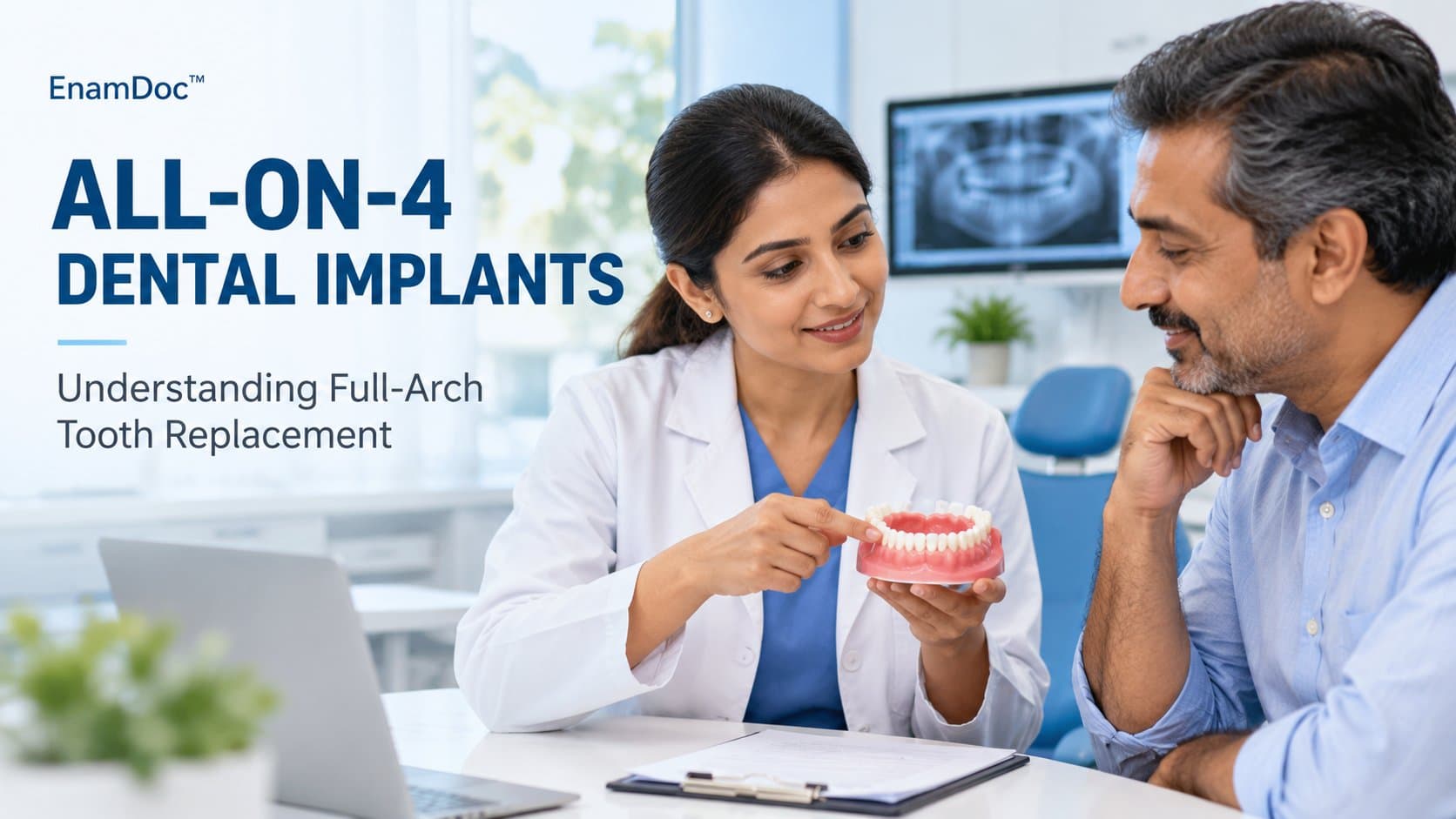
Losing most or all of your teeth — whether from decay, gum disease, or injury — is one of the more profound dental challenges a person can face. It affects how you eat, how you speak, and how you feel about yourself. Traditional dentures have been the standard solution for decades, but for many patients, they come with real drawbacks: slipping during meals, sore spots, and the constant need for adhesives.
All-on-4 dental implants were developed to address exactly these problems. Instead of replacing each tooth individually, the procedure anchors an entire arch of prosthetic teeth onto just four implants placed strategically in the jaw. The result is a fixed, stable set of teeth that doesn't come out — and for many patients, it can be placed the same day as surgery.
If you've been researching this treatment and wondering whether it's suitable for you and how much it costs in India, this guide covers what you need to know.
What Exactly Is All-on-4?
All-on-4 is a full-arch dental implant technique. The name refers to the core concept: supporting a complete prosthetic arch (upper or lower) on just four implants rather than the eight to ten implants that a traditional full-arch restoration might require.
Two implants are placed vertically at the front of the jaw where bone density is typically better. Two more are placed at an angle — usually 30 to 45 degrees — toward the back. This angulation allows the implants to engage more bone and avoid the sinuses (in the upper jaw) or the nerve canal (in the lower jaw), which means that patients who have experienced some bone loss can often qualify without needing bone grafts first.
A temporary prosthesis — a full arch of functional teeth — is usually attached on the same day as surgery. After three to six months, once the implants have integrated with the bone (a process called osseointegration), the temporary prosthesis is replaced with the permanent one.
Who Is a Good Candidate?
All-on-4 is designed for patients who have lost most or all of their teeth in one or both arches, or whose remaining teeth are so damaged that extraction is the better long-term path. Common scenarios include:
- Patients with advanced gum disease (periodontitis) who have lost bone and multiple teeth
- Patients with severely decayed teeth that cannot be restored
- Existing denture wearers who want a fixed alternative
- Patients who cannot afford or have been told they require bone grafts for conventional implants
Your dentist will take a CBCT (cone beam CT) scan to assess your bone volume and density before confirming candidacy. While All-on-4 reduces the need for bone grafts compared to conventional implants, very severe bone loss in specific locations may still require augmentation first.
Patients with uncontrolled diabetes, active cancer treatment, or certain medications that affect bone healing will need a medical evaluation before proceeding. Heavy smokers are also at higher risk of implant failure and should discuss this honestly with their surgeon.
The Procedure: What Happens Step by Step
The process typically unfolds over two main phases.
Phase 1 — Surgical day: Any remaining teeth in the arch are extracted. Four implants are placed in the planned positions. A temporary prosthesis — sometimes called a "smile in a day" bridge — is attached directly to the implants. You leave the clinic with a functional set of teeth.
Phase 2 — Final restoration (3–6 months later): After osseointegration is confirmed, impressions are taken and a permanent prosthesis is fabricated. This final bridge is typically made of zirconia or acrylic-fused-to-metal and is designed to be more aesthetic and durable than the temporary version.
Between these two phases, you'll have follow-up appointments for healing checks and to manage the temporary bridge.
How Much Does All-on-4 Cost in India?
Cost is one of the primary reasons patients from within India — and international dental tourists — consider this procedure here rather than abroad.
In India, a single arch All-on-4 procedure (including surgery, implants, temporary prosthesis, and final prosthesis) typically ranges from ₹2.5 lakh to ₹5 lakh, depending on:
- The city (metro cities like Mumbai, Delhi, Bangalore, and Chennai tend to be on the higher end)
- The implant brand used (premium brands like Nobel Biocare, Straumann, and Osstem cost more than local brands)
- Whether additional procedures like extractions or bone grafts are needed
- The material of the final prosthesis (zirconia bridges cost more than acrylic)
- The clinic's infrastructure and the surgeon's experience level
For comparison, the same procedure in the UK or Australia typically costs ₹15 lakh to ₹25 lakh per arch. The difference makes India a destination for dental tourism from these countries as well.
When evaluating quotes from Indian clinics, make sure the estimate clearly specifies what is included: implant brand, number of included appointments, temporary vs. final prosthesis, and any procedures billed separately (extractions, CBCT scans, bone grafts if needed).
What About "All-on-6" and Similar Variations?
Some clinics offer "All-on-6" procedures using six implants per arch rather than four. This may be recommended when bone volume allows for it, as more implants can provide additional stability and distribute chewing force more evenly. The principle is the same; the difference is the number of implants used.
You may also encounter terms like "teeth in a day," "same-day implants," or "full arch restoration" — these often describe procedures that are conceptually similar to All-on-4 even if not using the branded terminology.
Maintaining All-on-4 Implants
All-on-4 prostheses do not develop cavities, but the gum tissue and bone beneath them still need care. Food particles can accumulate under the bridge, so cleaning is different from brushing natural teeth.
Your dentist will show you how to use a water flosser or specialized interdental brushes to clean under the bridge. Regular professional check-ups every six months are important to monitor the implants and the fit of the prosthesis. With proper care, the implants themselves can last a lifetime, though the prosthesis may need replacement after 10 to 15 years due to normal wear.
Avoid habits that stress implants unnecessarily — chewing ice, biting very hard foods, or using teeth as tools. If you grind your teeth at night (bruxism), inform your dentist, as this can damage the prosthesis and should be managed with a night guard or other approach.
Is All-on-4 Right for You?
All-on-4 is a significant investment — both financially and in terms of the surgery involved. It is not the right choice for every patient. For someone missing only a few teeth, individual implants or bridges may be more appropriate. For patients who are medically complex or have very limited bone, other approaches may work better.
The best way to know whether you're a good candidate is a proper evaluation that includes a CBCT scan and a consultation with a dentist who has experience specifically with implant surgery. EnamDoc can help you find and book with qualified implant dentists in your city, and you can prepare your questions in advance so you make the most of the consultation.
If you've been living with dentures that don't fit comfortably, or if you've been avoiding social situations because of missing teeth, All-on-4 is worth investigating. For many patients, it genuinely changes their quality of life.
Frequently asked
Frequently asked questions
Can All-on-4 implants be placed the same day as tooth extraction?
Yes. In most All-on-4 cases, any remaining teeth in the arch are extracted and the four implants are placed during the same surgical appointment. A temporary prosthesis is then attached immediately, so you leave the clinic with functional teeth. The permanent bridge is fitted three to six months later once the implants have fully integrated with the bone.
How long do All-on-4 implants last?
The titanium implants themselves are designed to be permanent and, with good oral hygiene and regular check-ups, can last a lifetime. The prosthesis (the bridge of teeth attached to the implants) typically needs replacement every 10 to 15 years due to normal wear. Zirconia prostheses tend to be more durable than acrylic ones.
Does All-on-4 surgery hurt?
The surgery is performed under local anaesthesia, so you should not feel pain during the procedure itself. Post-operative discomfort — swelling, soreness, and bruising — is normal for a few days and is managed with prescribed pain relief. Most patients find the recovery more manageable than they expected. Your surgeon will give you specific post-operative instructions, including a soft-food diet for the initial healing period.
- all on 4 implants
- dental implants India
- full mouth restoration
- implant supported dentures
- teeth replacement
Keep reading