BDS Clinical Postings: The Unofficial Survival Guide for 3rd Year Students
Everything nobody tells you when you first walk into the clinic — from managing patients and navigating departmental dynamics to actually completing your cases.
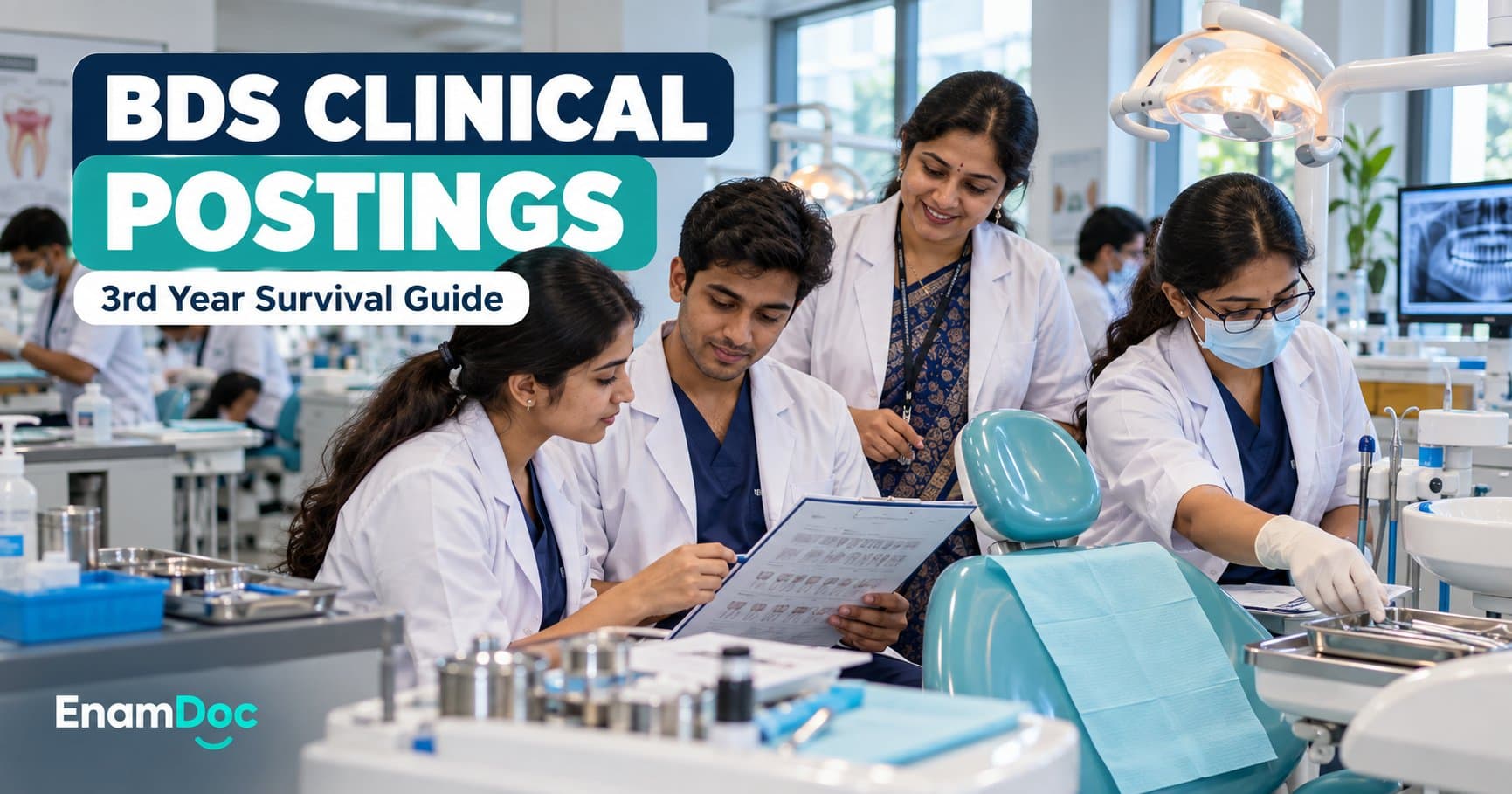
If you've just started your BDS clinical postings, you've already experienced the shift that no textbook fully prepares you for: the moment you go from sitting in a lecture hall memorising anatomy to actually sitting across from a patient who needs help.
It's overwhelming. It's exciting. And there's a lot nobody tells you.
This is the guide that should exist in every dental college library.
The Reality of 3rd Year BDS Clinical Postings
By the time clinical postings begin in 3rd year, most BDS students have a solid theoretical base. You know what periodontitis looks like on a diagram. You can describe a pulpectomy procedure step by step.
What you haven't done is:
- Taken a proper case history from a real, sometimes impatient patient
- Identified pathology on an actual human mouth rather than a textbook image
- Written a proper clinical presentation under departmental supervision
- Had a patient say "the previous doctor was faster"
This is normal. Every practising dentist you know went through exactly this phase.
Week 1: What to Focus On (Hint: Not Procedures)
The impulse in week one is to do as much as possible — get cases, fill out your record book, impress your guide. Resist this.
Week one is about:
Learning the department's rhythm: Every department runs differently. Some faculty expect you to observe first. Others expect you to jump in with simple cases. Spend the first 2–3 days understanding the expectations before trying to prove anything.
Getting comfortable with case history: The case history and examination is the foundation of every clinical interaction. A student who can take a thorough, organised case history and present it clearly is already ahead of most peers. Practise this every single time.
Setting up your chair station properly: Know where your instruments are. Know the suction setup. Know how to position the patient's head. These basics set the tone for your entire clinical period.
How to Actually Learn in the Clinic
Find One Senior Who Will Teach You
Out of the batch, one or two senior students (and occasionally a postgraduate resident) will make time to actually show you things. Find them. Follow them during their cases if permitted. Buy them chai.
Ask Questions Between Cases, Not During
Faculty are significantly more patient when you ask questions during downtime, not in the middle of their case. If you're curious about something you saw, note it down and ask afterward.
Use Your Record Book Strategically
The record book is often treated as a checkbox exercise. Treat it differently: make your case notes genuinely detailed, because reviewing them later — before exams, before presentations — will be more useful than any note you ever took in a lecture.
Don't Ignore Theory Connections
When you see a deep carious lesion, go back and read the relevant chapter that evening. The clinical-theory connection is where real learning happens and it's also what makes viva answers actually confident rather than memorised.
Department-Specific Tips
Oral Medicine & Radiology (OMR)
This is your chance to actually look at patients comprehensively. Practice the full extraoral and intraoral examination sequence until it becomes automatic. Get comfortable with radiograph mounting and interpretation before the exams.
Conservative Dentistry & Endodontics
Cavity preparation feels impossible the first five times. It gets better. Focus on your magnification loupe technique and the isolation of the working field. These skills matter for everything you do afterward.
Periodontics
Scaling is the first skill most students do on real patients. Practice on typodont until your hand position is automatic. The force and angle matter more than the speed.
Oral & Maxillofacial Surgery (OMFS)
Observe the patient assessment and consent process carefully. Surgical procedures in India often involve rapid case flow — positioning yourself to see clearly requires assertiveness.
Pedodontics (Paediatric Dentistry)
Working with children requires a completely different communication approach than adults. Observe how faculty use the Tell-Show-Do technique. A child who cooperates for a procedure is a skill demonstration in itself.
Managing Your Record Book and Case Requirements
Every department has case requirements. Getting behind is easy; catching up is stressful.
Practical advice:
- Count your cases at the end of every week, not the end of every month
- Identify early which case types are hard to find in your clinic and ask your guide about alternatives
- Complete write-ups within 48 hours of the case while details are fresh
How EnamDoc Supports Dental Students
EnamDoc has built a section specifically for dental students — including study resources, case logs, and access to a community of dental professionals and mentors. If your college permits digital supplemental case logging or you want to connect with dentists for mentorship, EnamDoc is worth exploring alongside your institutional requirements.
Frequently asked
Frequently asked questions
How many cases do I need to complete during BDS clinical postings?
Case requirements vary by dental college and by department. Most colleges follow the DCI guidelines, but individual departments set their own minimums. The best approach is to check your department's specific requirements in the first week, count your progress weekly rather than monthly, and speak to your guide early if you're struggling to find certain case types — they can often suggest alternatives.
What should I do if I make a mistake during a clinical procedure?
Stop, tell your supervising faculty immediately, and let them take over. Clinical mistakes are a normal part of learning, and faculties expect them — what they don't expect is a student trying to hide or fix an error alone. Being transparent earns trust. Most errors, caught early, are correctable. Document what happened in your record notes afterward; learning from your own errors, written down, is more valuable than anything in a textbook.
How do dental students use EnamDoc?
EnamDoc offers a dedicated section for dental students, including access to case logs, study resources, and a community of dental professionals and mentors. For students in academic clinics, EnamDoc can support supplemental digital case logging and connects you with practising dentists for guidance beyond your college's formal faculty structure.
- BDS
- clinical postings
- dental students
- 3rd year
- internship
Keep reading