Choosing Your MDS Specialisation in India: An Honest Guide to Every Dental Specialty
Choosing your MDS is one of the most important decisions of your dental career. Dr. Khanak Jain gives an honest breakdown of all 9 specialisations — what each involves, who it suits, and the career reality.
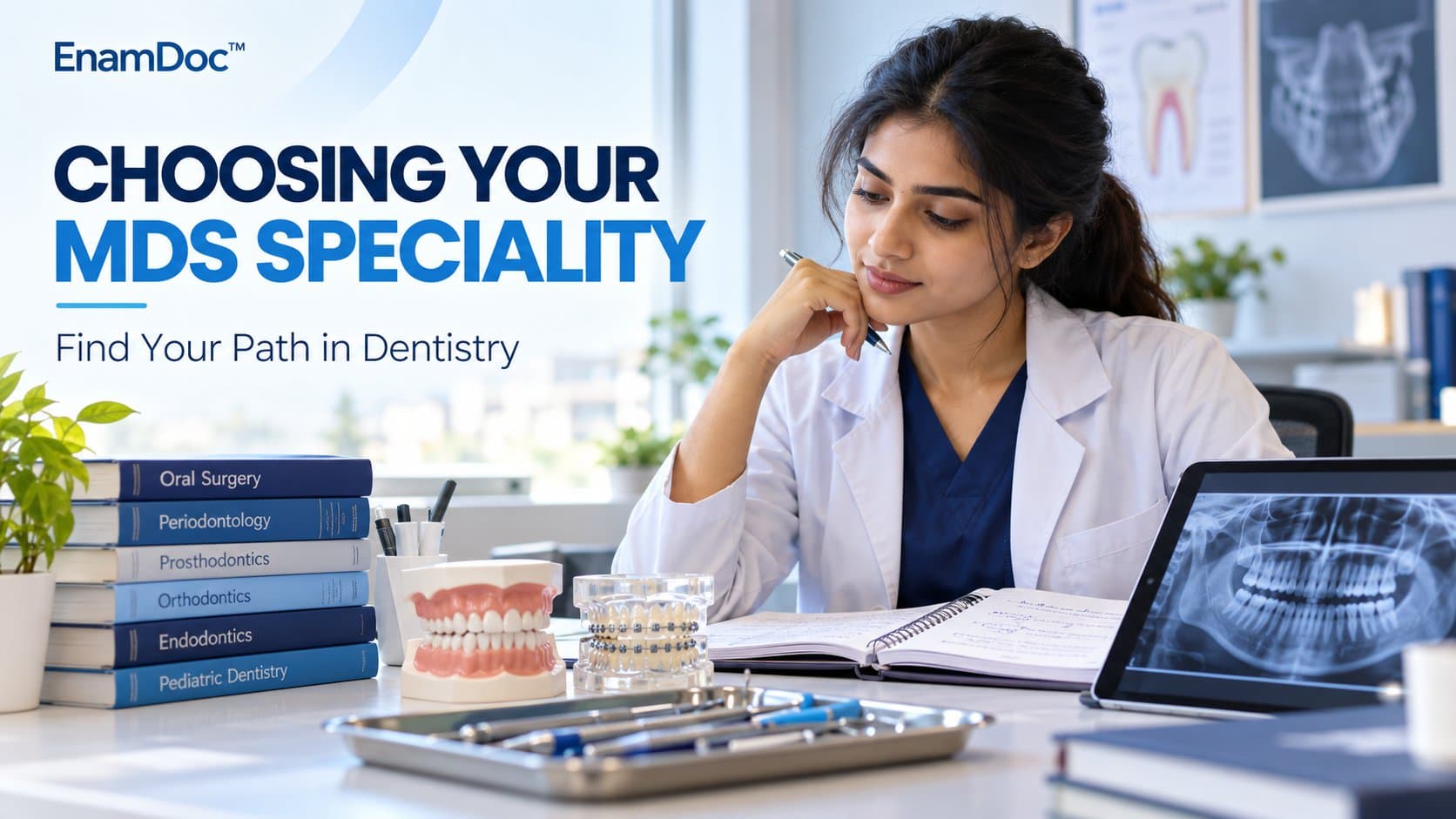
After years of BDS, countless clinical hours, and the grind of NEET MDS preparation — you have earned your PG seat. Now comes a decision that will define the next three years of your life, and potentially your entire career: which MDS specialisation do you choose?
This guide gives you the honest picture that most counsellors will not. Not just what each specialty looks like on paper, but what the work actually involves day to day, who genuinely thrives in it, and what the career landscape looks like in India right now.
The 9 DCI-Recognised MDS Specialisations
1. Oral and Maxillofacial Surgery (OMFS)
What It Involves
OMFS is the most surgical of all dental specialisations. You will spend three years mastering extractions, jaw surgeries, facial trauma management, cyst and tumour excision, cleft lip and palate repair, and orthognathic surgery. Your operating theatre is your classroom.
Who It Suits
If you are drawn to hands-on procedural work, can handle high-pressure emergency situations calmly, and want the most medicine-adjacent dental career available — OMFS is worth serious consideration. Physical stamina and steady hands are non-negotiable.
Career Reality
Strong demand in both private practice and hospital settings. Many OMFS graduates pursue additional training in craniofacial surgery or oncosurgery. Earning potential is high — but so is the training intensity. Collaborative work with oncology, plastic surgery, and ENT teams is routine.
2. Orthodontics and Dentofacial Orthopaedics
What It Involves
Orthodontics deals with diagnosing and correcting misaligned teeth and jaws using braces, clear aligners, retainers, and orthopaedic appliances. The specialty has enormous patient demand in India, driven by aesthetic awareness and rising disposable income.
Who It Suits
Detail-oriented graduates who enjoy treatment planning and a predictable workflow. You will see the same patients regularly over months or years, which suits those who value long-term patient relationships. Strong spatial reasoning helps considerably.
Career Reality
One of the most commercially successful dental specialisations in India. The rise of clear aligner brands has added a technology layer to the specialty. NEET rank requirements for orthodontics at premier institutes are consistently among the highest across all specialties.
3. Periodontology
What It Involves
Periodontists specialise in the gums, bone, and supporting structures of the teeth. Clinical work includes non-surgical periodontal therapy, flap surgery, bone grafts, guided tissue regeneration, and implant placement. The systemic links between gum disease and conditions like diabetes are central to the specialty.
Who It Suits
Graduates interested in the medical side of dentistry and those who enjoy surgical precision. Periodontology has strong collaborative potential with physicians managing diabetes and cardiovascular conditions.
Career Reality
Implantology has transformed periodontology into one of the more financially rewarding specialties in private practice. Demand is growing as India's population ages and awareness of gum disease increases. Many periodontists combine general practice with specialist implant and surgical services.
4. Prosthodontics and Crown & Bridge
What It Involves
Prosthodontics is the science and art of replacing missing teeth and restoring damaged ones. Training covers fixed prostheses (crowns, bridges, veneers), removable prostheses (complete and partial dentures), implant-supported restorations, and maxillofacial prosthetics. Aesthetic dentistry sits firmly in this domain.
Who It Suits
Creative, technically precise graduates who enjoy working with materials and aesthetics. If you find satisfaction in perfecting occlusion and making patients smile with confidence, prosthodontics is a natural home.
Career Reality
Extremely versatile — prosthodontists are relevant in almost every clinical setting, from private multispecialty clinics to academic institutions to implant centres. Demand for aesthetic dentistry continues to climb in urban India. The specialty pairs naturally with periodontology for comprehensive implant rehabilitation.
5. Conservative Dentistry and Endodontics
What It Involves
This specialty focuses on preserving natural teeth through restorations and root canal treatments. Training covers direct and indirect restorations, adhesive dentistry, bleaching, and endodontic procedures including complex re-treatments and surgical endodontics.
Who It Suits
Graduates with excellent fine motor skills and patience for meticulous, detail-oriented work. If you find root canal treatment intellectually satisfying rather than tedious — this is the specialty for you. The problem-solving aspect of endodontics appeals to analytical minds.
Career Reality
Root canal treatment is among the most commonly performed procedures in Indian dentistry. A skilled endodontist is valued in virtually every dental setup. Many MDS graduates in this specialty build successful private practices with strong patient recall. Teaching positions are plentiful, as this is one of the most widely offered MDS programmes in India.
6. Paedodontics and Preventive Dentistry
What It Involves
Paedodontics focuses on the dental care of infants, children, and adolescents. Beyond clinical skills, the specialty demands a particular human skill: the ability to manage anxious young patients and their parents with calm reassurance.
Who It Suits
Graduates who genuinely enjoy working with children and are naturally patient. If helping a child overcome dental fear and establishing lifelong oral health habits is motivating — paedodontics is deeply rewarding. Poor fit: those who find paediatric behaviour management draining.
Career Reality
Dedicated paediatric dental clinics are growing in Indian cities. There is also strong academic demand. Preventive dentistry's school outreach programmes and public health work make this specialty attractive for those inclined toward community work. Financially, it is steady rather than spectacular in most private setups.
7. Oral Medicine and Radiology
What It Involves
Oral medicine and radiology specialists diagnose conditions of the oral cavity and maxillofacial region. You will manage oral mucosal diseases, TMJ disorders, burning mouth syndrome, and conditions at the dentistry-medicine interface. Radiological training covers conventional, digital, CBCT, and MRI imaging interpretation.
Who It Suits
Graduates with strong diagnostic instincts and an interest in the medical aspects of oral health. If you are more drawn to diagnosis and consultation than surgical procedures, oral medicine offers a distinctive path. Research and teaching are natural extensions of this specialty.
Career Reality
Honest assessment: private practice in oral medicine alone is challenging in most Indian cities. Most graduates work in dental colleges, hospital departments, or as diagnosticians within multispecialty clinics. Excellent for those targeting academic or research careers. CBCT interpretation is an increasingly valued skill in implant planning.
8. Public Health Dentistry
What It Involves
Public health dentistry shifts focus from individual patients to populations. Training covers epidemiology, biostatistics, health policy, dental public health programmes, community outreach, and preventive strategies at a systemic level.
Who It Suits
Graduates with a genuine interest in healthcare systems and population-level impact. If improving dental health for thousands rather than treating individual patients motivates you — this specialty aligns with that vision.
Career Reality
Career paths include dental college teaching, NGO and public health organisations, and government health departments. Private practice revenue potential is limited. Choosing this specialty should be a deliberate, values-based decision — not a fallback.
9. Oral Pathology and Microbiology
What It Involves
Oral pathologists diagnose diseases of the oral cavity through biopsy interpretation and histopathological analysis. Your work involves studying tissue samples, identifying oral cancers and pre-cancerous lesions, and providing pathological reports to clinicians.
Who It Suits
Graduates drawn to laboratory science and microscopic diagnosis rather than chairside clinical work. Strong interest in oncology pathology, research, and academic work defines the profile this specialty rewards.
Career Reality
Academic careers are the primary path for most oral pathologists in India. A few large hospital systems have dedicated oral pathology departments. Research output and publications are central to career advancement. Not recommended as a fallback for those who wanted a clinical specialty — the work is genuinely different and requires authentic interest.
How to Actually Decide
Before you choose, ask yourself three honest questions:
- What kind of work will I actually enjoy doing every day for decades? Not what sounds impressive — what genuinely interests you when you think about the day-to-day reality.
- What are my clinical strengths? Fine motor precision points toward conservative or surgical specialties. Communication strengths suit paedodontics or public health. Diagnostic thinking fits oral medicine or pathology.
- What does my NEET rank realistically allow? Be pragmatic. A specialty at a strong institution that genuinely interests you will likely serve you better than a glamorous specialty at a weaker college.
The right MDS specialisation is the one that matches your temperament, your clinical skills, and the career you actually want. Whatever you choose — choose it deliberately. Three years of MDS training shapes the rest of your professional life.
Frequently asked
Frequently asked questions
Which MDS specialisation has the best career prospects in India?
Orthodontics and implant-focused specialties — Periodontology and Prosthodontics — currently offer the strongest private practice revenue potential in India. Orthodontics has consistently high demand with good fee realisation, while implant-focused specialties benefit from rapidly growing patient awareness. That said, career prospects depend heavily on your city, college reputation, clinical skills, and business acumen — not just the specialty name on your degree.
How should I choose my MDS specialisation in India?
Choose based on three factors: what clinical work genuinely interests you day to day, what your clinical strengths are, and what your NEET rank realistically allows at good institutions. Avoid choosing based solely on earning potential or peer pressure. A specialty you are genuinely engaged with will build a stronger career than one chosen for prestige alone. If you are unsure, speak with MDS graduates in each specialty you are considering — their honest experience is more valuable than any ranking.
- MDS specialisation India
- choosing MDS specialty
- dental postgraduate India
- NEET MDS specialty
- best MDS specialty dentistry
Keep reading