Dental Implants vs. Dental Bridge: Which Is the Better Long-Term Investment?
Confused between a dental implant and a bridge? Dr. Aditya Swami breaks down the real differences in cost, durability, bone health, and long-term value — so you can make the right call for your smile.
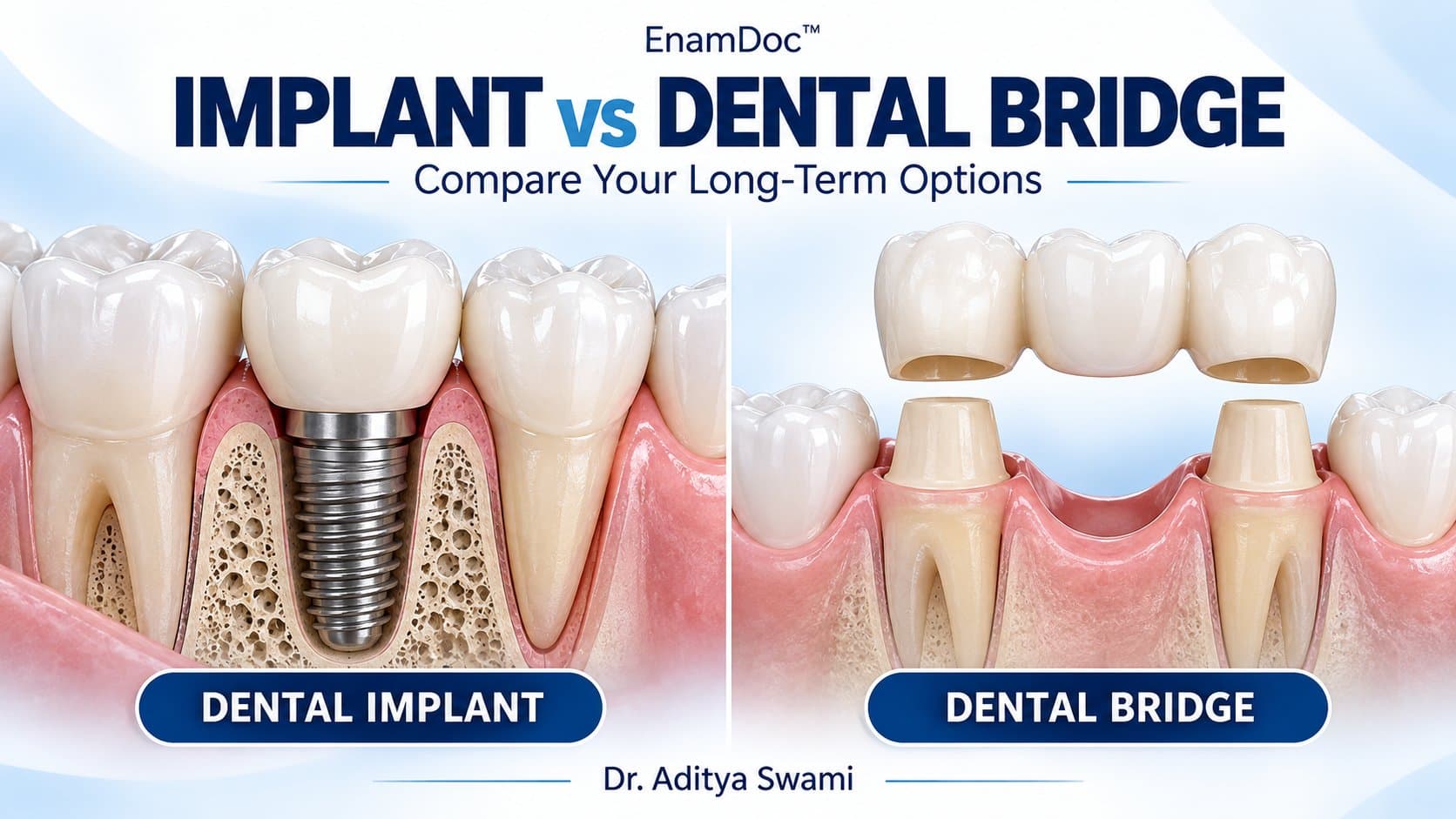
You've just lost a tooth — or been told you're about to — and your dentist has given you two options: a dental implant or a dental bridge. Both will restore your smile, but they work very differently and come with very different long-term implications. Making the right choice now could save you a significant amount of money, discomfort, and regret down the road.
In this guide, Dr. Aditya Swami breaks down everything you actually need to know to make an informed decision, specifically for Indian patients navigating costs, dental health, and long-term outcomes.
What Is a Dental Implant?
A dental implant is a titanium screw that is surgically placed into your jawbone to act as an artificial tooth root. Once the implant fuses with the bone (a process called osseointegration that takes three to six months), a crown is attached on top. The result looks, feels, and functions almost exactly like a natural tooth.
Implants are a standalone solution — they don't depend on your neighbouring teeth in any way. That's a crucial distinction.
What Is a Dental Bridge?
A dental bridge fills the gap left by a missing tooth by anchoring an artificial tooth (called a pontic) to the teeth on either side of the gap. Those anchor teeth (abutments) are permanently filed down and crowned to hold the bridge in place.
It's a faster, less invasive procedure than an implant — typically completed in two to three dental visits over a couple of weeks.
Key Differences: A Side-by-Side Comparison
| Feature | Dental Implant | Dental Bridge |
|---|---|---|
| Procedure time | 3–9 months total | 2–3 weeks |
| Surgery required | Yes | No |
| Adjacent teeth affected | No | Yes (filed down permanently) |
| Bone loss prevention | Yes | No |
| Average lifespan | 20+ years (often lifetime) | 10–15 years |
| Cost in India | ₹25,000–₹80,000 per tooth | ₹8,000–₹30,000 |
| Cleaning | Like a natural tooth | Requires special floss threaders |
| Feel and function | Closest to natural | Good but slightly different |
The Bone Loss Problem Nobody Talks About
When a tooth is extracted, the jawbone beneath it begins to shrink — because it's no longer being stimulated by a root. A dental bridge replaces the visible tooth but does nothing to prevent this bone resorption. Over years, this can change your facial structure, cause adjacent teeth to shift, and even compromise the bridge itself.
A dental implant, on the other hand, mimics a natural root. It stimulates the jawbone with every bite, preventing bone loss and preserving your facial structure for the long term. This is one of the most medically significant advantages of implants that patients rarely hear about until it's too late.
The Real Cost Comparison
On the surface, a bridge seems like the obvious budget choice. But the full picture looks different when you factor in the complete lifecycle of each option.
A bridge typically needs replacement every ten to fifteen years. Each replacement cycle involves fresh preparation of the abutment teeth, new crowns, and sometimes root canal treatment if those supporting teeth develop complications. The supporting teeth that were filed down are permanently weakened, making them more susceptible to decay and fracture over time.
An implant, while more expensive upfront, requires only routine maintenance. Many patients never need to replace them. When you calculate the total lifetime dental spend, implants are often the more economical option by the time you're in your 50s or 60s.
When a Bridge Makes More Sense
Implants are not always the right answer. A dental bridge is often the better choice when:
- You have significant bone loss in the jaw and are not a candidate for implants
- You need the tooth replaced urgently without months of healing time
- The adjacent teeth already need crowns anyway
- Your budget doesn't allow for the implant at this time
- You have uncontrolled diabetes or other health conditions that affect bone healing
When an Implant Is the Better Investment
An implant is typically the superior long-term choice when:
- You are under 50 and in good general health
- The adjacent teeth are healthy and untouched by previous dental work
- You want a permanent solution with no ongoing dependence on neighbouring teeth
- You're concerned about bone preservation and long-term facial structure
- You can manage the healing period of three to six months
What About EnamDoc?
If you're evaluating treatment options and want to compare quotes or find a trusted dentist near you, EnamDoc's clinic directory and patient record system let you consult multiple dentists, track your treatment history, and make well-informed decisions at your own pace — all in one place.
A Note on Medical Accuracy
Every patient's anatomy, bone density, and health history is different. The information in this article is for general education only. Always consult a qualified prosthodontist or oral surgeon before making any decision about tooth replacement.
Frequently asked
Frequently asked questions
Is a dental implant worth the higher cost compared to a bridge?
For most patients under 60 with good bone density, yes. An implant lasts 20+ years, prevents jawbone loss, and doesn't damage adjacent teeth. A bridge needs replacement every 10-15 years, with each cycle risking the supporting teeth. The total lifetime cost often evens out, and implants offer significantly better oral health outcomes.
Can I get a dental implant if I have been told I have bone loss?
It depends on the extent of bone loss. Mild to moderate bone loss can often be addressed with a bone graft procedure before the implant is placed. Severe bone loss may mean an implant is not suitable, and a bridge or partial denture would be recommended instead. A prosthodontist can assess this with a 3D cone beam CT scan.
- adentalimplantsdentalbridgetoothreplacementimplantcostIndiamissingtooth
Keep reading