Gum Graft Surgery for Receding Gums: What to Expect Before, During, and After the Procedure
Receding gums can expose tooth roots, cause sensitivity, and lead to bone loss if left untreated. Dr. Khanak Jain explains what gum graft surgery involves, how to prepare, and what recovery looks like.
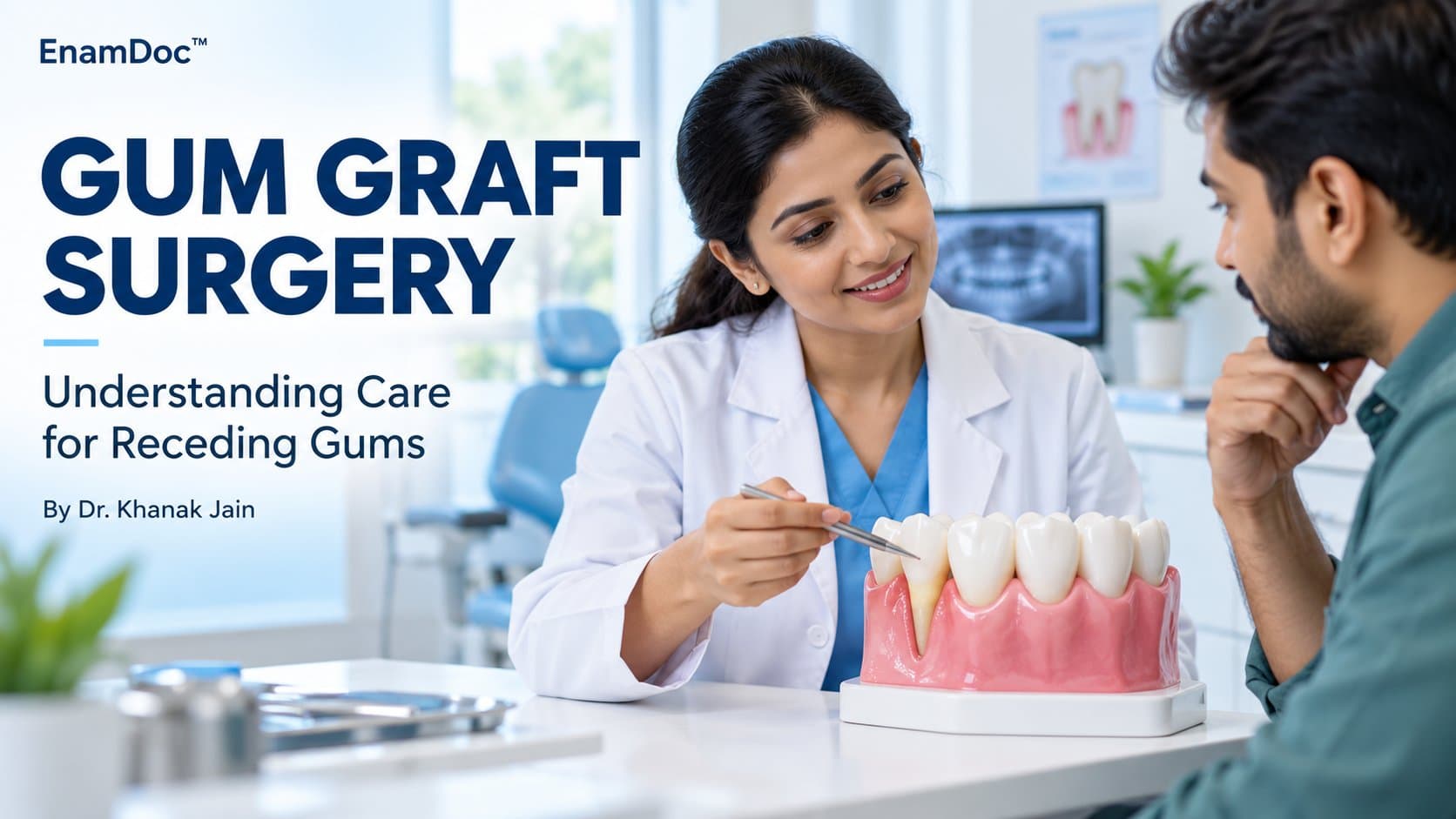
If your dentist has told you that your gums are receding, or you've noticed your teeth looking longer than they used to, you may already be experiencing gingival recession — the gradual pulling back of the gum tissue that exposes the root of the tooth. Left untreated, recession can lead to root sensitivity, increased cavity risk, and eventually tooth loss. For cases where recession is significant or progressing, a gum graft is often the most effective way to stop the damage and protect the root.
Here's a clear, practical guide to what gum graft surgery involves, when it's necessary, and what the recovery looks like.
Why do gums recede?
Gum recession has several causes, and understanding yours matters for both treatment and prevention. The most common include:
Periodontal disease: Bacterial infection of the gum and supporting bone is the leading cause of recession in adults. As the infection destroys tissue, the gum margin migrates downward on the tooth.
Aggressive brushing: Brushing with a hard-bristled brush or using excessive pressure wears away the gum tissue at the margin over time — a surprisingly common cause, particularly in patients who feel that brushing harder means brushing better.
Thin gum tissue: Some people naturally have less keratinised (firm, attached) gum tissue than others. This thinner tissue is more prone to recession even with normal forces.
Orthodontic treatment: Teeth moved outside their natural bone envelope during orthodontic treatment can sometimes cause localised recession.
Anatomy: Teeth that are naturally positioned further forward in the jaw may have thinner bone and gum on the outer surface, making them more susceptible.
When is a gum graft actually necessary?
Not every case of recession needs surgery. Your dentist or periodontist will consider the following before recommending a graft:
A graft is generally recommended when recession is causing significant root sensitivity that isn't manageable with desensitising products; when the exposed root surface is at risk of decay; when there is progressive recession that is likely to continue; when the patient is about to start orthodontic treatment and thin gum tissue is a risk factor; or when the recession is cosmetically distressing and affecting the patient's quality of life.
If recession is mild, stable, and not causing symptoms, your dentist may recommend monitoring and addressing the underlying cause (such as improving brushing technique) without surgery.
What types of gum graft are used?
There are three main types, and your periodontist will choose based on the extent of the recession, the number of teeth involved, and the characteristics of your gum tissue.
Connective tissue graft (subepithelial)
This is the most commonly performed type. A small flap is created on the roof of the mouth (the palate), and a piece of connective tissue is harvested from underneath the flap. That tissue is then sutured over the exposed root at the recession site. The palate heals with the overlying tissue intact. This technique offers a good colour match and predictable root coverage.
Free gingival graft
In this technique, a strip of tissue is taken directly from the surface of the palate (rather than from underneath) and placed at the recession site. This is used primarily to increase the width of firm, attached gum tissue rather than for root coverage, and is often chosen for patients with very thin gum tissue who need more structural support.
Pedicle graft (lateral or coronally repositioned)
When adequate tissue is available adjacent to the recession site, the existing gum can be partially cut and repositioned to cover the exposed root. Because the tissue is not fully detached, blood supply is maintained throughout and healing can be faster. This technique does not suit all cases and is chosen when there is sufficient healthy tissue nearby.
What happens on the day of surgery?
Gum graft surgery is performed under local anaesthesia as an outpatient procedure, usually lasting between 60 and 90 minutes depending on the number of sites being treated. You will be awake throughout but should feel only pressure, not pain.
The surgical steps vary by graft type, but generally involve preparing the recipient site (the area of recession), harvesting donor tissue if required, positioning and suturing the graft, and placing a protective dressing if necessary.
You will need someone to drive you home after the procedure, even though you will be fully conscious — the local anaesthetic will take a few hours to wear off, and most patients are more tired than they expect.
What is recovery like?
Recovery from gum graft surgery is manageable for most patients, though it does require careful attention for the first two weeks.
The first 24–48 hours: Swelling and discomfort are normal. Apply ice to the outside of the face for the first day (20 minutes on, 20 minutes off). Take prescribed or recommended pain relief as directed. Eat only soft, cool foods — avoid anything hot, spicy, crunchy, or hard.
The first two weeks: Do not brush or floss the surgical sites — your dentist will provide a special rinse (usually chlorhexidine) to keep the area clean. The donor site on the palate can be more uncomfortable than the grafted area and may have a temporary protective stent. Avoid strenuous physical activity, which raises blood pressure and can disrupt healing.
Longer term: Sutures are usually removed or dissolve within 1–2 weeks. Initial colour change and slight puffiness around the graft are normal and resolve over weeks to months. Full maturation of the graft tissue can take up to six months.
What is the success rate?
Connective tissue grafts have a high predictability, with studies reporting complete or near-complete root coverage in the majority of treated sites. Long-term success depends heavily on addressing the original cause of recession — if aggressive brushing or untreated gum disease triggered the recession, the same problem will cause it to recur unless corrected.
Your periodontist will schedule follow-up appointments to assess graft integration and ensure healing is progressing as expected.
What can I do to prevent further recession?
After a gum graft, protecting your result requires adjusting the habits that caused or worsened the original recession. Switch to a soft-bristled toothbrush and use gentle, circular motions — if you brush with significant force, your dentist may recommend an electric toothbrush with a pressure sensor. Treat any active gum disease with regular professional cleaning. Continue with your dentist's recommended monitoring schedule. If teeth clenching or grinding is a factor, discuss a night guard.
Recession that is caught early and treated appropriately is very manageable. If your dentist has flagged it at a check-up, that is the ideal time to act — before it progresses to the point where more extensive treatment is needed.
Frequently asked
Frequently asked questions
Is gum graft surgery painful?
The procedure itself is performed under local anaesthesia and should not be painful during the surgery — you may feel pressure but not sharp pain. The recovery is the more uncomfortable phase. The donor site on the roof of the mouth is typically more sore than the graft site, and patients usually describe the discomfort as moderate rather than severe. Most find it manageable with standard pain relief (paracetamol or ibuprofen as directed by their dentist) for the first few days, with significant improvement by the end of the first week.
How long does it take to recover from gum graft surgery?
Most patients return to work and light activity within a few days to a week. The soft diet restriction typically applies for two to four weeks, and the surgical site should be avoided during brushing for about two weeks (using a prescribed antiseptic rinse instead). Sutures dissolve or are removed at one to two weeks. The graft will look and feel different from surrounding tissue for several weeks while it matures; full integration and a natural appearance can take three to six months. Your periodontist will schedule follow-up visits to monitor healing.
- gum graft surgery
- receding gums
- gingival recession
- gum recession treatment
- periodontist
- patients
Keep reading