How to Ace Your Dental OSCE: A Complete Study Guide for BDS Students
Complete dental OSCE guide for BDS students: station types, marking schemes, common mistakes, and revision strategies to pass your clinical exam.
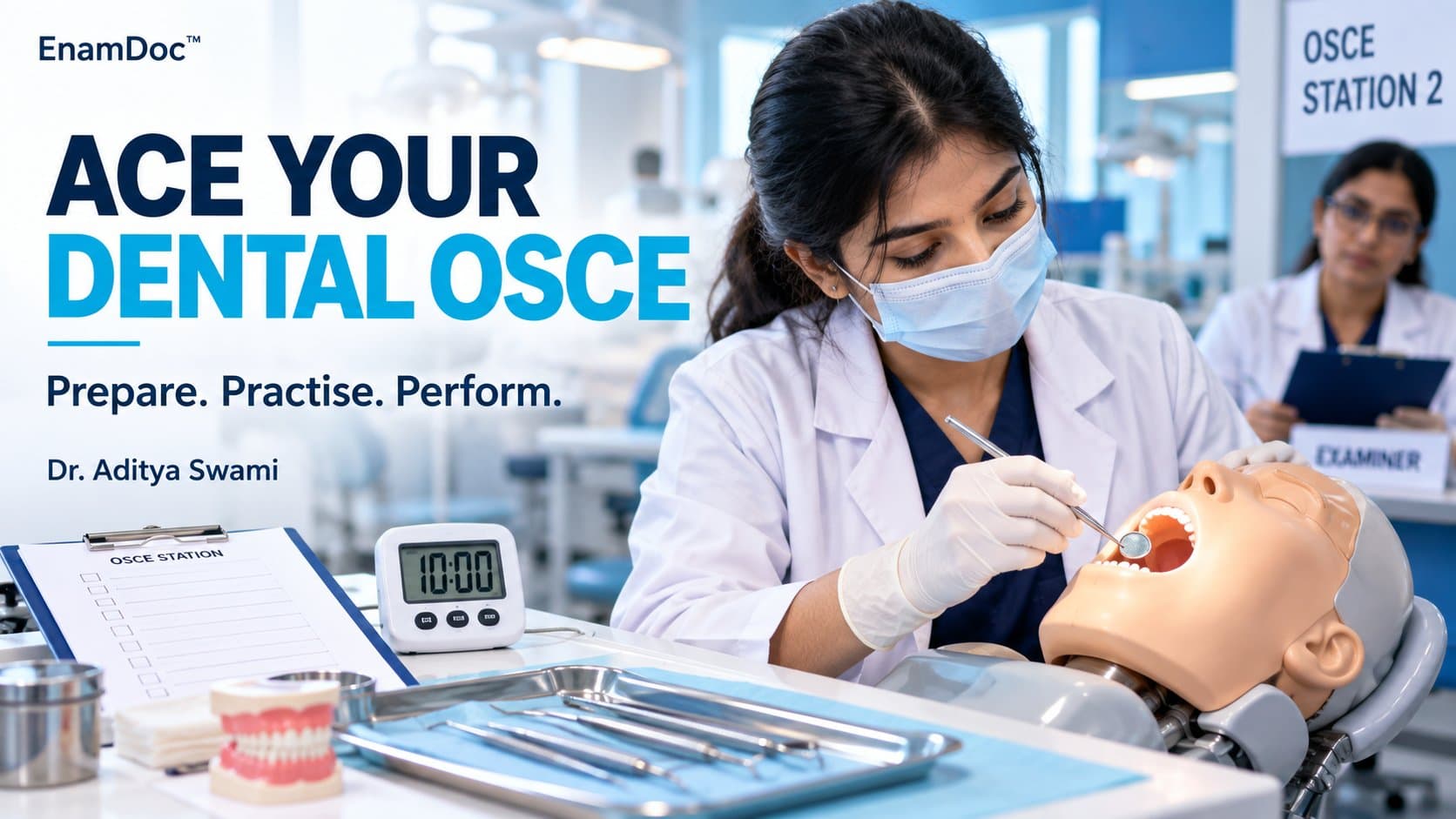
The Objective Structured Clinical Examination, or OSCE, is the most anxiety-inducing assessment many BDS students face. Unlike written papers, there is no hiding behind a desk — every station tests whether you can actually do what you have been learning. The good news is that OSCEs are highly predictable if you understand how they are marked and what examiners look for.
What Is a Dental OSCE?
An OSCE is a circuit of short, timed stations — typically 5 to 10 minutes each — where you perform clinical tasks, answer questions, or interpret data in front of examiners. Stations rotate on a bell, and you must stop the moment time is called, even mid-sentence.
Unlike a viva, the examiner follows a structured mark sheet rather than improvising. This means every question they ask has a pre-written answer bank. Your job is to cover those points, not to impress them with extra information.
Types of OSCE Stations
Communication Stations
You may speak with a real patient, a trained actor (simulated patient), or an examiner acting in role. Common scenarios include: explaining a diagnosis, obtaining informed consent, breaking bad news, or managing an anxious patient. Marks go to structure, empathy, and whether you covered the required information points — not how eloquent you sound.
Clinical Skills Stations
These test hands-on competence on a mannequin or typodont: recording a BPE, placing a rubber dam, mixing cements, writing a prescription, or taking a blood pressure. Follow the correct sequence every time — examiners mark procedure, not outcome.
Data Interpretation Stations
X-rays, study models, blood results, drug charts, and photos of lesions are common. Read the question carefully; it usually tells you exactly what to address. A systematic approach (name the view, assess quality, describe findings, give differential, suggest next step) earns more marks than jumping to a diagnosis.
Written and History-Taking Stations
Some OSCEs include short-answer written stations or ask you to take a structured history from a simulated patient. Use a standard framework (PC, HPC, PMH, DH, SH, FH, allergies) and say each heading out loud — it signals to the examiner that you are following a system.
The Marking Scheme: What Examiners Actually Count
Most dental OSCEs use a global rating scale alongside a structured checklist. The checklist catches specific required points; the global scale captures overall professionalism and clinical reasoning. To score well on both:
- Cover the mark-scheme points explicitly — do not assume the examiner will infer what you meant.
- Introduce yourself, confirm the patient's name and date of birth, and wash your hands at every relevant station — these are easy marks that students routinely drop.
- End every station with a clear closing statement, even if it is brief.
Common Mistakes That Cost Marks
Experienced OSCE examiners see the same errors repeatedly:
- Rushing through the introduction. Students under time pressure skip consent and wash their hands. These steps appear on virtually every mark sheet.
- Overloading the patient with information. In communication stations, check understanding at intervals rather than delivering a monologue.
- Ignoring the question on the door. Read the stem twice before you enter. The scenario on the door tells you exactly what the station tests.
- Stopping work when the examiner writes notes. Keep going. Writing does not mean you made an error — examiners often mark continuously.
- Leaving stations early. If you finish early, review what you have done. Revisit the question and add anything you may have omitted.
Revision Strategy for OSCEs
Active Practice Over Passive Reading
OSCEs are a performance skill. Watching procedure videos and reading clinical guidelines will not prepare you the way that actually doing the procedure will. Set up practice circuits with your study group: one person plays the patient or examiner, one performs, others observe and give structured feedback.
Use the BNF and Guidelines, Not Memory Alone
Drug prescribing and dose questions are common station types. Rather than memorising every drug from scratch, focus on drugs you will commonly prescribe as a foundation dentist: amoxicillin, metronidazole, ibuprofen, paracetamol, chlorhexidine, and topical fluoride preparations. Know the contraindications and common drug interactions.
Timed Mock Circuits
Run at least two full timed mock circuits before your exam. Use a bell or timer set to the exact station length your university uses. The sensation of the bell ringing mid-task is disorienting at first; repeated exposure takes away most of the anxiety response before the real exam.
On the Day: Managing the Pressure
Arrive early enough to sign in without rushing. Read the instructions at each station carefully before the bell. If a station goes badly, treat the next one as a fresh start — there is no carry-over between stations, and a weak performance at one station cannot drag down your marks elsewhere.
If you blank on a question, buy yourself time by saying "Let me think through that systematically" and then apply a framework out loud. Examiners mark what you say, and organised thinking earns marks even when you do not immediately have the answer.
Frequently asked
Frequently asked questions
How many OSCE stations are there in a typical dental BDS exam?
This varies by university, but most BDS OSCEs run 10–16 stations lasting 5–10 minutes each, covering communication, clinical skills, data interpretation, and written tasks. Your university's student handbook or past timetables are the most reliable source for your specific format.
What happens if I run out of time during an OSCE station?
Stop immediately when the bell rings — continuing after time is called can result in no marks for that station. The examiner will score your performance up to that point. Aim to leave 30–60 seconds at the end to check you have covered all required points.
How should I prepare for OSCE communication stations as a dental student?
Practise with a partner acting as the patient. Use a structured framework for each scenario type: consent (procedure, risks, alternatives, questions), breaking bad news (setting, warning shot, clear language, support), and history taking (PC, HPC, PMH, DH, SH, FH, allergies). Record yourself once — it is uncomfortable but very revealing.
- dentalOSCEBDSexamOSCEstationsclinicalexaminationdentalstudent
Keep reading