How to Choose Between Private Practice, Academia, and Hospital Residencies After BDS
Navigate your post-BDS career path by comparing private practice, dental academia, and hospital residencies across salary, work-life balance, clinical exposure, and long-term growth.
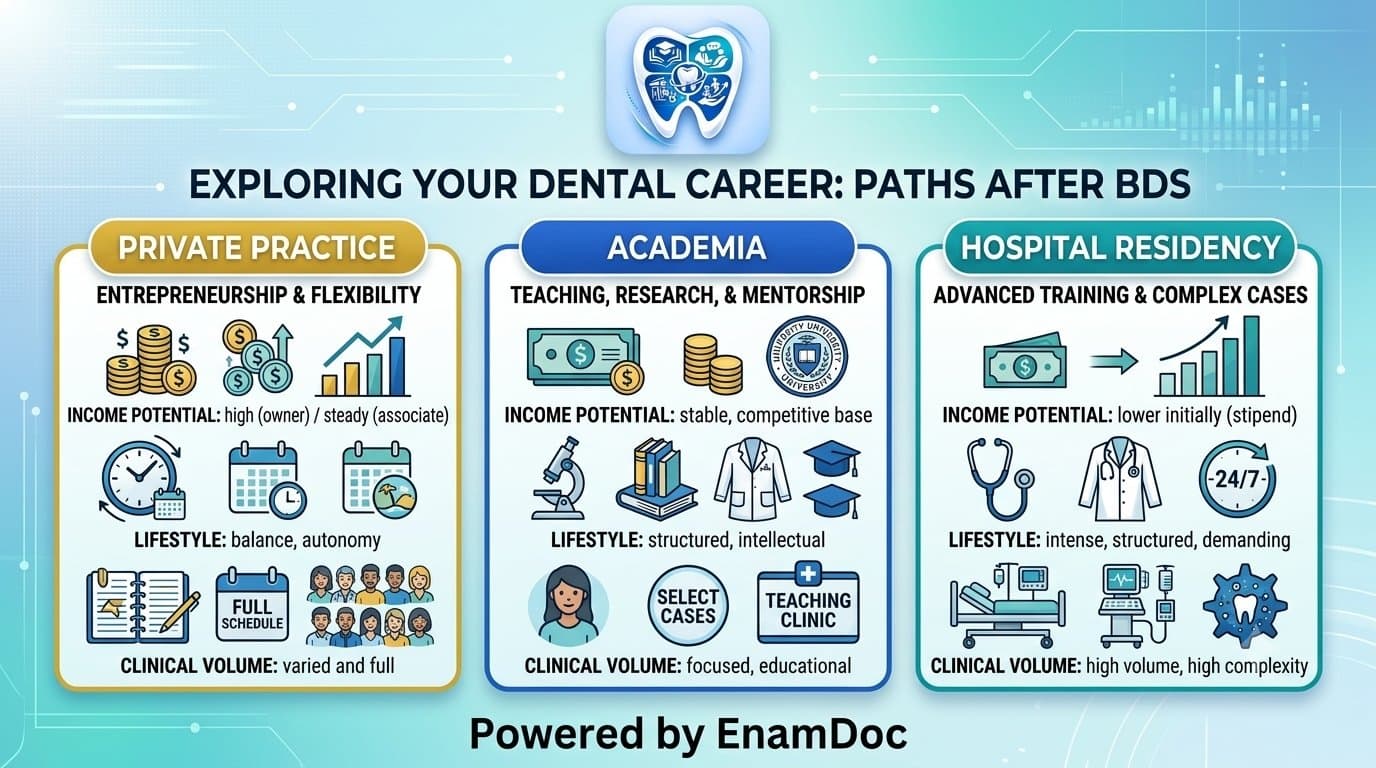
Completing a Bachelor of Dental Surgery (BDS) marks the beginning of a crucial transition: deciding how and where to build your professional life. While clinical training provides a strong foundation, the post-graduate landscape presents three distinct primary pathways: launching or joining a Private Practice, entering Dental Academia, or securing a Hospital Residency/Junior Residency.
Each trajectory offers distinct advantages and challenges regarding earning potential, clinical volume, daily working hours, and long-term professional fulfillment. Evaluating these options across core career metrics will help you determine the best fit for your personal and professional goals.
1. Private Practice: Entrepreneurship and Clinical Autonomy
Private practice remains the most traditional route, whether starting as an associate dentist or establishing your own standalone clinic.
- Clinical Exposure: Highly varied across general dentistry procedures such as restorations, endodontics, prosthodontics, and extractions. However, complex surgical or multi-specialty cases depend entirely on your clinic's patient demographic.
- Lifestyle & Work-Life Balance: Highly demanding in the first 3 to 5 years, often requiring weekend hours, emergency availability, and practice management duties. Autonomy increases significantly once the practice matures.
- Compensation: Associate roles often start with modest base salaries or commission models (₹15,000–₹35,000/month initially). However, successful clinic owners face virtually no upper ceiling on long-term earnings.
- Career Trajectory: Direct path to business ownership, clinical autonomy, brand building, and clinic scaling.
2. Hospital Residencies (JR/SR): High Volume & Medical Complexity
Junior Residency (JR) posts in government medical colleges, trust hospitals, or corporate healthcare networks focus on intense, hands-on clinical service.
- Clinical Exposure: Unmatched volume and variety. Residents routinely manage maxillofacial trauma, complex impactions, medically compromised patients, and dental emergencies in multidisciplinary settings.
- Lifestyle & Work-Life Balance: Fast-paced and physically demanding. Involves rotational shifts, overnight on-call duties, and emergency triage responsibilities.
- Compensation: Fixed, structured monthly stipends or salaries (typically ₹45,000–₹90,000+/month in government institutions, depending on the state and institution).
- Career Trajectory: Builds clinical speed, surgical confidence, and interdisciplinary competence, serving as an ideal launchpad for Master of Dental Surgery (MDS) entrance exams or advanced clinical positions.
3. Dental Academia: Teaching, Research, and Stability
Pursuing a career in a dental institution as a tutor, lecturer, or clinical instructor combines patient supervision with academic education.
- Clinical Exposure: Focused on foundational diagnostics, preclinical training, and supervising undergraduate student clinics. Direct advanced procedure volume is generally lower unless paired with an attached hospital OPD.
- Lifestyle & Work-Life Balance: Predictable working hours, structured academic calendars, standard holiday schedules, and minimal emergency calls.
- Compensation: Stable and predictable fixed salaries (typically starting at ₹25,000–₹45,000/month for BDS tutors, scaling significantly with MDS qualifications, professorships, and administrative roles).
- Career Trajectory: Ideal for clinicians passionate about mentoring, scientific publication, and clinical research, leading to departmental leadership and academic dean roles.
Comprehensive Pathway Comparison
| Evaluation Metric | Private Practice | Hospital Residency | Dental Academia |
|---|---|---|---|
| Immediate Income | Low to Moderate (Commission/Base) | Moderate to High (Fixed Stipend) | Moderate (Fixed Salary) |
| Long-Term Earning Potential | Uncapped (Equity & Ownership) | Structured (Institutional Scales) | Predictable (Academic Pay Bands) |
| Daily Schedule | Flexible, but long hours early on | Rigid shifts, emergency on-call duties | Standard daytime hours (9 AM–4 PM) |
| Skill Development | General dentistry, marketing, business operations | High surgical speed, trauma care, complex pathology | Pedagogy, scientific research, evidence-based methods |
How to Make Your Decision
Your ideal career path aligns with your risk tolerance, clinical interests, and lifestyle priorities:
- Choose Private Practice if you have an entrepreneurial mindset, want clinical independence, and are prepared to build a business over time.
- Choose a Hospital Residency if your priority is mastering surgical speed, handling acute emergency cases, or preparing for MDS entrance exams.
- Choose Dental Academia if you prioritize regular working hours, job stability, teaching, and academic research.
Many successful clinicians also adopt a hybrid model—such as working in academia or hospital shifts during morning hours while managing an evening private practice—to balance stability with clinical growth.
Frequently asked
Frequently asked questions
Is a Junior Residency mandatory before starting private dental practice?
No, it is not mandatory. However, a hospital residency provides immense clinical volume, fast-tracking your procedural confidence and emergency management skills before you treat patients independently in private practice.
Can I transition from academia to private practice later?
Yes. Many dental professionals maintain part-time academic or hospital affiliations while running an evening clinic, or eventually transition into full-time private practice once their patient base is established.
Which path is best suited for MDS entrance preparation?
Academic tutor roles and structured hospital residencies are often favored by exam aspirants because they provide access to academic libraries, journal access, faculty guidance, and direct exposure to clinical concepts tested in postgraduate exams.
- BDS career paths
- dental residency
- dental academia
- private dental practice
- post-BDS options
- dental salary
- clinical exposure
- dental careers
Keep reading