How to Choose the Right Dental College in India: A Guide for BDS Aspirants
With over 300 dental colleges in India and huge variation in infrastructure, faculty, and clinical exposure, choosing wisely can define your entire career. Dr. Khanak Jain breaks down what actually matters — and what to ignore.
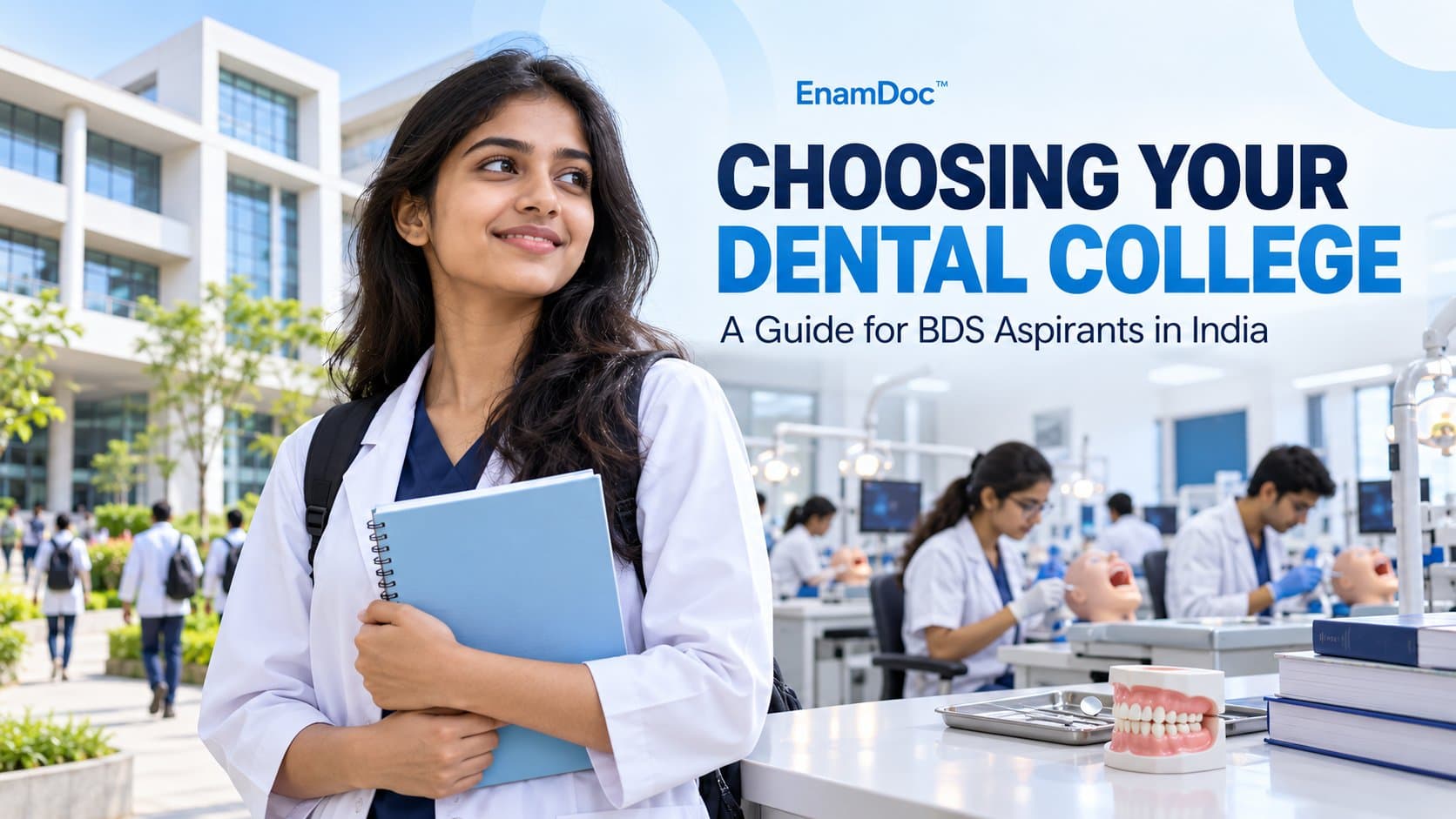
You have cleared NEET with a score that qualifies you for dentistry. Now comes the decision that will shape the next five years of your life — and, in many ways, the decade that follows. India has more than 315 dental colleges, ranging from government institutions with excellent infrastructure to private colleges that vary enormously in quality. With so much at stake, here is a practical framework to help you choose well.
Step One: Understand Why College Choice Matters More in Dentistry Than in Medicine
In MBBS, the degree is what opens doors. In BDS, clinical training is what makes you competent. A dentist who graduates with minimal hands-on experience — too few patients, inadequate materials, poor faculty supervision — will struggle in practice regardless of which college's name is printed on the certificate. The clinical years of BDS are foundational in a way they are not for every medical degree. This is why the quality of the institution matters so much.
DCI Recognition and University Affiliation
Before anything else, confirm that the college is recognised by the Dental Council of India (DCI) and affiliated to a statutory university. Both are mandatory for your degree to be valid. Check the DCI's official list of recognised dental colleges rather than relying on the institution's own marketing. Re-inspection notices or provisional recognition status are warning signs worth investigating.
Some colleges operate under deemed university status. This is not inherently problematic, but check the UGC's list of deemed universities and whether the institution appears in any de-recognition or show-cause proceedings.
Patient Load: The Number That Matters Most
A dental college must have a teaching hospital to be DCI-recognised. But the volume and variety of patients that hospital actually sees varies dramatically. A college in an urban area with a large outpatient department will expose you to more complex cases, more emergency dental situations, and a wider range of procedures than a college where students fight over a handful of patients per week.
When visiting a college, ask: How many new outpatients attend the dental OPD per day? How many patients does each clinical student typically treat per week in their third and fourth year? Are there oral surgery cases, not just extractions? Is the orthodontics department taking new cases throughout the year?
Faculty and students may give you rough numbers. These matter.
Faculty Qualifications and Stability
DCI norms require specific faculty-to-student ratios and qualifications for each department. In practice, some colleges maintain minimal faculty on paper while actual teaching is sparse. Turnover is telling — if the faculty list changes significantly from year to year, that signals instability.
Check: Are the professors actually practising clinicians with MDS degrees? Do they publish research? Are faculty from AIIMS, government institutions, or reputable private practices? A strong head of department in a specialty like periodontics, oral surgery, or orthodontics can define the quality of learning in that department for years.
Infrastructure: What to Look for Beyond the Brochure
Walk through the clinical departments yourself. Look for:
- Number of dental chairs and whether they are fully equipped with handpieces, suction, and lighting
- Condition of autoclave and sterilisation equipment — dental procedures require rigorous infection control
- Radiology department with intraoral and orthopantomographic (OPG) X-ray facilities, ideally with digital sensors
- Oral surgery operation theatre with general anaesthesia facilities for complex cases
- Laboratory equipment for fixed and removable prosthodontics — whether the lab is on-site or outsourced affects learning
- A well-stocked library with physical and digital access to dental journals (access to Cochrane, PubMed, and dental-specific databases)
- Adequate hostel facilities if you will be living on campus
Government vs. Private: The Real Trade-offs
Government dental colleges almost always offer superior infrastructure, patient volume, faculty calibre, and fees. If your NEET score qualifies you for a government seat, take it. The fee difference between a government BDS seat (typically ₹30,000–₹1,50,000 per year) and a private management-quota seat (₹5–25 lakh per year, sometimes more) is substantial enough to affect your financial life for years after graduation.
If you are considering a private college, scrutinise it with the questions above. Some private institutions are genuinely excellent. Others exist primarily to collect fees. The brochure will not tell you which category applies.
Location and Its Practical Consequences
The city or region where your college is located affects your clinical exposure, your quality of life, and your professional network. A dental college in Mumbai, Delhi, Bengaluru, or Hyderabad will generally see more diverse patient populations and offer more internship and job connections than one in a small town with limited access to referral cases. This is not always true — some excellent colleges exist in smaller cities — but location matters more in dentistry than in many other fields because your network during BDS often translates into partnerships, referrals, and opportunities after graduation.
PG Entrance Preparation: Start Thinking About It Now
If you are even slightly interested in pursuing MDS — and the specialist vs. general practice divide in income and opportunities makes this a serious consideration — your BDS college matters for PG preparation too. Institutions with strong academics, regular internal theory examinations, and faculty who are themselves MDS holders from good universities tend to produce students who perform better in NEET PG (Dental) and state PG entrance examinations. Ask current students whether the college supports or hinders PG aspirants.
Accreditation and Rankings
NAAC (National Assessment and Accreditation Council) accreditation and rankings from bodies like the NIRF (National Institutional Ranking Framework) offer imperfect but useful data points. A dental college with a valid NAAC A or A+ grade and a strong NIRF ranking has been through external review. These rankings do not capture everything, but an institution that cannot achieve basic accreditation is not meeting minimum quality standards.
Practical Checklist Before You Decide
- Confirm DCI recognition and university affiliation from official sources
- Visit the campus in person — never choose based solely on a website or agent's description
- Ask to meet third-year and fourth-year students, not just the admissions office
- Ask specifically about patient numbers per student per week in the clinical years
- Review the faculty list on the DCI inspection report, not the college website
- Confirm the total fee structure (not just first-year fees) in writing before paying any deposit
- Check student performance in NEET PG (Dental) if the data is available
- Speak to recent graduates about internship quality and job placement support
A Final Word
The best dental college for you is not necessarily the most expensive one, the one with the most impressive campus photographs, or the one that an agent tells you offers the easiest admission. It is the one with DCI recognition, adequate patient load, qualified faculty, functional infrastructure, and a fee structure that does not saddle you with debt that will take a decade to repay on a general dentist's starting salary in India.
Choose carefully, visit in person, and talk to people who studied there — not just the people selling admission.
Frequently asked
Frequently asked questions
What is the most important factor to consider when choosing a BDS college in India?
Patient load is the single most important factor — specifically, the number and variety of patients each clinical student actually treats during the third and fourth years. Dental competence is built through doing procedures under supervision, not just observing them. A college with strong DCI recognition, qualified faculty, and a genuinely busy teaching hospital OPD will develop you into a confident dentist. After patient load, look at faculty qualifications (MDS holders in each department), functioning clinical infrastructure (working dental chairs, sterilisation, OPG radiology), and honest feedback from students currently enrolled there.
Is a government dental college always better than a private one?
Government dental colleges are generally superior in terms of patient volume, faculty stability, infrastructure, and fees — and if your NEET score qualifies you for a government seat, it is usually the right choice. The fee difference (often ₹30,000–₹1,50,000 per year in government versus ₹5–25 lakh or more in private management quota) is significant enough to affect your financial situation for years after graduation. That said, some private dental colleges in India are genuinely excellent, with strong clinical training, reputable faculty, and good PG entrance results. The key is to evaluate each institution individually using objective criteria rather than assuming name or price equals quality.
How do I verify that a dental college is genuinely DCI-recognised before applying?
Check the Dental Council of India's official website (dciindia.org.in) directly, rather than relying on the college's own website or an admission agent. DCI publishes the list of recognised dental colleges by state. Look at whether the college has full recognition or is under provisional recognition or re-inspection notice — provisional or conditional status can affect your degree's validity and your ability to register with state dental councils after graduation. Also verify the university affiliation separately through the UGC's website to confirm the awarding university is statutorily recognised. These checks take minutes and can save years of problems.
- BDScollegeIndiadentalcollegeadmissionchoosingdentalcollegebestdentalcollegeIndiaBDSaspirantsguide
Keep reading