How to Study Dental Pharmacology for BDS Exams: A Topic-Wise Strategy
Dental pharmacology covers a lot of ground — from local anaesthetics to antibiotics to emergency drugs. This topic-wise strategy helps BDS students focus their revision, understand high-yield areas, and avoid wasting time on low-priority content.
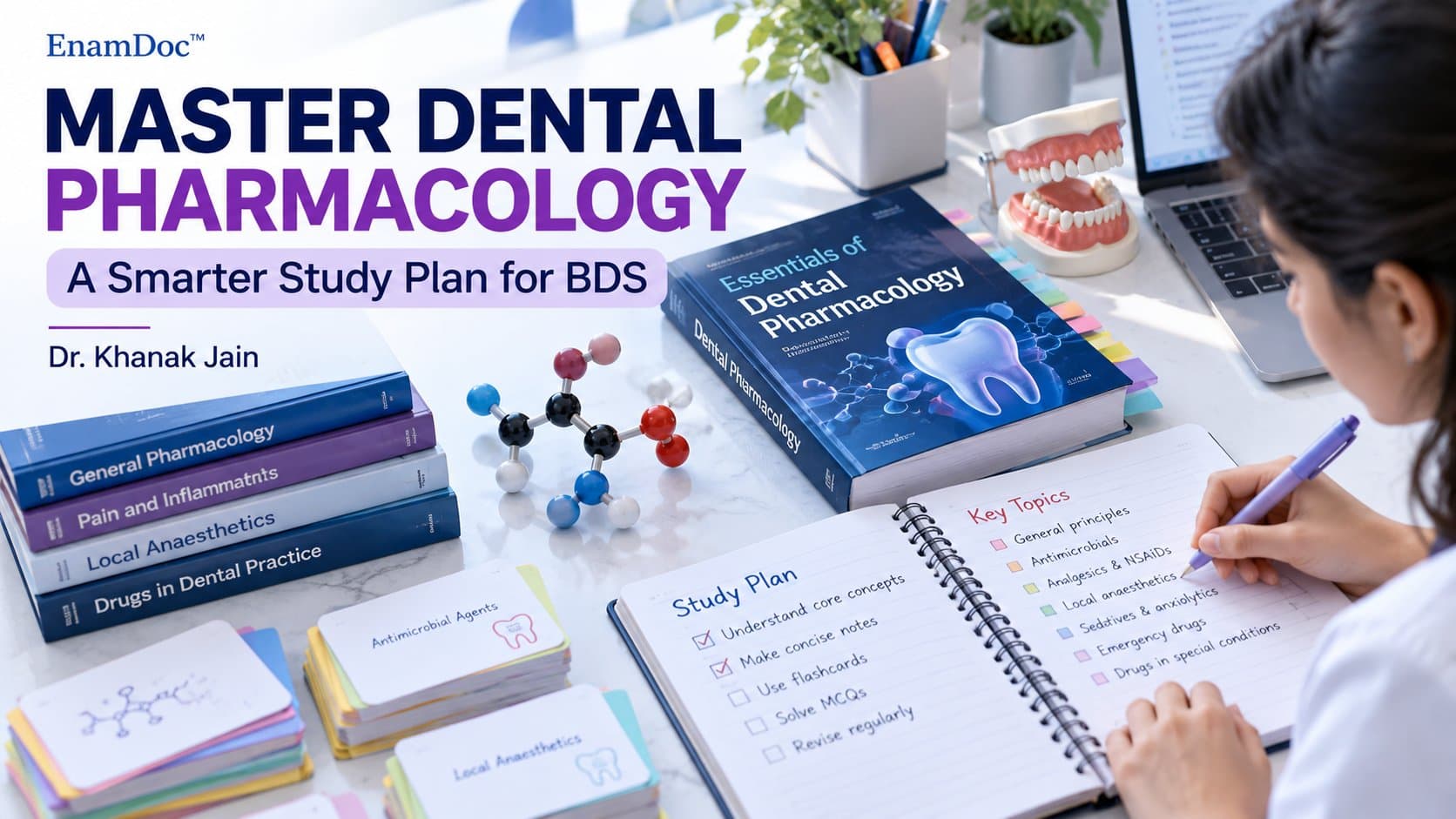
Among all subjects in the BDS curriculum, pharmacology sits in an awkward middle: too clinical to treat purely as theory, too broad to memorise everything, and written in most textbooks in a way that makes it feel disconnected from actual dentistry. The good news is that dental pharmacology is highly pattern-driven — the same drugs appear across different clinical scenarios, and once you understand why a drug is used rather than just what it is, revision becomes significantly faster.
This guide breaks down the subject by topic area, tells you where to focus your energy, and gives you a practical approach to questions in both theory papers and objective exams.
Why Topic-Wise Revision Works Better for Pharmacology
Trying to read a pharmacology textbook front to back is one of the least efficient revision strategies for dentistry students. Instead, group your revision by clinical relevance. This mirrors how MCQs and theory questions are actually written — they usually present a clinical scenario and test whether you know which drug to use and why.
High-Priority Topics (Do These First)
1. Local Anaesthetics
This is the single most tested topic in dental pharmacology, and for obvious reasons — you will use these drugs in every clinical session. Know the mechanism of action (voltage-gated sodium channel blockade), the classification (amides vs esters), and why lignocaine (lidocaine) with adrenaline is the gold standard. Understand maximum doses, why adrenaline is contraindicated in certain patients, and what happens in systemic toxicity. Questions on LA are predictable — master this topic completely.
2. Analgesics and NSAIDs
Paracetamol, ibuprofen, diclofenac, and ketorolac appear repeatedly. Know the mechanism (COX inhibition for NSAIDs), contraindications (aspirin in children — Reye's syndrome; NSAIDs in peptic ulcer disease, renal impairment, and pregnancy), and the difference between COX-1 and COX-2 selective drugs. For opioid analgesics, focus on morphine, tramadol, and their reversal with naloxone. MCQs frequently test drug interactions: NSAIDs with warfarin, antihypertensives, or lithium are common traps.
3. Antibiotics Used in Dentistry
Amoxicillin (with and without clavulanate), metronidazole, clindamycin, and doxycycline are your priority drugs. Understand their spectrum (gram-positive vs gram-negative, aerobic vs anaerobic), and know the rationale for prophylactic antibiotic use in infective endocarditis. The NICE guidelines on antibiotic prophylaxis have changed significantly — know the current recommendations, not just what older textbooks say.
4. Corticosteroids
Know prednisolone and dexamethasone — their uses (post-surgical swelling, oral ulcers, airway emergencies), contraindications, and the concept of adrenal suppression. Understand why long-term steroid users need a stress dose of hydrocortisone before dental procedures. This is a topic where theory and clinical reasoning intersect nicely.
5. Emergency Drugs
These are high-yield for theory papers and essential clinical knowledge: adrenaline (anaphylaxis), salbutamol (bronchospasm), glyceryl trinitrate (angina), aspirin (myocardial infarction, early management), and midazolam or diazepam (seizures). Learn doses, routes, and the rationale for each. This topic is frequently asked as "drug of choice" MCQs.
Medium-Priority Topics (Revise After the Above)
Antifungals
Nystatin and fluconazole for oral candidiasis. Know their mechanisms, why one is topical and the other systemic, and the classic scenario: immunocompromised patient or post-antibiotic candidiasis.
Antivirals
Aciclovir for herpes labialis and primary herpetic gingivostomatitis. Know mechanism (thymidine kinase dependent activation), dose, and when topical vs systemic is appropriate.
Anxiolytics and Sedation Agents
Benzodiazepines (midazolam, diazepam), nitrous oxide, and their properties for conscious sedation. Understand minimum monitoring requirements and reversal agents (flumazenil).
Haemostatic Agents
Tranexamic acid and its role in patients on anticoagulants. Know when to use a haemostatic rinse versus when systemic therapy adjustment is required (in coordination with the physician).
Lower-Priority Areas (Skim, Do Not Memorise in Detail)
General anaesthesia pharmacology, cardiovascular drugs beyond basic knowledge, and antiepileptic drugs are tested less frequently in dental pharmacology papers specifically. Understand the basics (enough to recognise drug names in MCQs), but do not spend disproportionate time here.
Approach for Theory Papers
Theory questions in pharmacology typically ask you to "write about" a drug or drug class. The safest structure is: classification → mechanism of action → pharmacokinetics → indications (especially dental) → contraindications → adverse effects → drug interactions → dose. For local anaesthetics and antibiotics, also include maximum doses and specific dental protocols. Always end with a brief clinical note tying the drug to dentistry — examiners appreciate contextualisation.
Approach for MCQs
In MCQs, the common question types are: drug of choice for a given scenario, which drug is contraindicated in a condition, the mechanism of action of a named drug, and drug interactions. The traps are almost always about contraindications (aspirin in children, NSAIDs in renal failure, adrenaline in cocaine toxicity) or drug-drug interactions. Review a dedicated MCQ bank alongside your theory reading rather than treating MCQs as a separate exercise at the end.
Recommended Resources
For Indian BDS students, Pharmacology for Dentistry by Tara V Shanbhag is the standard reference. Supplement with KD Tripathi's concise sections on relevant drug classes. For MCQ practice, Amit Ashish's collections cover dental pharmacology well. Avoid reading general MBBS pharmacology textbooks in full — they cover far more than BDS needs and can derail your revision.
Final Advice
Pharmacology rewards active recall over passive reading. After reading a drug class, close the book and try to write out the key facts from memory — mechanism, indications, contraindications, and one clinical dental use. Do this repeatedly, and you will retain far more than any amount of highlighting. Group similar drugs together and compare them side-by-side to understand the differences that MCQs exploit.
Frequently asked
Frequently asked questions
How many marks does pharmacology typically carry in BDS exams?
This varies by university, but in most Indian BDS curricula, pharmacology is assessed in the second or third year with a theory paper of 80–100 marks, a practical/viva component of 20–40 marks, and MCQs in multiple choice papers. Dental pharmacology questions also appear in integrated subject papers in later years. Check your specific university syllabus for exact weightage, as Rajiv Gandhi University, Maharashtra University of Health Sciences, and others differ in structure.
Is Tara Shanbhag enough for dental pharmacology, or do I need KD Tripathi too?
For most Indian BDS students, Tara Shanbhag is sufficient for dental-specific pharmacology content and covers the curriculum well. KD Tripathi is helpful as a reference for mechanisms and drug interactions — particularly for MCQs — but you do not need to read it cover to cover. Use Tripathi selectively to clarify mechanisms or compare drug classes when Shanbhag is unclear on a point. Do not attempt to read both books in their entirety.
What are the most commonly repeated MCQ topics in dental pharmacology exams?
The most frequently repeated MCQ areas in dental pharmacology are: local anaesthetic maximum doses and contraindications; drug of choice for specific oral infections (antibiotics); analgesic contraindications (aspirin in children, NSAIDs in kidney disease); emergency drug doses and routes; mechanism of action of common drugs (penicillin, metronidazole, fluconazole); and adverse effects of corticosteroids. Preparing a one-page summary of these high-frequency topics before the exam is highly effective.
- dental pharmacology
- BDS exam
- pharmacology revision
- dental drugs
Keep reading