Invisalign vs Traditional Braces in India: Cost, Comfort, and What Actually Works Better
Confused between Invisalign and metal braces? Dr. Aditya Swami compares both options for Indian patients — covering cost, treatment time, comfort, and which one actually works better for your teeth.
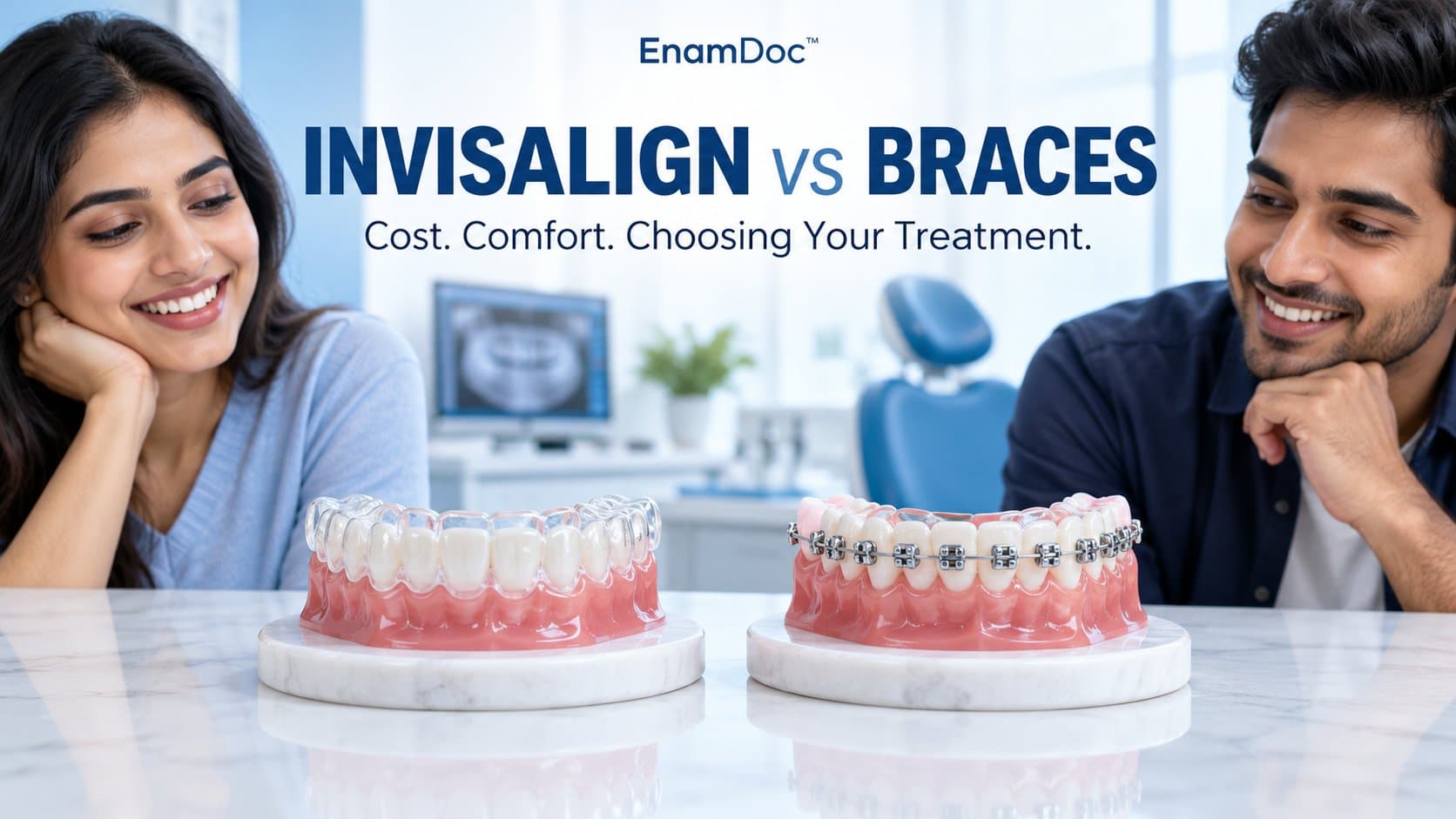
You have decided your teeth need straightening. Your orthodontist presents two options: traditional metal braces or Invisalign clear aligners. Both can give you a straighter smile — but they do it differently, cost differently, and suit different patients. Here is what you actually need to know before making this decision.
How Each Treatment Works
Traditional Metal Braces
Metal brackets are bonded to each tooth and connected by a wire. Your orthodontist tightens the wire at regular intervals — usually every 4 to 6 weeks — to gradually move teeth into their correct positions. You cannot remove them for eating or cleaning. Treatment typically takes 18 months to 3 years depending on the complexity of the case.
Invisalign Clear Aligners
Invisalign uses a series of custom-moulded, transparent plastic trays that you swap out every one to two weeks. Each tray shifts your teeth a fraction of a millimetre in a pre-programmed direction. You remove them to eat and brush. Treatment time ranges from 6 months for mild cases to 18–24 months for more complex ones. In India, Invisalign uses the same international system but is prescribed and monitored by a trained orthodontist.
What Can Each Treatment Fix?
This is the most important factor in your decision. Braces can correct virtually any orthodontic problem — crowding, gaps, crossbites, underbites, deep overbites, and severely rotated teeth. Invisalign works well for mild to moderate crowding and spacing, but has limitations with complex bite problems and severely rotated teeth. Ask your orthodontist specifically whether your case is within Invisalign's clinical range.
Cost Comparison in India
Cost is often the deciding factor for Indian patients:
- Metal braces: ₹25,000 – ₹80,000 depending on the city and clinic
- Ceramic (tooth-coloured) braces: ₹40,000 – ₹1,00,000
- Invisalign Lite (mild cases): ₹80,000 – ₹1,50,000
- Invisalign standard: ₹1,50,000 – ₹3,50,000
Invisalign costs roughly three to five times more than metal braces in India. This reflects the cost of the proprietary aligner trays and the digital planning technology. Budget for retainers after treatment as well — both systems require long-term retainer use to keep results stable.
Comfort and Daily Life
Braces cause soreness after each tightening appointment, and the brackets can irritate the cheeks and lips — especially during the first few weeks. Food restrictions are real: you must avoid hard, sticky, and crunchy foods. Cleaning around brackets is time-consuming.
Invisalign trays are smoother and cause less irritation, though pressure and mild soreness occur with each new tray. The key discipline required is wearing them 20–22 hours per day. Patients who remove them too often get slower results or treatment failures. Invisalign requires more patient commitment than braces, not less.
Appearance
Invisalign is nearly invisible, which is why adults often prefer it. Metal braces are clearly visible. Ceramic braces are tooth-coloured and less obvious, though the wire may still show. If appearance is your main concern, Invisalign or ceramic braces are the more discreet choice — but only if your case is clinically appropriate for them.
Treatment Duration
For comparable cases, treatment times are similar. Mild Invisalign cases can be completed faster than braces, while complex cases may take equally long or longer. There is no universal answer — ask your orthodontist for a realistic estimate based on your specific situation.
Which Should You Choose?
Here is a simple way to think through the decision:
- Choose braces if your case is complex, your budget is limited, or you know you will not wear aligners consistently
- Choose Invisalign if your case is mild to moderate, you can manage the higher cost, and your lifestyle benefits from a less visible option
- Get a clinical opinion first — your suitability for Invisalign depends on your specific bite and crowding, not on what you prefer aesthetically
EnamDoc can help you find verified orthodontists in your city who offer both options and can give you an honest case assessment before you commit.
Conclusion
Both metal braces and Invisalign can deliver excellent results — when they are the right tool for the job. Invisalign is not a premium upgrade that always performs better; it is a different system that works well for the right cases. Let your orthodontic complexity, your lifestyle, and your realistic budget drive the decision — not the marketing around either option.
Frequently asked
Frequently asked questions
Is Invisalign more expensive than braces in India?
Yes, significantly. Metal braces in India typically cost ₹25,000–₹80,000, while Invisalign ranges from ₹1,50,000 to ₹3,50,000 for standard cases. The price difference reflects the proprietary aligner trays and digital treatment planning technology. If cost is a primary concern, ceramic braces offer a middle ground — they are tooth-coloured and more discreet than metal, at ₹40,000–₹1,00,000.
Can all orthodontic problems be fixed with Invisalign?
No. Invisalign works well for mild to moderate crowding, spacing, and some bite issues — but it has limitations for complex cases. Severely rotated teeth, large overbites, underbites, and skeletal discrepancies often require braces or a combination of Invisalign with additional attachments or even jaw surgery. Your orthodontist will assess your specific case and advise whether Invisalign is clinically appropriate for you.
- invisalign
- braces
- orthodontics
- teeth straightening
- india
Keep reading