MDS After Internship: How to Build Your PG Entrance Strategy During Final Year BDS
Final year BDS is both exciting and overwhelming. Dr. Aditya Swami breaks down exactly how to build a focused, sustainable MDS entrance strategy while completing your internship — without burning out.
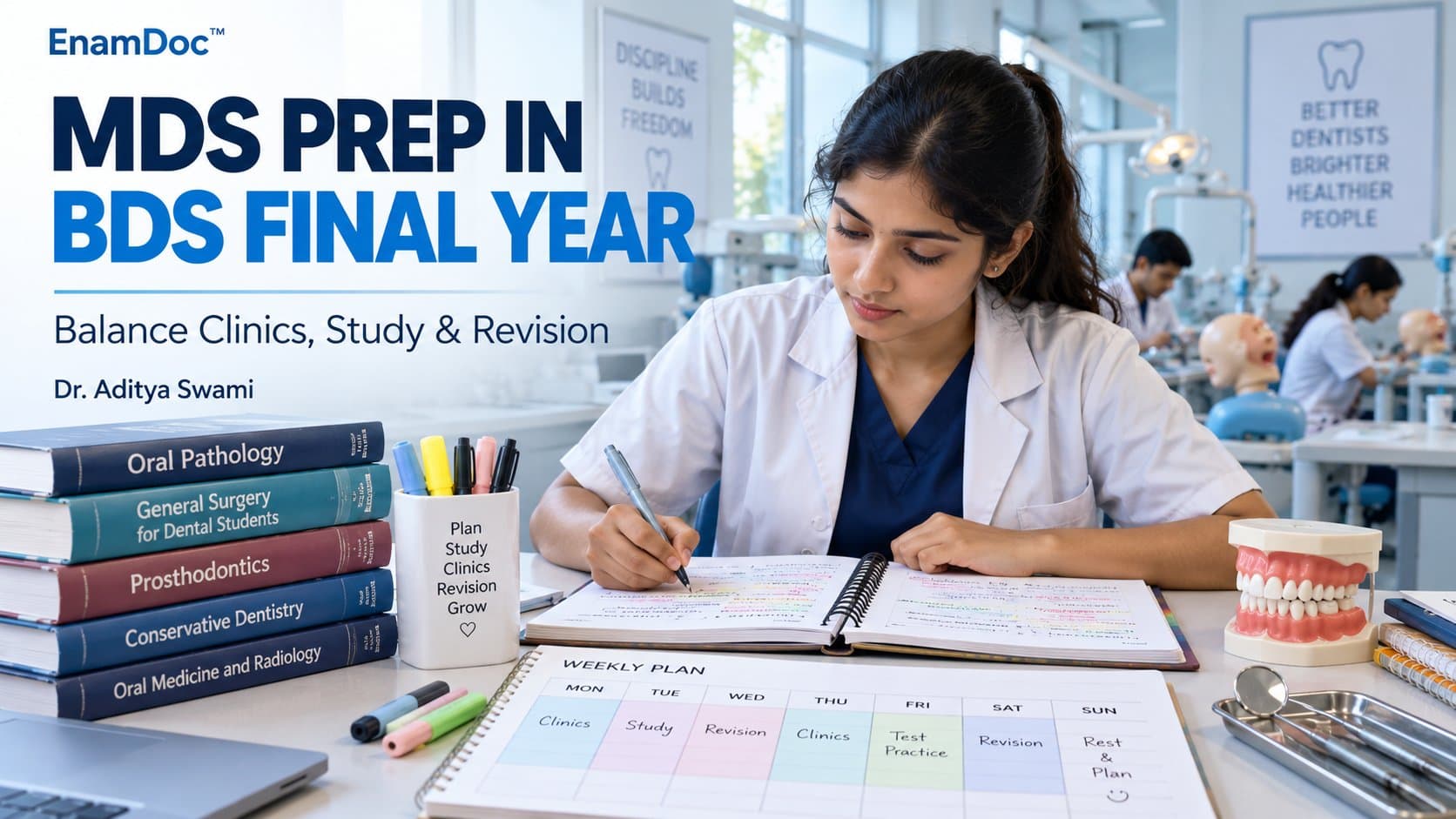
The moment you receive your final year BDS schedule, a quiet alarm goes off in the back of your mind — MDS. When do I start preparing? The answer, backed by the experience of thousands of successful PG aspirants, is almost always: earlier than you think. Final year BDS is the most demanding phase of your undergraduate journey, but it is also your best window to build the strategic foundation that carries you through NEET MDS.
This guide lays out a realistic, structured approach to preparing for PG entrance exams during your final year and internship, without sacrificing your clinical performance.
Why Final Year Is the Right Time to Start
Many BDS students make the mistake of waiting until internship to begin serious MDS preparation. By then, you are rotating through departments, attending duty hours, and adjusting to a new rhythm. Beginning your prep even in a limited capacity during final year gives you two key advantages: familiarity with the NEET MDS pattern before the real grind begins, and subject retention that overlaps with what you are studying for university exams.
NEET MDS tests 19 dental subjects. The subjects in your final year — Conservative Dentistry, Prosthodontics, Orthodontics, Oral Medicine, and Oral Surgery — account for a significant portion of the exam. Studying for both purposes simultaneously is not just possible, it is the most efficient path forward.
Understanding the NEET MDS Pattern
NEET MDS is conducted by the National Board of Examinations (NBE). The exam consists of 240 multiple choice questions to be answered in 3 hours, covering all 19 subjects of the BDS curriculum. Questions test conceptual understanding, clinical decision-making, and subject-specific facts. The marking scheme awards one mark per correct answer, with a negative marking of 0.25 per wrong response.
The most heavily weighted subjects include Oral Pathology, Conservative Dentistry, Prosthodontics, Orthodontics, Oral Surgery, Periodontics, and Oral Medicine. Understanding the subject-wise weightage helps you allocate preparation time proportionally rather than distributing energy equally across all 19 subjects.
Building Your Subject-Wise Strategy
Divide your subjects into three priority tiers:
Tier 1 — High yield, review regularly
Oral Pathology, Oral Medicine and Radiology, Conservative Dentistry, Prosthodontics, Orthodontics. These subjects carry the most questions and have the most stable question patterns year on year. Start here and return to them frequently.
Tier 2 — Solid coverage needed
Periodontics, Oral Surgery, Paediatric Dentistry, Dental Anatomy, General Anatomy. These subjects reward consistent practice and conceptual clarity. Do not leave any topic entirely unprepared.
Tier 3 — Focused revision only
Dental Materials, General Pathology, Microbiology, Public Health Dentistry, Pharmacology, Physiology, Biochemistry. Targeted high-yield revision for these subjects is more efficient than attempting comprehensive coverage under time pressure.
Balancing Internship Duties With Exam Preparation
Internship rotations are non-negotiable — your attendance and clinical exposure matter for both your certificate and your actual readiness to practise. The key is protecting study time without fighting your department schedule.
A practical approach that works for most aspirants: study in two blocks daily. A short morning block of 1–1.5 hours before duty, and an evening block of 2–3 hours after returning. Weekends are your extended revision window. This adds up to roughly 15–20 focused hours per week — more than enough to work through the syllabus methodically across 12 months.
Avoid the common error of long study sessions followed by crash rest. Consistent daily engagement, even in small blocks, produces better long-term retention than marathon studying. This is especially true for the factual, detail-heavy content that NEET MDS tests.
Choosing the Right Speciality Before the Exam
Many students delay this decision, but your target speciality influences how you prepare. If you are drawn to Endodontics, for example, you will approach Conservative Dentistry questions differently than someone aiming for Orthodontics. A rough idea of your target branch — even if it shifts later — helps you prioritise clinical experiences during internship that reinforce your preparation.
Consider three factors when evaluating specialities: your clinical aptitude and interest, the current seat availability and competition in your target colleges, and the career potential in the practice environment you envision. Talking to practising MDS specialists in your city is one of the best investments of time you can make during internship.
Coaching Classes Versus Self-Study
Both paths produce successful PG dentists. Coaching institutes offer structured schedules, MCQ practice banks, and peer accountability — valuable if you need external structure. Self-study with quality books (Ash, Shafer, Carranza, Proffit, Shobha Tandon for Public Health) supplemented by subject-specific question banks works equally well if you have strong self-discipline.
A hybrid approach suits many final year students: attend online coaching sessions for Tier 1 subjects to get structured input, and self-study Tier 2 and Tier 3 subjects independently. This keeps costs manageable while maintaining access to good exam-pattern material.
Tracking Clinical Hours and Cases During Internship
Your internship case log is not just a procedural requirement — it is also study material. Each procedure you complete, each case you assist on, and each patient history you record reinforces the clinical reasoning that NEET MDS increasingly tests. Some dental platforms, like EnamDoc, are designed to help clinics manage patient records and appointments efficiently, which can reduce the administrative burden on you during internship rotations and leave more mental energy for preparation.
Maintain a personal case log even beyond your official records. Noting the presenting complaint, diagnosis, treatment plan, and outcome for each case you handle creates a personal reference bank that pays dividends during clinical scenario-based MCQ revision.
Three Months Before the Exam: What to Focus On
The final quarter before NEET MDS is for consolidation, not new learning. Shift your focus to: full-length mock tests under timed conditions (aim for one per week), rapid revision of your own notes for Tier 1 subjects, targeted drilling of your weak areas identified through mock performance, and reviewing previous years' NEET MDS question papers from at least the past five years.
Manage the mental load actively during this phase. Sleep, physical activity, and social connection are not distractions from preparation — they are prerequisites for the memory consolidation and performance under pressure that the exam demands.
Setting Realistic Targets
NEET MDS counselling opens seat selection across all-India and state quota seats. Research the cutoff scores for your target speciality and college from recent years. Setting a score target, rather than just a rank target, gives you a concrete benchmark to calibrate your mock test performance against.
Be honest about your starting point. If you are beginning during final year with no prior MCQ preparation, your first few months will feel slow. That is normal. The students who succeed are not necessarily the most naturally gifted — they are the ones who sustain consistent effort across twelve to eighteen months without losing direction.
Final year BDS is demanding. Internship will be demanding. PG preparation adds another layer. But this phase is also where career trajectories diverge, and the students who approach it with a clear strategy consistently outperform those who rely on aptitude alone. Start early, build systems, and stay the course.
Frequently asked
Frequently asked questions
When should I start preparing for NEET MDS during BDS?
The ideal time to start is during your final year BDS, when your curriculum overlaps significantly with the NEET MDS syllabus. Even 1–2 hours of daily MCQ practice during final year, alongside your university exam preparation, builds a strong foundation before the more intensive internship prep phase begins.
Is coaching necessary for NEET MDS, or can I self-study?
Both approaches work. Coaching provides structure, scheduled tests, and peer motivation, which many students find valuable during internship. Self-study with standard textbooks and question banks works equally well for disciplined students. A hybrid approach — online coaching for high-yield subjects combined with independent study for others — is a practical middle ground that keeps costs reasonable while maintaining access to good exam-pattern material.
How many hours should I study daily during BDS internship for MDS prep?
Most successful NEET MDS aspirants study 3–4 hours per day during internship, split across a morning block before duty and an evening block after returning. This adds up to 20–25 focused hours per week. Quality matters more than quantity — consistent daily study with active recall and MCQ practice outperforms sporadic marathon sessions. Protecting this time by planning your rotation schedule in advance makes a significant difference.
- MDS entrance
- PG dentistry
- NEET MDS
- BDS internship
- dental postgraduate
- exam preparation
Keep reading