Mouth Breathing: How Breathing Through Your Mouth Is Silently Damaging Your Teeth
Most people don't realise they're mouth breathers — let alone that it's quietly harming their teeth and gums. Dr. Aditya Swami explains how breathing through your mouth affects your oral health, and what to do about it.
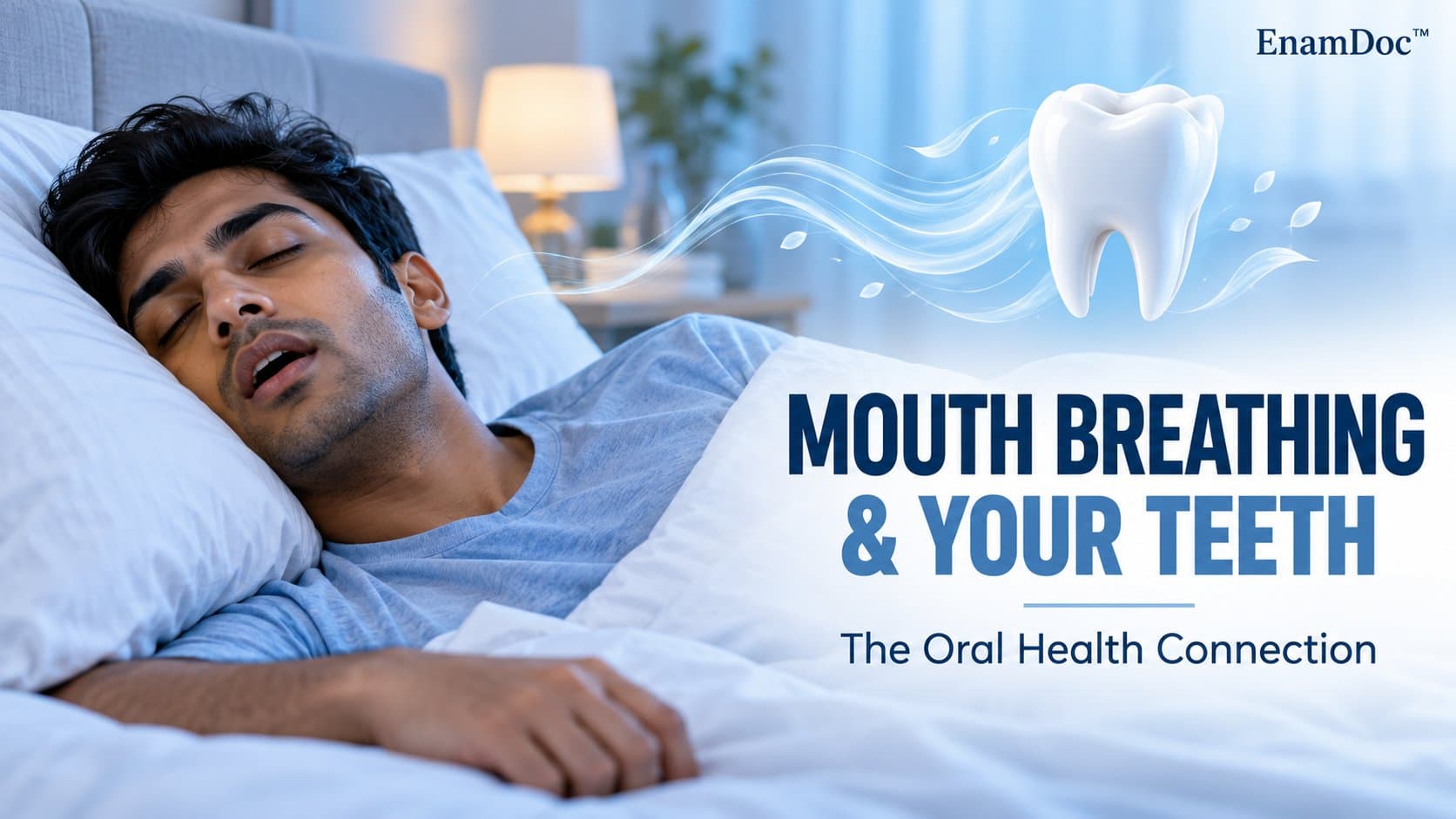
Breathing is so automatic that most people never think about how they do it. But whether you breathe through your nose or your mouth has a surprisingly significant effect on your oral health — and for a large number of people, mouth breathing is happening all day, or throughout the night, without them even realising it.
Dr. Aditya Swami, periodontist, explains what mouth breathing actually does to your teeth and gums, why children are particularly vulnerable, and what you should do if you or someone in your family is a mouth breather.
What Is Mouth Breathing?
Mouth breathing simply means breathing primarily through the mouth rather than the nose. While occasional mouth breathing — during exercise, or when your nose is blocked by a cold — is normal and harmless, chronic mouth breathing is a different matter.
Chronic mouth breathers are people who habitually keep their mouths open and breathe through them during the day, during sleep, or both. It is more common than most people realise. Causes include nasal obstruction (due to allergies, a deviated nasal septum, or enlarged adenoids or tonsils), nasal polyps, and in some cases, simply a learned habit.
The Role of Saliva — and Why Mouth Breathing Undermines It
To understand why mouth breathing damages teeth, you first need to understand what saliva does. Saliva is your mouth's first line of defence against tooth decay. It does several things simultaneously:
- Washes away food debris and bacteria from tooth surfaces
- Neutralises the acids produced by bacteria after you eat
- Contains antibacterial proteins that directly inhibit the bacteria responsible for decay and gum disease
- Keeps the oral tissues moist and comfortable
When you breathe through your mouth, the constant airflow dries the oral cavity. Salivary flow does not stop entirely, but its effectiveness is dramatically reduced as saliva evaporates faster than it is produced. The result is a persistently dry oral environment — exactly the conditions in which the harmful bacteria responsible for tooth decay and gum disease thrive.
Increased Risk of Tooth Decay
A dry mouth is a cavity-prone mouth. When saliva cannot adequately buffer the acids produced by oral bacteria, and cannot wash away food particles efficiently, the conditions for dental caries become favourable.
People who are chronic mouth breathers — particularly during sleep, when salivary flow is already at its lowest — often develop a characteristic pattern of decay. Tooth surfaces that should be protected by pooling saliva are left exposed and vulnerable for hours at a time. This is why some patients are surprised to find multiple new cavities despite brushing regularly; the problem is not technique but rather the oral environment.
Gum Disease and Gingival Inflammation
The gums (gingiva) are particularly sensitive to dryness. In mouth breathers, the gums at the front of the mouth — the ones most directly exposed to the airflow — often become red, swollen, and inflamed, even in the absence of significant plaque buildup.
This pattern, sometimes called "mouth breathing gingivitis," can confuse both patients and dentists if the underlying cause is not identified. A patient may have perfectly adequate oral hygiene habits yet still present with inflamed anterior gums. The inflammation is driven not by poor brushing but by chronic dryness, which reduces the local immune response and allows bacteria to establish themselves more easily.
Left unaddressed, this low-grade gingival inflammation can progress over time and contribute to more serious periodontal disease.
Bad Breath
Persistent bad breath (halitosis) is one of the most common and socially noticeable consequences of chronic mouth breathing. Dry mouth conditions favour the anaerobic bacteria responsible for producing the sulphur compounds that cause bad breath. Patients who brush and floss diligently but still struggle with halitosis are often mouth breathers — and the problem will not resolve until the dryness is addressed.
The Impact on Children: Jaw Development and Bite Problems
In children, chronic mouth breathing carries risks beyond those seen in adults. The developing facial skeleton is highly responsive to the forces acting on it — including the position of the tongue, the lips, and the pattern of breathing.
When a child breathes habitually through the mouth, the tongue rests on the floor of the mouth rather than against the palate. The palate, without the tongue's natural upward pressure, tends to become narrow and high-arched. The lower jaw may be positioned differently. Over time, these changes can lead to malocclusion — crowded teeth, open bites, and crossbites — that may require orthodontic treatment.
The facial changes associated with long-term childhood mouth breathing are sometimes referred to clinically as "adenoid facies" — a characteristic appearance including a long, narrow face, open lips, and a flattened midface. Identifying and treating mouth breathing early in childhood can meaningfully reduce the extent of these changes.
How Your Dentist Can Spot Mouth Breathing
A dentist or periodontist looking carefully will often see signs of mouth breathing before a patient raises it as a concern:
- Redness and swelling of the anterior gums, particularly the upper front teeth
- Dryness of the anterior oral tissues
- A high, narrow palatal arch (especially in children)
- A characteristic pattern of decay on exposed tooth surfaces
- Chapped or habitually parted lips
If your dentist notices these signs, they are likely to ask about your breathing habits during sleep and at rest. Do not be surprised by this question — it is clinically relevant.
What To Do About Mouth Breathing
If you suspect you or your child is a chronic mouth breather, the starting point is identifying the cause.
Nasal obstruction is the most common underlying reason, and an ENT (ear, nose and throat) specialist can assess whether allergies, a deviated septum, enlarged adenoids, or nasal polyps are contributing. Treating the underlying obstruction often resolves the mouth breathing itself.
For children, early intervention is particularly important. An orthodontist can assess whether palatal expansion or other appliances are needed. Myofunctional therapy — exercises that retrain the tongue, lips, and facial muscles — is increasingly used to support nasal breathing and correct oral rest posture.
For adults, addressing any nasal obstruction, managing allergies, and in some cases using a nasal dilator at night can make a significant difference. Your dentist can also recommend prescription-strength fluoride to reduce cavity risk if your oral environment is persistently dry.
The key point is that mouth breathing is treatable — but only once it is recognised. If you notice that you frequently wake with a dry mouth, have persistent gum sensitivity despite good oral hygiene, or your dentist keeps finding new cavities, it is worth bringing up breathing habits in your next appointment.
Frequently asked
Frequently asked questions
Can mouth breathing damage my teeth?
Yes. Mouth breathing dries out the oral cavity, reducing the protective effect of saliva. Without adequate saliva, bacteria multiply more easily, acid is not neutralised between meals, and the risk of tooth decay and gum disease increases significantly. In children, persistent mouth breathing can also affect jaw development and the alignment of teeth over time.
How do I stop mouth breathing at night?
The first step is identifying the cause. Mouth breathing during sleep is often linked to nasal obstruction — from allergies, a deviated nasal septum, or enlarged adenoids — and may need an ENT consultation. Your dentist or orthodontist may also recommend myofunctional therapy (exercises that retrain the tongue and facial muscles to support nasal breathing), or an oral appliance. If sleep apnoea is suspected, a sleep study may be recommended.
- mouth breathing dental effects
- mouth breathing teeth
- mouth breathing dry mouth
- open mouth breathing dentist
- mouth breathing treatment
Keep reading