Orthodontic Retainers: Why You Must Wear Them After Braces or Invisalign
The day your braces come off or your Invisalign completes is exciting — but the treatment is not finished. Dr. Aditya Swami explains why retainers are the most important stage of orthodontic treatment and exactly what happens when patients skip them.
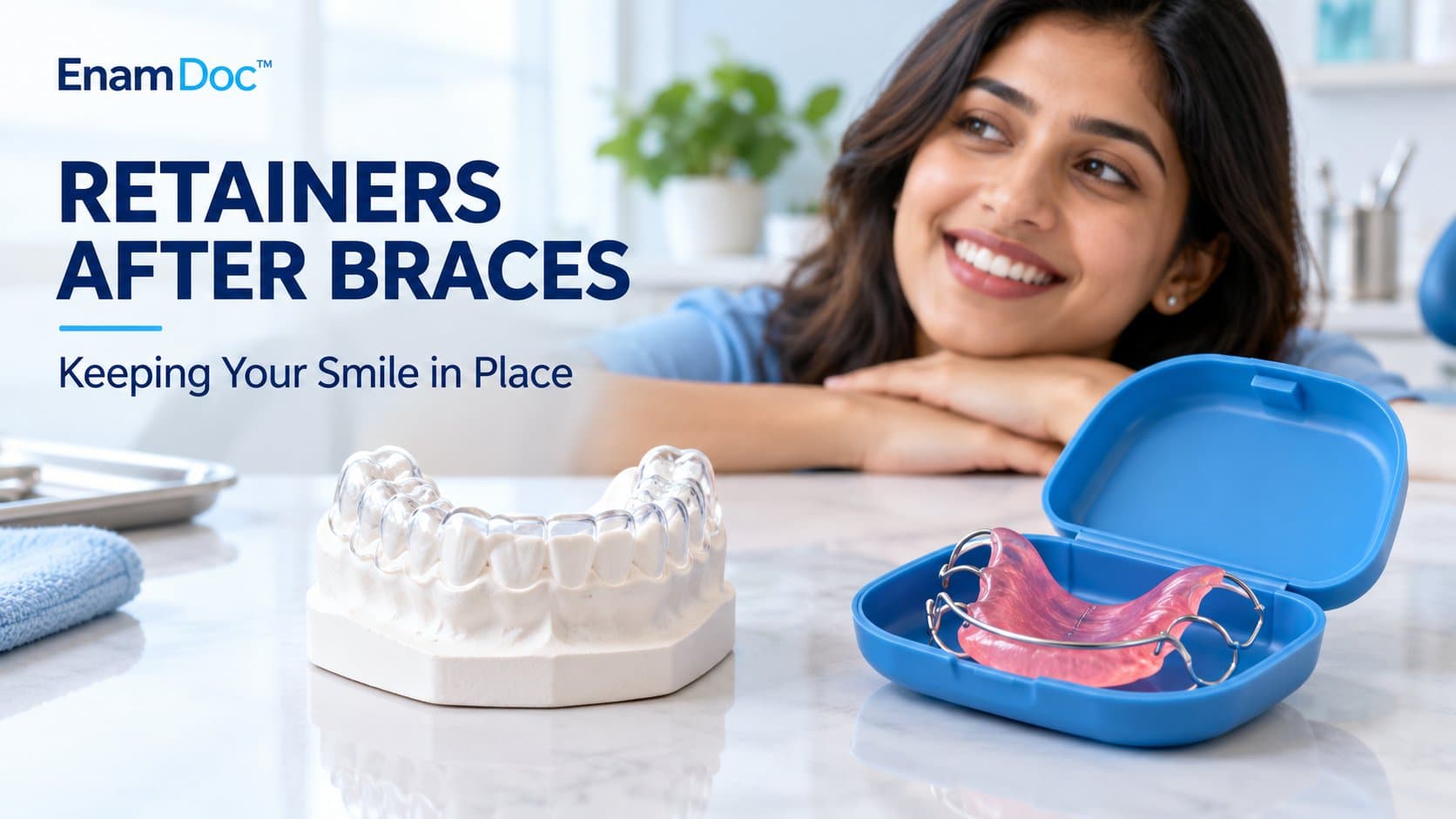
The day your orthodontist removes your braces or hands you your final Invisalign tray is a genuinely exciting moment. Two years of wires, tightening appointments, and careful eating habits — and finally, you have the smile you worked for.
Then your orthodontist hands you a retainer and tells you to wear it every night — possibly forever.
Many patients nod, take the retainer home, and quietly stop wearing it after a few weeks. A year later, they come back to find their teeth have shifted noticeably. The relapse is real, it is common, and it is entirely preventable.
Here is why retainers matter more than most orthodontic patients realise.
Why Teeth Want to Move Back
Teeth are not fixed structures. They sit in sockets of alveolar bone and are held in position by periodontal ligaments — flexible fibres that connect each tooth root to the surrounding bone. When braces or aligners move teeth, they change the orientation of those ligaments. After treatment ends, those ligaments have a memory — they exert tension on the teeth, trying to pull them back toward where they were.
This force is greatest in the first few months after treatment but never fully stops. The natural tendency for teeth to drift is a lifelong reality, not just a post-treatment phase. This is why orthodontists prescribe retainers for long-term use, not just short-term "settling."
Beyond ligament tension, other forces continue acting on teeth throughout life: the tongue pressing from the inside, the lips pressing from the outside, chewing forces, and the slow forward drift of teeth that happens naturally with age. Without a retainer, these forces gradually undo the alignment you worked hard to achieve.
Types of Retainers
Your orthodontist will recommend one of two main types, or sometimes a combination of both.
Removable retainers: These are retainers you take in and out yourself. The two main designs are the Hawley retainer (a traditional acrylic plate with a wire across the front teeth) and the clear Essix retainer (a transparent plastic tray, similar in appearance to an Invisalign tray). Essix retainers are more popular today because they are discreet and comfortable. They require you to remember to wear them consistently.
Fixed (bonded) retainers: A thin wire, usually stainless steel, bonded to the inner surface of your front teeth with composite resin. You cannot feel it with your tongue after a short adjustment period, and it requires no active effort to maintain compliance because you cannot remove it. The limitation is that it requires careful flossing around the wire and must be maintained professionally. The wire can break or debond — when this happens, prompt repair is important to prevent shifting.
Many orthodontists now recommend a fixed retainer for the lower front teeth (which are most prone to shifting) combined with a removable retainer for the upper arch, worn nightly.
How Long Do You Need to Wear a Retainer?
The honest answer is: for the rest of your life, in some form.
In the first six to twelve months after treatment, most orthodontists recommend full-time wear of a removable retainer (every night, ideally some daytime hours too). After that, nightly wear is the standard recommendation.
The logic behind indefinite retainer use is straightforward: the forces causing teeth to drift do not stop at any point in your life. A patient who wore retainers every night for five years and then stopped will still see gradual movement over the following decade.
This is not a failure of treatment. It is the same reason you need to maintain muscle with regular exercise — the underlying biological system needs ongoing input to maintain its result.
What Happens If You Skip the Retainer?
The most common consequence of inconsistent retainer wear is lower front tooth crowding — the teeth behind your bottom front teeth are among the most relapse-prone in the mouth and will begin to crowd again. Upper front teeth can also space or crowd depending on what they were doing before treatment.
The speed of relapse varies between patients based on the severity of the original problem, the length of treatment, and individual biology. Some patients notice significant movement within weeks of stopping. Others see gradual change over months. Nobody is entirely immune.
Once relapse occurs, the only options are to restart orthodontic treatment or to accept the result. Retreatment is more costly, more time-consuming, and more frustrating than simply wearing the retainer.
Retainer Care
For removable Essix or Hawley retainers: clean with a soft toothbrush and mild soap or retainer-cleaning tablets. Do not use toothpaste, which is mildly abrasive and can scratch clear plastic. Store in the case provided to prevent breakage. Keep away from heat — never leave a plastic retainer in a hot car or near a stove.
For fixed bonded retainers: use a floss threader or interdental brush to clean around the wire daily. Have the bond checked at your regular dental visits. If the wire breaks or lifts off a tooth, contact your dentist promptly.
Lost or Broken Retainer?
This is the situation that trips up the most patients. A retainer breaks or goes missing, the patient delays replacing it, and by the time they return to the orthodontist, there has been noticeable movement.
If your retainer breaks or is lost, contact your orthodontist as soon as possible — within a few days ideally. Do not wait weeks or months. Replacement retainers are straightforward and cost far less than retreatment.
EnamDoc and Orthodontic Follow-Up
Keeping track of retainer review appointments and flagging retainer issues early is part of long-term orthodontic care. Clinics using EnamDoc's appointment management system can send automated follow-up reminders to orthodontic patients, reducing the gap between when a problem occurs and when it gets treated.
Frequently asked
Frequently asked questions
My retainer feels tight after not wearing it for a few weeks. Can I force it back on?
A retainer that feels tight or does not seat fully after missing wear is a sign that some movement has occurred. Do not force it — this can crack the retainer or stress the teeth. See your orthodontist to assess how much movement has happened. They may need to take a new impression and make a corrective aligner or retainer before resuming normal retention.
How much does a retainer cost if I need a replacement in India?
A new Essix (clear) retainer typically costs ₹1,500 to ₹4,000 per arch at most orthodontic clinics in India, depending on the city and clinic. A Hawley retainer is in a similar range. This is significantly less than the cost of re-treatment if relapse progresses.
I had braces as a teenager and my teeth shifted. Is it too late for a retainer to help?
A retainer maintains position — it does not move teeth that have already shifted. If your teeth have already moved, retreatment (new braces or clear aligners) would be needed to re-align them. After that, consistent retainer use can prevent a second relapse.
- orthodontic retainer
- braces aftercare
- Invisalign aftercare
- teeth retention
- retainer types India
Keep reading