Snoring and Sleep Apnea: How a Dental Mouth Guard Could Replace Your CPAP
If you have been told you have mild or moderate sleep apnea, a dentist-fitted oral appliance may be an effective alternative to a CPAP machine. Here is what the device actually does, who qualifies, and what to expect in India.
Medically reviewed by Dr. Aditya Swami, BDS
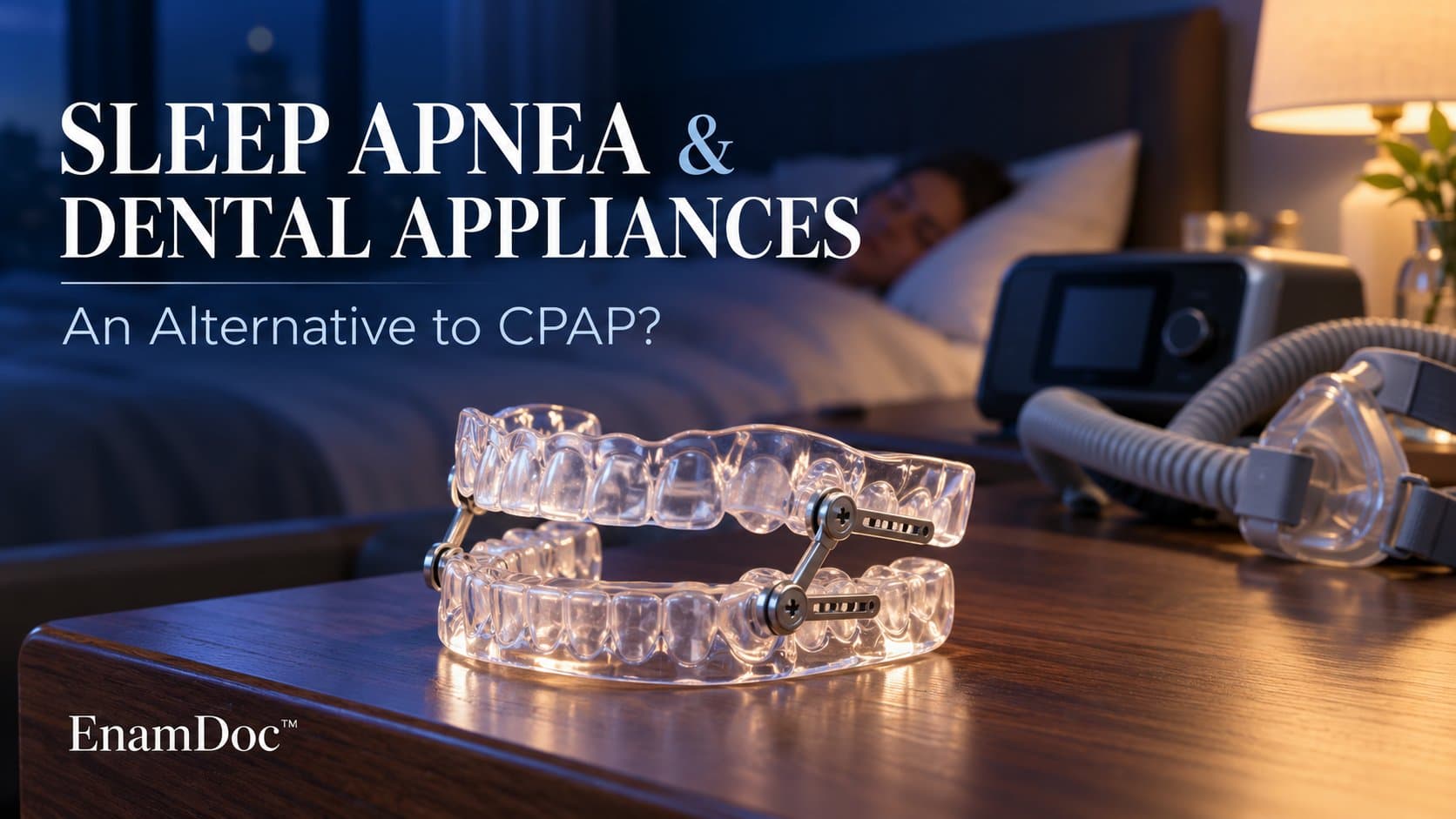
Most people who snore — and many who have been told they have sleep apnea — assume the CPAP machine is the only medical option available to them. It's effective, but it's also uncomfortable, noisy, and dependent on a power supply. What fewer people know is that for mild to moderate obstructive sleep apnea, a dentist-fitted oral appliance can be equally effective for many patients and is far easier to use consistently.
What Is Obstructive Sleep Apnea?
Obstructive sleep apnea (OSA) occurs when the soft tissues at the back of the throat collapse during sleep, partially or completely blocking the airway. The result is a cycle of reduced or stopped breathing — sometimes hundreds of times a night — followed by brief arousals as the body forces an airway open. Most people have no memory of these events, but they prevent deep, restorative sleep and cause the characteristic daytime fatigue, morning headaches, and difficulty concentrating that bring patients to a doctor.
Snoring is caused by the same tissue vibrating as air passes through a narrowed airway. Not everyone who snores has sleep apnea, but most people with sleep apnea snore.
OSA is classified by severity — mild, moderate, or severe — based on how many breathing interruptions occur per hour (the apnea-hypopnea index, or AHI). A sleep study (polysomnography) is the standard diagnostic tool.
How Dental Oral Appliances Work
The most common type of oral appliance for sleep apnea is a mandibular advancement device (MAD) — a custom-fitted mouthguard that holds the lower jaw slightly forward during sleep. By advancing the jaw, the device opens the airway at the back of the throat and prevents the soft tissue collapse that causes apnea and snoring.
A custom-fitted MAD is made from impressions of your teeth, adjusted over several follow-up appointments to find the most effective position, and worn only during sleep. It looks broadly similar to a sports mouthguard but fits both upper and lower arches and includes a mechanism to advance the jaw in calibrated increments.
A second type, the tongue-retaining device, uses suction to hold the tongue forward instead of advancing the jaw, and is used in patients who cannot use MADs due to dental conditions or jaw problems.
Who Is a Candidate for a Dental Sleep Appliance?
Dental oral appliances are currently recommended as a first-line treatment for mild to moderate obstructive sleep apnea and as an alternative to CPAP for patients who cannot tolerate it — including those with severe OSA who refuse or cannot use CPAP consistently.
Good candidates are generally people who:
- Have a confirmed diagnosis of mild or moderate OSA (AHI below 30)
- Have sufficient natural teeth to retain the device
- Do not have significant temporomandibular joint (TMJ) problems that would make jaw advancement uncomfortable
- Are committed to follow-up appointments for device adjustment
People with severe OSA should have a thorough discussion with a sleep physician before opting for an oral appliance alone. The device can still be used in severe OSA when CPAP is not tolerated, but monitoring outcomes is especially important.
How Effective Are They?
For mild to moderate OSA, custom-fitted MADs reduce the AHI by roughly 50% on average, and a substantial proportion of patients achieve full normalisation of their AHI. They are generally less effective than CPAP at reducing AHI in absolute terms, but because patients use them more consistently, real-world outcomes are often comparable.
Snoring reduction is consistently very good — most patients and their partners report significant improvement. The key word is "custom-fitted" — over-the-counter boil-and-bite devices purchased online or at pharmacies have substantially weaker evidence and should not be considered equivalent.
The Process: What to Expect
If your sleep physician or ENT specialist believes you are a candidate for an oral appliance, they will usually refer you to a dentist experienced in sleep medicine. The process typically involves:
- A dental examination to assess your teeth, gums, and TMJ
- Impressions or a digital scan of your teeth
- Fabrication of the custom device (usually 2–3 weeks)
- A fitting appointment and instructions for use
- Follow-up appointments to adjust the jaw advancement setting incrementally
- A follow-up sleep study after titration to confirm the device is working
Cost in India
Custom-fitted mandibular advancement devices in India typically cost between ₹15,000 and ₹40,000, depending on the device brand, the clinic, and the city. This is a one-time cost, compared with the ongoing cost of CPAP consumables (masks, filters, tubing). The device typically needs replacement every 3–5 years or when there is significant tooth movement.
Insurance coverage for dental sleep appliances in India varies — some health policies cover them under durable medical equipment if prescribed by a sleep specialist; many do not. It is worth checking with your insurer before committing.
Side Effects and Limitations
Most side effects are mild and temporary, especially in the early adjustment period: increased salivation, jaw soreness, tooth tenderness, and dry mouth. These generally improve as the jaw adapts. A small number of patients experience more persistent jaw discomfort or TMJ symptoms, in which case the device advancement is reduced or the patient is assessed for underlying TMJ issues.
Long-term use of MADs can cause small changes in bite and tooth position over years. This is monitored at regular dental check-ups. The changes are usually minor, but patients should be aware that they are using a device that places sustained force on their teeth and jaw.
CPAP vs Oral Appliance: Choosing Between Them
The short answer is that CPAP is more effective at reducing AHI across all severity levels, but oral appliances are more comfortable and consequently used more consistently. For mild to moderate OSA, the real-world outcomes are often similar. The right choice depends on your AHI, your ability to tolerate each option, and your dentist and sleep physician's joint assessment.
Many patients try CPAP first and, finding it intolerable, switch to an oral appliance. This is a recognised and supported pathway — not a compromise, but an appropriate alternative treatment.
Finding a Dentist for Sleep Apnea in India
Not all dentists fit sleep appliances — look for a dentist with specific training in dental sleep medicine or one who works in collaboration with a sleep clinic. On EnamDoc, you can filter for dentists by specialty and book appointments directly — making it easier to find a clinic that offers this service in your city.
Frequently asked
Frequently asked questions
Do I need a sleep study before getting a dental sleep appliance?
Yes — a confirmed diagnosis from a sleep study is required before a dentist can fit an oral appliance for sleep apnea. The study determines severity, which decides whether an oral appliance is appropriate or whether CPAP should be the first-line treatment.
Is a dental sleep appliance covered by health insurance in India?
Coverage varies. Some health policies in India cover mandibular advancement devices under durable medical equipment if prescribed by a sleep specialist; many do not. Check with your insurer before committing to the device. Costs for a custom-fitted device typically range from ₹15,000 to ₹40,000, which is a one-time expense compared to the ongoing cost of CPAP consumables.
How long does it take for a dental sleep appliance to start working?
Most patients notice improvement in snoring and sleep quality within the first few nights, even before the device is fully titrated (adjusted to its optimal jaw advancement position). Full titration usually takes 4–8 weeks of gradual adjustment and follow-up appointments. A follow-up sleep study after titration confirms the device is working and establishes a baseline for ongoing monitoring.
- sleep apnea
- snoring
- dental mouth guard
- mandibular advancement device
- oral appliance
Keep reading