Water Flosser vs Traditional Floss: Which One Actually Cleans Better?
Your dentist says floss — but is a water flosser just as good? Dr. Aditya Swami compares water flossers and string floss on plaque removal, gum health, and convenience, so you can make the right choice for your teeth.
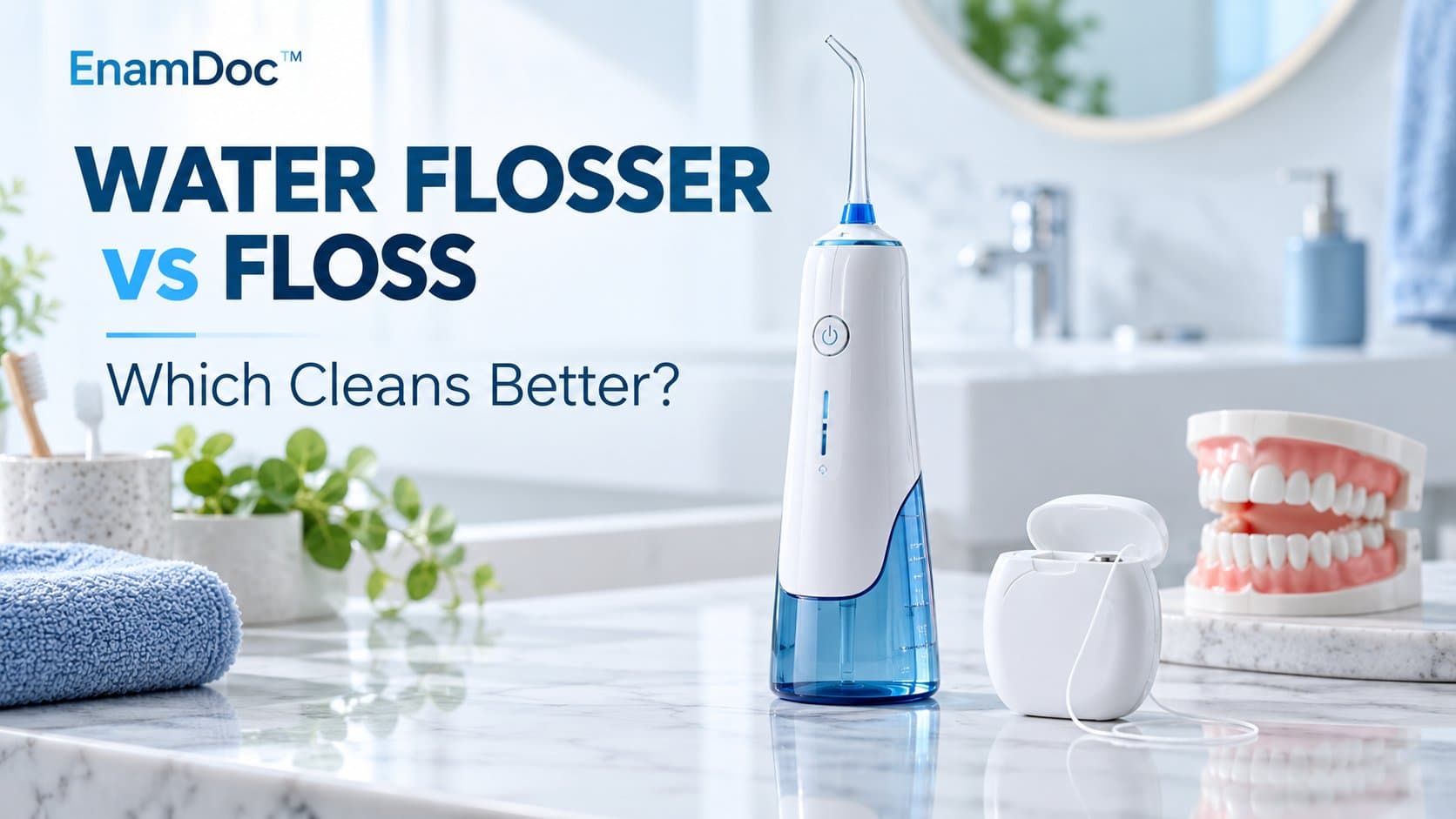
Your dentist tells you to floss every day — but these days, "flossing" might mean string floss, a water flosser, or an interdental brush. With so many options on the market, it is natural to wonder: is a water flosser actually as good as traditional floss, or is string floss still the gold standard?
As a periodontist, I see the consequences of inadequate interdental cleaning every day. Let me break down exactly what each method does, what the research says, and which might work best for you.
What Is a Water Flosser?
A water flosser (also called an oral irrigator) is a device that shoots a pressurised stream of water between your teeth and along the gumline. Popular brands include Waterpik, Oral-B, and Panasonic. They come in countertop and cordless varieties — cordless models are especially popular in India for smaller bathrooms and travel.
Most units let you adjust water pressure to your comfort level. Some models have tips designed for braces, implants, or periodontal pockets. You fill the reservoir with plain water, or sometimes a diluted antimicrobial rinse if your dentist recommends it.
What Is Traditional String Floss?
Traditional dental floss is a thin strand of nylon or PTFE that you slide between teeth in a c-shaped motion, scraping the tooth surface to remove plaque and debris. It reaches the tight interdental spaces and slightly below the gumline — areas your toothbrush cannot access.
Types include waxed, unwaxed, flat, round, and flavoured varieties. Floss picks and threaders are useful variations for people who struggle with wrapping floss around their fingers.
How Do They Compare on Plaque Removal?
This is the most important question, and the research is more nuanced than most people expect.
String floss has a mechanical advantage: it physically contacts the tooth surface and scrapes away the sticky biofilm (plaque) that adheres tightly to enamel. When used correctly — with a proper c-shape technique — floss is highly effective at removing interproximal plaque, especially close to and slightly below the gumline.
Water flossers are excellent at flushing food debris and disrupting loosely attached plaque. A 2014 study published in the Journal of Clinical Dentistry found that a water flosser was 29% more effective than string floss at reducing whole-mouth plaque. However, other research has noted that floss is superior at removing tightly adhered plaque directly from the tooth surface.
The bottom line: both methods remove plaque effectively, but through different mechanisms. Water flossers excel at flushing and disrupting loose debris; string floss excels at mechanically scraping the tooth surface.
Which Is Better for Gum Health?
Gum disease — gingivitis and periodontitis — is driven by plaque bacteria accumulating along the gumline. Whichever method better controls that plaque will better protect your gums.
Multiple clinical studies have shown that water flossers significantly reduce gingival bleeding, which is a key indicator of gum inflammation. A 2011 study in the Journal of Clinical Dentistry found that water flossers reduced bleeding by 93% compared to 53% with string floss after a four-week period.
This matters in practice. Many patients who switch to water flossers notice their gums bleed less during brushing and cleaning. Reduced bleeding means reduced inflammation — which is a meaningful clinical improvement.
For patients with gingivitis, deeper periodontal pockets, or a history of scaling and root planing, water flossers are particularly valuable. The pulsating stream can reach approximately 6mm below the gumline — deeper than string floss can reliably reach — and delivers the flushing action right where bacteria accumulate.
Ease of Use and Compliance
The best flossing method is the one you will actually use every single day. This is not a small consideration — compliance is arguably more important than which method is theoretically superior.
Patients who find traditional flossing difficult include those with:
- Braces or fixed retainers
- Dental bridges or implants
- Arthritis or limited hand dexterity
- A strong gag reflex
- Sensitivity to floss cutting into their fingers or gums
For these patients, a water flosser often turns a dreaded chore into a manageable part of their routine. Consistency over years has a far greater impact on oral health than theoretical superiority used inconsistently.
String floss remains inexpensive, portable, and requires no charging or refilling. It works anywhere and needs no electricity — a practical advantage for frequent travellers.
Special Considerations for Indian Patients
In India, where dal, rice, sabzi, and fibrous vegetables form the core of most diets, food impaction between teeth is a very common complaint. Water flossers are exceptionally good at clearing food particles from tight contacts and embrasures. They are also gentler on gums that are already inflamed or sensitive — a common finding in Indian adults who have not had regular professional dental cleanings.
Entry-level cordless water flossers are now widely available in India for approximately ₹1,500 to ₹3,000, while premium countertop models range from ₹4,000 to ₹8,000. Quality string floss typically costs ₹100 to ₹200 per pack. Both options are accessible, and the question is simply which one you will use consistently.
Can You Use Both?
Yes — and many periodontists, including myself, recommend a combined approach for patients with complex dental work or a history of gum disease. Using string floss first to mechanically disrupt the biofilm, then following with a water flosser to flush debris and rinse the gumline, gives you the benefits of both methods without significant additional time.
If you have a bridge, implant crown, or periodontal pockets deeper than 4mm, adding a water flosser to your existing flossing routine can make a meaningful difference in your long-term gum health.
The Final Verdict
If you currently do not floss at all, start with a water flosser. The compliance advantage is real, and using it consistently will produce better outcomes than using string floss once a week. If you already floss with string and your gums are healthy, continue — but consider adding a water flosser for additional benefit around bridges, implants, or if you notice persistent gum bleeding.
If you have braces, implants, bridgework, or a history of periodontal disease, a water flosser is not a luxury — it is an essential part of your home care.
Every mouth is different. Speak with your dentist or periodontist at your next visit about which combination is right for your oral anatomy, existing dental work, and health status. Personalised guidance will always serve you better than a general recommendation.
Frequently asked
Frequently asked questions
Is a water flosser better than traditional floss?
Neither is universally better — they work differently. Water flossers excel at flushing food debris and reducing gum bleeding, while string floss is more effective at mechanically scraping tightly adhered plaque from tooth surfaces. For most patients, the best tool is whichever one they will use consistently every day. Those with braces, bridges, or gum disease often benefit from combining both methods.
Can I use a water flosser if I have braces or dental implants?
Yes — water flossers are especially recommended for patients with braces, dental implants, bridges, and crowns. Traditional string floss is difficult to thread around orthodontic wires and implant abutments. A water flosser with an orthodontic or implant tip cleans these areas safely and effectively without risking damage to restorations or gum tissue.
How often should I floss, and does timing matter?
Dentists recommend flossing at least once a day. The timing matters less than the consistency. If you can only choose one time, flossing before bed is preferable because saliva flow decreases overnight, leaving teeth more vulnerable to plaque acids if debris remains between them. Whether you use string floss or a water flosser, daily use is what produces long-term results.
- waterflosserdentalflossoralhygieneflossingteethwaterflosserIndiainterdentalcleaning
Keep reading