Your First Clinical Posting in Dental College: What to Expect
Your first clinical posting in dental college is equal parts exciting and nerve-wracking. Here is an honest guide to what actually happens, what you will be asked to do, and how to make the most of your early clinical years.
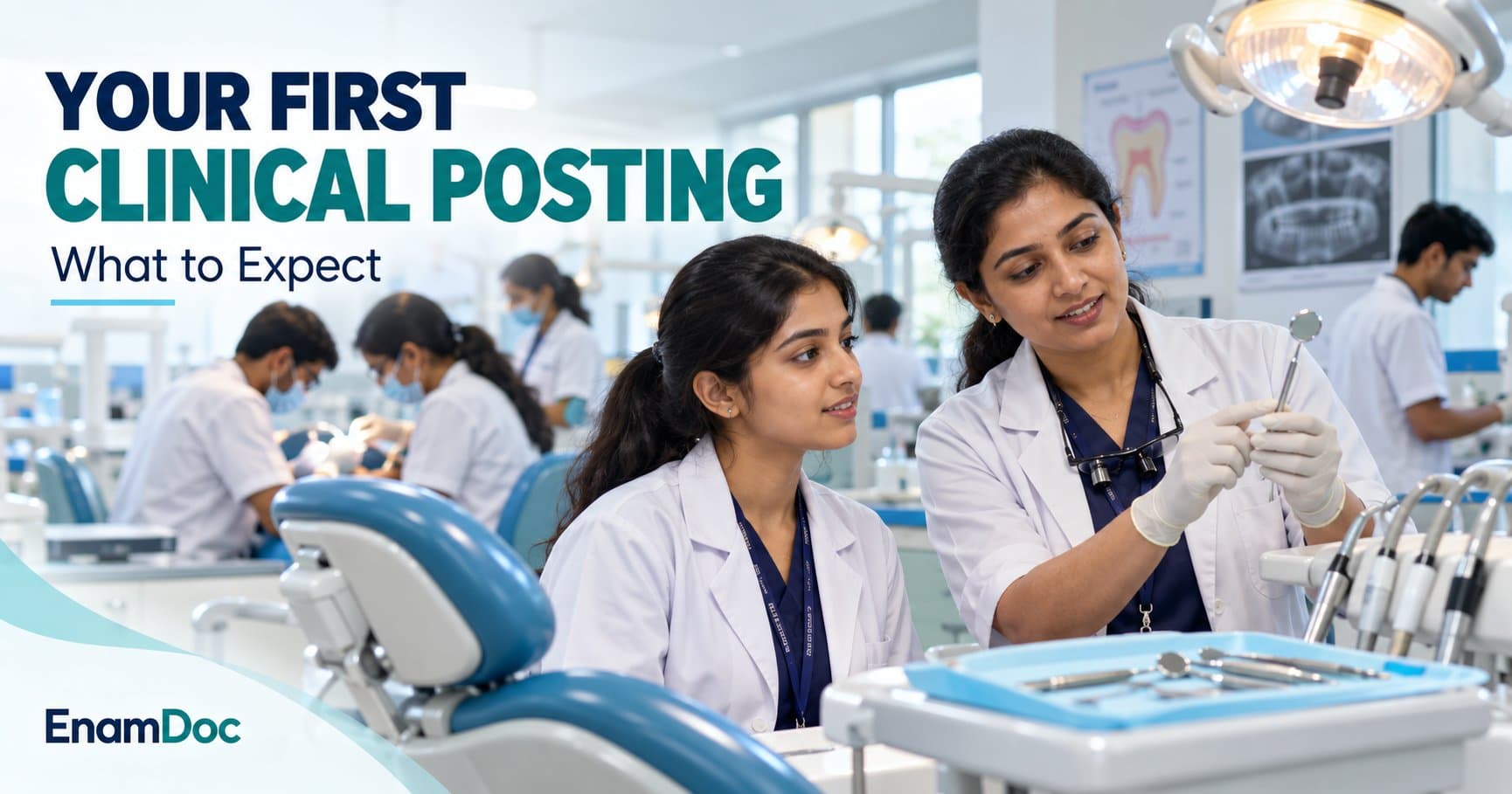
The Moment You Walk Into Clinic for the First Time
Most BDS students have a version of the same memory: the first day of clinical posting. The smell of the dental unit, the sound of the air turbine in the next cubicle, a patient looking up at you with varying degrees of trust. And you — in your freshly pressed white coat, armed with two years of pre-clinical theory and almost no idea what to do next.
Clinical posting is a landmark transition in dental education. It marks the shift from the phantom head to a real human being sitting in your dental chair. This guide is for students about to begin that journey, or those a few weeks in and trying to make sense of what they are experiencing.
What Clinical Posting Actually Means
Clinical posting in a BDS programme typically begins in the third year and continues through the final year and internship. You are placed in different departments — Conservative Dentistry, Oral Medicine, Prosthodontics, Oral Surgery, Periodontics, Orthodontics, Paediatric Dentistry, and Public Health Dentistry — on a rotating schedule.
Each posting has a set of clinical requirements you must fulfil before the end of the academic year — a minimum number of cases, procedures, or patient interactions as specified by your college and the Dental Council of India (DCI) guidelines. These are not optional. They are recorded in your clinical diary and are prerequisites for appearing in practical examinations.
What You Will Actually Be Doing in Your First Posting
In most colleges, the first clinical department you encounter is Oral Medicine and Radiology or Conservative Dentistry. Here is a realistic picture of what early clinical work looks like:
History Taking and Case Recording
Before any procedure, you will be expected to take a detailed patient history — chief complaint, history of present illness, past dental and medical history, personal history, and family history. At first, this feels formal and scripted. With practice, it becomes conversational and efficient. Your case recording proforma is not just a requirement — it trains you to think systematically about every patient.
Clinical Examination
General examination, extraoral examination, intraoral examination — you will learn to do these in sequence, and to document findings accurately. At first, everything looks the same. Within weeks, you will start noticing pathologies, variations, and textbook findings on real patients that make your pre-clinical learning suddenly come to life.
Radiograph Interpretation
In Oral Medicine postings, reading periapical X-rays, OPGs, and bitewings is a core skill. Do not rush this. Take the time to orient each film, identify the anatomical landmarks, and then systematically describe what you see. Your professors will correct you — that is the point.
Assisting and Observing
In early postings, you will spend time assisting your batchmate as they work, or observing a senior student or postgraduate handle a complex case. This is not passive time. Watch carefully — the instrument grip, the patient communication, how the clinician handles an anxious patient. You are building a mental library of technique before you are handed the instruments yourself.
Your First Independent Procedure
The first time you do an extraction, place a restoration, or take your own X-ray is a milestone. It will feel uncertain. You will second-guess every step. This is normal. Every dentist who has ever graduated has been exactly where you are. What matters is that you ask questions, prepare thoroughly, and accept correction graciously.
The Realities No One Tells You
Patients Are Not as Scary as You Think
Most patients are more afraid of the dental chair than you are of treating them. When you introduce yourself confidently, explain what you are going to do, and work gently, you will find that most patients are cooperative and often appreciative of the time you spend with them. Rapport matters more than clinical speed at this stage.
Your Batchmates Are Your Best Resource
The student who just came back from clinic after doing a challenging case is often more useful than a textbook right now. Share cases, discuss findings, quiz each other before practical examinations. The clinical years are when batchmate collaboration becomes genuinely valuable.
Criticism Is Not Personal
Professors in clinical departments may be direct — sometimes sharply so — when they correct your technique or your diagnosis. This is not about you personally. It is about the standard of care they are responsible for upholding. Learn to separate the correction from the delivery and extract the clinical lesson every time.
You Will Not Know Everything — and That Is Fine
The honest truth about clinical posting is that you are there to learn, not to perform. When you do not know something, say so and find out. The dangerous habit to avoid is guessing or pretending confidence you do not have — in a clinical context, that has consequences for patients.
How to Make the Most of Your Clinical Years
- Maintain a clinical diary meticulously. Record every case, every procedure, every outcome. This is not just for exam requirements — it is how you track your own growth.
- Read the theory behind every procedure you do. Why this cavity design? Why this material for this patient? Clinical reasoning is built by connecting practice to theory.
- Ask to observe beyond your posting schedule. If the Oral Surgery department is doing an interesting case on the day you are posted in Conservative, ask if you can observe during a free period. Most departments welcome curious students.
- Communicate with your patients. Not just "open wide." Explain the procedure. Ask about their comfort. Check in during the appointment. This builds the communication skills that will define your practice for the rest of your career.
- Take the internship seriously. Many students treat it as a formality to be completed. Internship is your last protected environment to make mistakes and learn from them before independent practice. Make full use of it.
Final Thought
Your first clinical posting is supposed to feel hard. The transition from theory to practice is not meant to be smooth — it is meant to challenge you in ways that classroom learning cannot. Every senior dentist, every professor in your college, went through the same uncertain beginning. Stay curious, stay careful, ask questions, and trust the process. The skills you build in these years will carry you through an entire career.
Frequently asked
Frequently asked questions
How many cases do I need to complete in my first clinical posting?
The number of cases required per posting varies by college and department, and is governed by the Dental Council of India's BDS regulations. Typically, each department sets a minimum number of cases that must be recorded in your clinical diary before you can appear for the department's internal or practical examination. For example, Conservative Dentistry may require a minimum number of Class I, II, and III restorations, while Oral Surgery requires a certain number of extractions. Your head of department or college prospectus will have the exact requirements. The key is to start working on fulfilling these from day one of each posting rather than rushing at the end of the semester.
What should I do if I make a mistake during a clinical procedure?
Stop, stay calm, and immediately inform your supervising professor or postgraduate student present. Do not attempt to fix a clinical error without supervision, especially in procedures involving anaesthesia, extraction, or restorations. Clinical errors in a supervised teaching environment are handled as learning events — your supervisor will guide you on how to correct the situation and what to do differently next time. What matters most is transparency and the willingness to ask for help. The worst thing a student can do is attempt to conceal an error or continue without informing the supervising clinician. There are no consequences for honest mistakes made in good faith under supervision; there can be serious consequences for errors concealed or compounded.
How do I deal with a patient who refuses treatment after sitting in the chair?
This happens more often than you might expect, especially in a teaching hospital where patients are sometimes anxious about being treated by students. The right response is to stay calm, do not pressure or argue with the patient, and acknowledge their concern directly. Ask them what is making them uncomfortable — sometimes it is a specific fear, a question about your experience level, or simply a previous bad dental experience. If they still decline, thank them for coming in, make a note in their record, and inform your professor. Patient consent is fundamental in dentistry and cannot be coerced. Most colleges have a process for handling patient refusals, and there is always another patient. Use the time to review your case or observe a batchmate.
- dental college
- clinical posting
- BDS students
- dental internship
- clinical skills
- students
Keep reading