Black Triangles Between Teeth: Causes and Whether They Can Be Fixed
Those small gaps at the gumline aren't decay and they aren't dirt. They're gum tissue that's pulled back — and the fix depends on why.
Medically reviewed by Dr. Ashay Jain, BDS
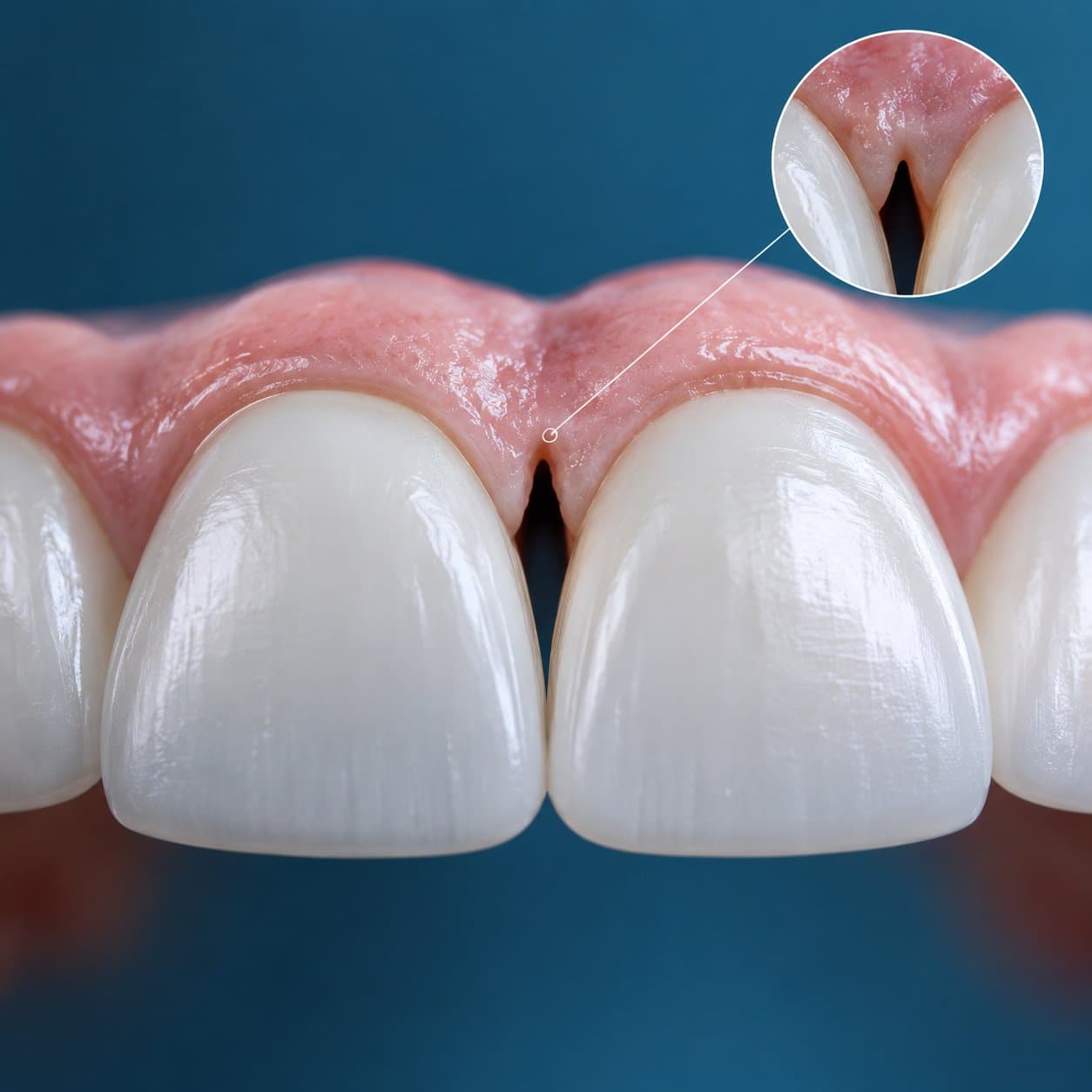
Look closely between your front teeth near the gumline and you might spot a small dark gap shaped like a triangle. It isn't a cavity and it isn't a shadow — it's an open space where gum tissue used to be, and dentists call it exactly what it looks like: a black triangle.
What causes them
Black triangles form when the gum tissue that once filled the space between two teeth — the papilla — shrinks back or never fully fills the space to begin with. The usual causes: gum recession from periodontal disease, aggressive brushing or flossing that wears the tissue down over years, natural bone loss with age, triangular-shaped teeth that leave a wider gap at the base, and orthodontic treatment that moves teeth into alignment but leaves the gum behind. Periodontal treatment itself can also uncover a black triangle that was hidden under swollen, inflamed gum tissue before treatment.
Are they a sign of a problem?
Usually not urgently — most black triangles are a cosmetic side effect of tissue that's already stabilised, not a sign of active disease. But not always. If the gum around it looks red, bleeds easily, or the gap seems to be widening, that's worth a dental check rather than a bonding appointment — it can mean gum disease is still active and treating the symptom first would just mask it.
How dentists actually close them
The right fix depends on how the gap formed and how large it is. For small gaps caused by thin gum tissue, some dentists inject hyaluronic acid gel into the papilla to add volume — a temporary fix that needs repeating. For gaps from tooth shape or minor spacing, composite bonding along the edges of the teeth can visually close the triangle without touching the gum at all. Larger gaps from significant bone or tissue loss sometimes need orthodontic re-treatment to close the space itself, or in select cases, gum grafting to rebuild lost tissue — a more involved periodontal procedure with a real recovery period.
What doesn't work
Whitening won't touch it — it's not a stain. Over-the-counter gum gels marketed for "gum health" won't rebuild lost papilla. And because it isn't decay, a filling isn't the right tool either. Matching the treatment to the actual cause is what makes the difference here, more than in most cosmetic dental complaints.
If you've noticed one recently, the useful next step isn't a home fix — it's asking a dentist whether the gum around it is healthy. That answer decides everything else.
Frequently asked
Frequently asked questions
Are black triangles a sign of gum disease?
Not always. Many are leftover from tissue loss that's already stable. But if the surrounding gum is red, swollen, or bleeds easily, that can mean disease is still active — a dentist can tell the difference in one look.
Can black triangles be prevented?
Not completely, but you can reduce the risk: brush at a gentle angle instead of scrubbing, use floss without sawing it hard into the gum, and get gum disease treated early so the tissue never has to retreat in the first place.
Is treatment for black triangles expensive?
It depends entirely on the method. Composite bonding is usually the fastest and cheapest option. Hyaluronic acid gel injections cost more and need repeating. Gum grafting, reserved for larger cases, is a full periodontal procedure and priced accordingly.
- gum recession
- cosmetic dentistry
- patients
Keep reading