Building Your First Dental Portfolio: What Clinics Look For in an Associate Dentist
Learn how to create an impactful dental clinical portfolio post-BDS. Master case documentation, dental photography, and presentation skills to stand out to hiring clinics.
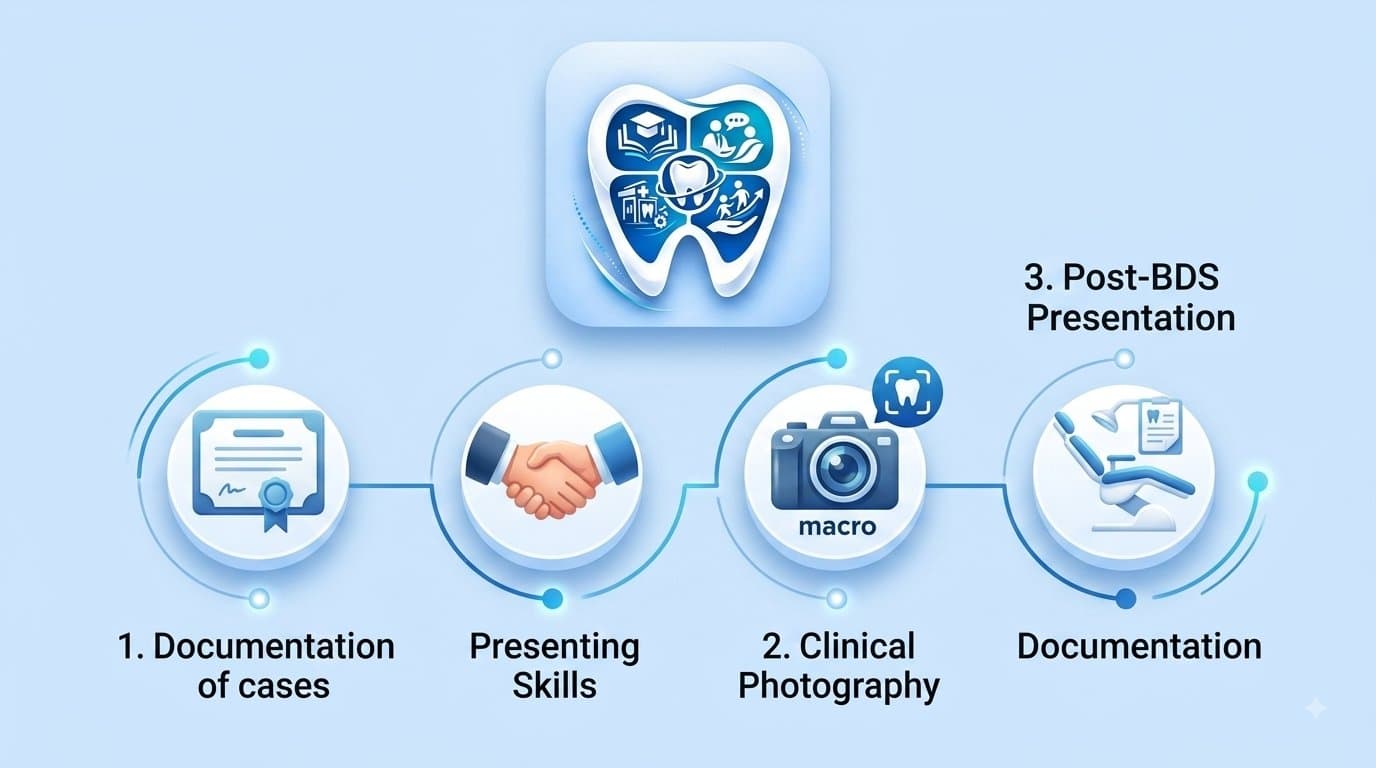
Stepping out of dental school with a fresh BDS degree is both thrilling and daunting. While your degree and academic scores prove your foundational knowledge, private clinics and hiring dental directors look for something far more tangible: clinical competence, diagnostic clarity, and reflective practice. This is where a well-crafted dental clinical portfolio becomes your most powerful asset.
A standard CV lists where you studied and which rotatory postings you completed; a clinical portfolio proves how you think, diagnose, handle complications, and execute treatments chairside. Here is a definitive guide on what clinic owners look for and how to build a standout dental portfolio post-BDS.
1. What Clinic Owners Actually Look For in an Associate
Senior dentists and clinic directors review dozens of resumes each month. When reviewing prospective associate dentists, they aren't expecting full-mouth rehabilitation or advanced implantology cases right out of college. Instead, they look for:
- Solid Fundamentals: Clean cavity preparations, proper rubber dam isolation, well-adapted composite restorations, accurate alginate/elastomeric impressions, and sound endodontic principles.
- Diagnostic & Treatment Planning Rationale: The ability to justify why a particular treatment modality or material was chosen.
- Honesty and Self-Awareness: Reflection on minor errors, biological compromises, or what could have been managed better.
- Attention to Detail & Protocols: Strict adherence to sterilization, isolation, patient consent, and standardized clinical documentation.
2. Mastering Clinical Photography (The Core of Your Portfolio)
High-quality clinical photography separates an amateur portfolio from a professional one. You do not necessarily need an expensive DSLR setup on day one—a modern smartphone paired with good retractors, contrastors, and proper lighting can produce compelling case photos.
Essential Views for Routine Case Documentation
- Standard Pre-op & Post-op Series: Full-face smile view, retracted 1:1 frontal view, right/left lateral 45° views, and maxillary/mandibular occlusal views.
- Step-by-Step Procedure Shots:
- Caries excavation and cavity outline (showing complete decay removal).
- Rubber dam isolation and matrix band adaptation.
- Restoration finishing and polishing with anatomical contouring.
- Radiographic Integration: Crop and align pre-operative, working length, master cone, and post-obturation IOPAs side-by-side with clinical photos.
Key Rules for Dental Photography
- Clear the field: Ensure mirrors are defogged, saliva and blood are aspirated, and cotton rolls are removed from the frame before capturing the final shot.
- Standardize exposure and angles: Keep camera angles consistent across before-and-after comparisons to maintain integrity.
- Patient Confidentiality: Anonymize patient details and always obtain signed consent for clinical photography and portfolio usage.
3. Structuring Each Case Study: The SOAP & SBAR Framework
Avoid simply dumping pictures on a page. Clinic owners appreciate a structured, case-study format. For each highlighted case, include:
- Patient Chief Complaint & History: Brief overview of age, gender, relevant medical history, and presenting symptoms.
- Pre-Operative Assessment: Clinical and radiographic findings, along with differential diagnosis.
- Treatment Plan & Consent: Options discussed with the patient and reasons for the final selected plan.
- Execution & Protocol: Step-by-step documentation detailing materials used (e.g., bonding agent generation, composite shades, rotary file sequence).
- Outcome & Follow-up: Immediate post-op result and, if possible, 1-week or 1-month follow-up showing soft tissue healing or occlusal stability.
- Clinical Takeaway/Reflective Note: A 2-sentence note explaining what you learned or how you would refine the procedure in the future.
4. Which Cases Should a Fresh BDS Graduate Include?
Quality always trumps quantity. Aim for 6 to 10 thoroughly documented, diverse cases covering foundational dentistry:
- Class II Composite Restorations: Showcasing tight proximal contacts, marginal ridge anatomy, and zero overhangs.
- Anterior Class IV / Diastema Closure: Demonstrating shade matching, layering technique, and polished surface texture.
- Endodontic Treatment (Anterior & Premolar/Molar): Clean access cavity, canal curvature management, uniform taper, and well-condensed obturation without voids.
- Prosthodontic Work: Precise crown preparations (clear finish lines, adequate reduction) and clean margin fit on delivery.
- Periodontal Therapy: Pre- and post-scaling/root planing showing significant gingival inflammation reduction.
- Atraumatic Exodontia / Minor Oral Surgery: Flap design, bone preservation, and clean suturing technique.
5. Formatting and Presenting Your Portfolio
A poorly formatted portfolio undermines great clinical work. Choose clean, modern mediums to present your skills:
- Digital PDF / Keynote / Slides: The industry standard. Create a minimalist, landscape 16:9 presentation (10–15 slides total) saved as an optimized PDF. Keep the design neutral (white or dark slate backgrounds work best).
- Personal Web Portfolio / Notion Page: A clean Notion link or single-page site makes your work easily shareable across messaging platforms and email.
- Physical Hardcopy Binder: While digital is primary, having a high-resolution, matte-printed binder during an in-person clinic interview leaves a lasting, tactile impression.
Conclusion: Turn Your Clinical Growth Into Your Career Advantage
Building a dental portfolio isn't a one-time project—it is a continuous habit that elevates your clinical standards. When an associate demonstrates that they routinely photograph, document, and critically appraise their own work, hiring clinics recognize an associate who is committed to clinical excellence, patient trust, and long-term practice growth.
Frequently asked
Frequently asked questions
Do I need an expensive DSLR camera to build a dental portfolio post-BDS?
No. While a DSLR with a 100mm macro lens and ring flash is the gold standard, modern smartphones with good ring lights, cheek retractors, and intraoral mirrors are more than sufficient to document clean, professional cases for an entry-level associate role.
How many cases should be in a dental associate portfolio?
Quality is more important than quantity. A focused portfolio of 6 to 10 well-documented cases covering routine operative dentistry, endodontics, crown preps, and scaling is ideal for a post-BDS candidate.
- dental portfolio
- associate dentist
- post BDS career
- clinical photography
- case documentation
- dental jobs
Keep reading