Missing a Tooth? Here's How Implants, Bridges, and Dentures Actually Compare
Each option for replacing a missing tooth has real trade-offs in cost, procedure, lifespan, and daily use. Here's what implants, bridges, and dentures actually involve — so you can have an informed conversation with your dentist.
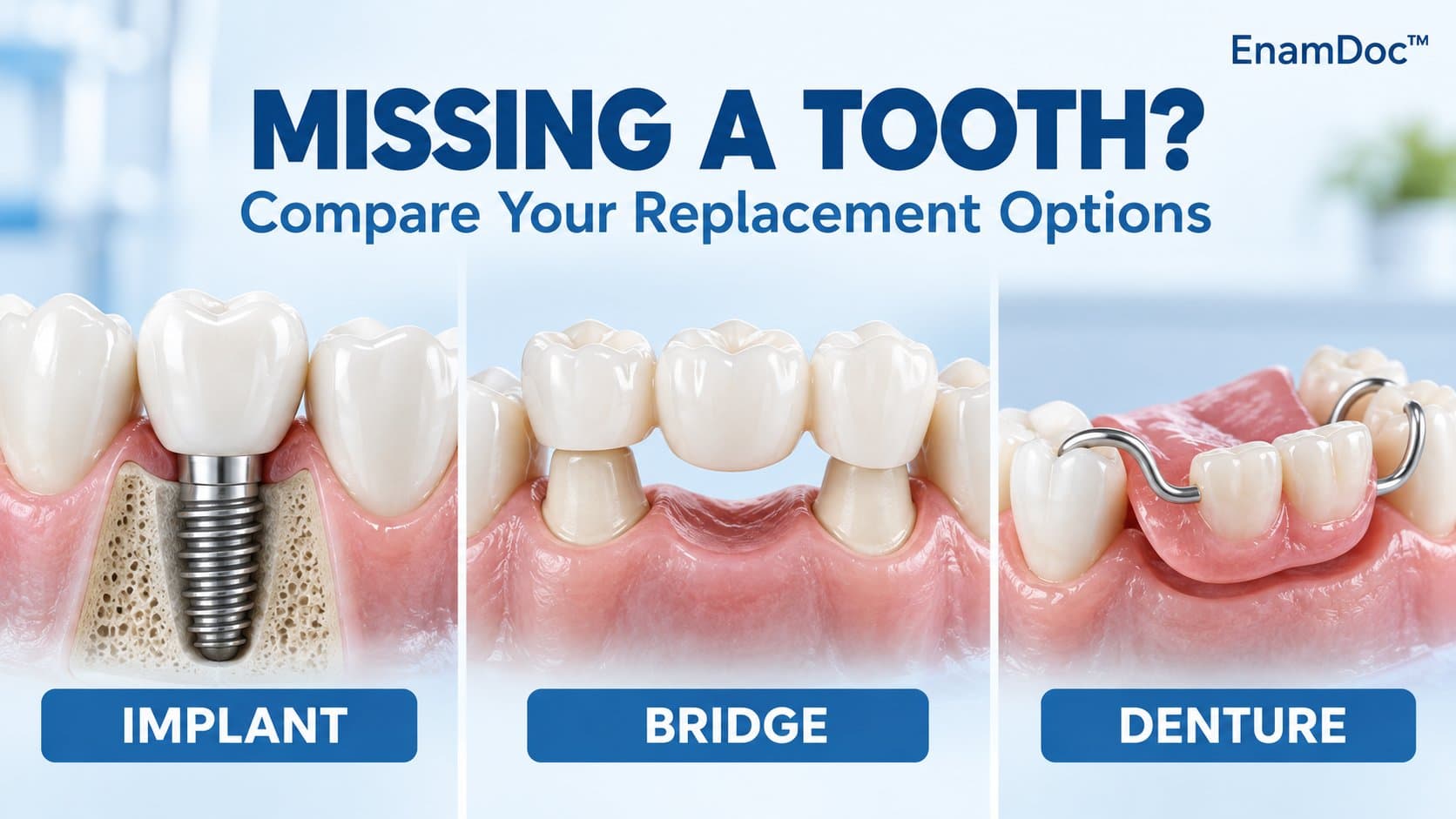
You've lost a tooth — maybe from decay, an accident, or a failed root canal — and now you're looking at your options. Your dentist mentions implants, bridges, and dentures. Each one does the same basic job (fills the gap), but they work very differently, cost very differently, and suit very different situations.
This guide breaks them down honestly, including what the procedures actually involve and what nobody tells you beforehand.
Why You Shouldn't Leave a Missing Tooth Untreated
The teeth on either side of a gap gradually drift inward to fill the space. The opposing tooth (the one above or below) over-erupts — it moves toward the gap because there's nothing to bite against. The jawbone under the missing tooth begins to shrink (resorb) within months, because bone needs the stimulation of a tooth root to maintain its density.
The longer a gap is left, the harder — and more expensive — replacement becomes. If you're weighing your options, acting sooner gives you more of them.
Dental Implants
What Is a Dental Implant?
A dental implant is a titanium screw placed directly into the jawbone. It acts as an artificial tooth root. Once it integrates with the bone (a process called osseointegration), a crown is placed on top. The result looks and functions like a natural tooth and doesn't affect the adjacent teeth at all.
The Procedure
Implants are typically done in stages over several months:
- Extraction and socket healing (if the tooth isn't already gone)
- Implant placement surgery under local anaesthesia
- Healing period of 3–6 months while the implant bonds with bone
- Crown placement once the implant is stable
The surgery itself is generally well-tolerated under local anaesthesia. Soreness for a few days afterward is normal.
Lifespan and Cost
A well-maintained implant can last a lifetime — the titanium screw rarely fails. The crown on top may need replacing after 15–20 years. Implants are the most expensive option upfront, but when viewed over 20+ years, they're often comparable in cost to options that need repeated replacement.
Who Is a Good Candidate?
You need sufficient bone density at the implant site. Smokers, people with uncontrolled diabetes, and those who have experienced significant bone loss may need additional evaluation or bone grafting. Your oral surgeon will assess your bone structure via X-rays or a CBCT scan before recommending this.
Dental Bridges
What Is a Dental Bridge?
A bridge fills the gap by anchoring an artificial tooth (called a pontic) to the teeth on either side of the missing one (called abutment teeth). The abutment teeth must be significantly reshaped — ground down to accept crowns — to support the bridge.
The Procedure
- Assessment and X-rays
- Reshaping of abutment teeth
- Impressions and fabrication (takes 1–2 weeks in a lab)
- Temporary bridge while the permanent one is made
- Fitting and cementing of the final bridge
The procedure is faster than an implant — typically 2–3 appointments over 2–3 weeks.
Lifespan and Cost
Bridges typically last 10–15 years with good care. They cost less than implants but more than dentures. Since the abutment teeth are permanently altered, they may need additional treatment down the line if the bridge fails.
The Trade-off Nobody Explains Clearly
Bridges feel natural to bite and chew on, and they're fixed — you don't remove them. But because the abutment teeth are filed down, you're making a permanent change to two healthy teeth to replace one missing one. Cleaning under a bridge requires floss threaders or interdental brushes; if cleaning is neglected, the abutment teeth are at higher risk of decay.
Dentures
What Are Dentures?
Dentures are removable replacements for missing teeth — either a full set (complete dentures) or a partial set (partial dentures for one or a few missing teeth). They sit on the gums and are held in place either by suction, clasps onto remaining teeth, or adhesive.
The Procedure
Complete dentures require multiple appointments over several weeks for impressions, bite registration, try-ins, and fitting. If teeth are being extracted, healing time is needed before the final denture is made. Partial dentures are quicker but still require careful fitting to avoid irritating the remaining teeth.
Lifespan and Cost
Dentures are the least expensive option. However, they typically need relining or replacing every 5–8 years as the jawbone changes shape (resorbs). The ongoing cost adds up over time.
The Honest Trade-offs
Dentures take time to adjust to — eating and speaking may feel different for weeks. They can move during eating, particularly lower dentures. They require removal and cleaning at night, and some people find this uncomfortable. For patients who cannot have surgery (due to health reasons or bone loss), dentures are often the only viable option.
Side-by-Side Comparison
- Implant: Longest lifespan, most natural feel, preserves bone, highest upfront cost, requires surgery and months of healing
- Bridge: Fixed (non-removable), faster procedure, involves reshaping adjacent teeth, 10–15 year lifespan
- Denture: Removable, no surgery required, lowest upfront cost, needs ongoing maintenance and adjustment
What Dentists Typically Recommend
For a single missing tooth in a patient with adequate bone: implants are generally considered the best long-term choice, because they preserve bone and don't affect adjacent teeth.
For multiple missing teeth in a row where adjacent teeth already have crowns: a bridge can be practical.
For patients with significant bone loss, health conditions that prevent surgery, or multiple missing teeth across the arch: partial or full dentures may be recommended, sometimes alongside implants to anchor them (implant-supported dentures).
The right answer depends on your bone structure, overall health, the location of the missing tooth, your budget, and how you weigh surgery versus ongoing maintenance. These are all things to work through with your dentist or oral surgeon during a proper consultation.
How EnamDoc Can Help
Tooth replacement treatment often spans several months and involves multiple appointments across different stages. EnamDoc lets you book these appointments and keep your dental records in one place — so nothing gets missed between visits and your treatment timeline stays on track.
If you're currently weighing your options, the most useful first step is a consultation with an oral surgeon or prosthodontist who can examine your bone structure and give you a recommendation based on your specific situation.
The Bottom Line
There's no universally "best" option — implants, bridges, and dentures each have genuine advantages in the right situation. What matters is making an informed decision rather than a rushed one. Understanding what each procedure involves, what it costs over time, and what trade-offs it carries puts you in a much stronger position to choose.
Frequently asked
Frequently asked questions
How long does a dental implant take from start to finish?
The full implant process typically takes 4–9 months, depending on how much bone is available and whether extraction or grafting is needed. The implant itself is placed in a single surgical appointment, but it then needs 3–6 months to fuse with the jawbone before the final crown can be placed. Most of the time is waiting for bone integration, not active treatment.
Is a dental bridge permanent, or does it need to be replaced?
A dental bridge is fixed in place and not removable, but it isn't permanent in the sense that it lasts forever. Most bridges last 10–15 years before needing replacement. The bridge itself is cemented onto the abutment teeth, but the abutment teeth remain at risk of decay (especially around the margins of the crowns), which is the most common reason bridges fail. With diligent cleaning under the bridge using floss threaders, many bridges last considerably longer.
Can everyone get a dental implant?
Not everyone is immediately suitable. You need sufficient bone density at the implant site — if the bone has resorbed significantly, a bone graft may be needed first. Uncontrolled diabetes, heavy smoking, certain medications (like bisphosphonates), and active gum disease can complicate implant healing. Age is not usually a barrier for adults, but implants are not placed in teenagers whose jaws are still growing. An oral surgeon will assess your eligibility through X-rays or a CBCT scan before recommending whether you're a good candidate.
- dental implant
- bridge
- denture
- missing tooth
- tooth replacement
Keep reading