Dental Implants vs Bridges vs Dentures: Which Tooth Replacement Is Right for You?
Missing a tooth and not sure which replacement option to choose? This guide compares dental implants, bridges, and dentures — so you can pick the option that suits your budget, lifestyle, and oral health.
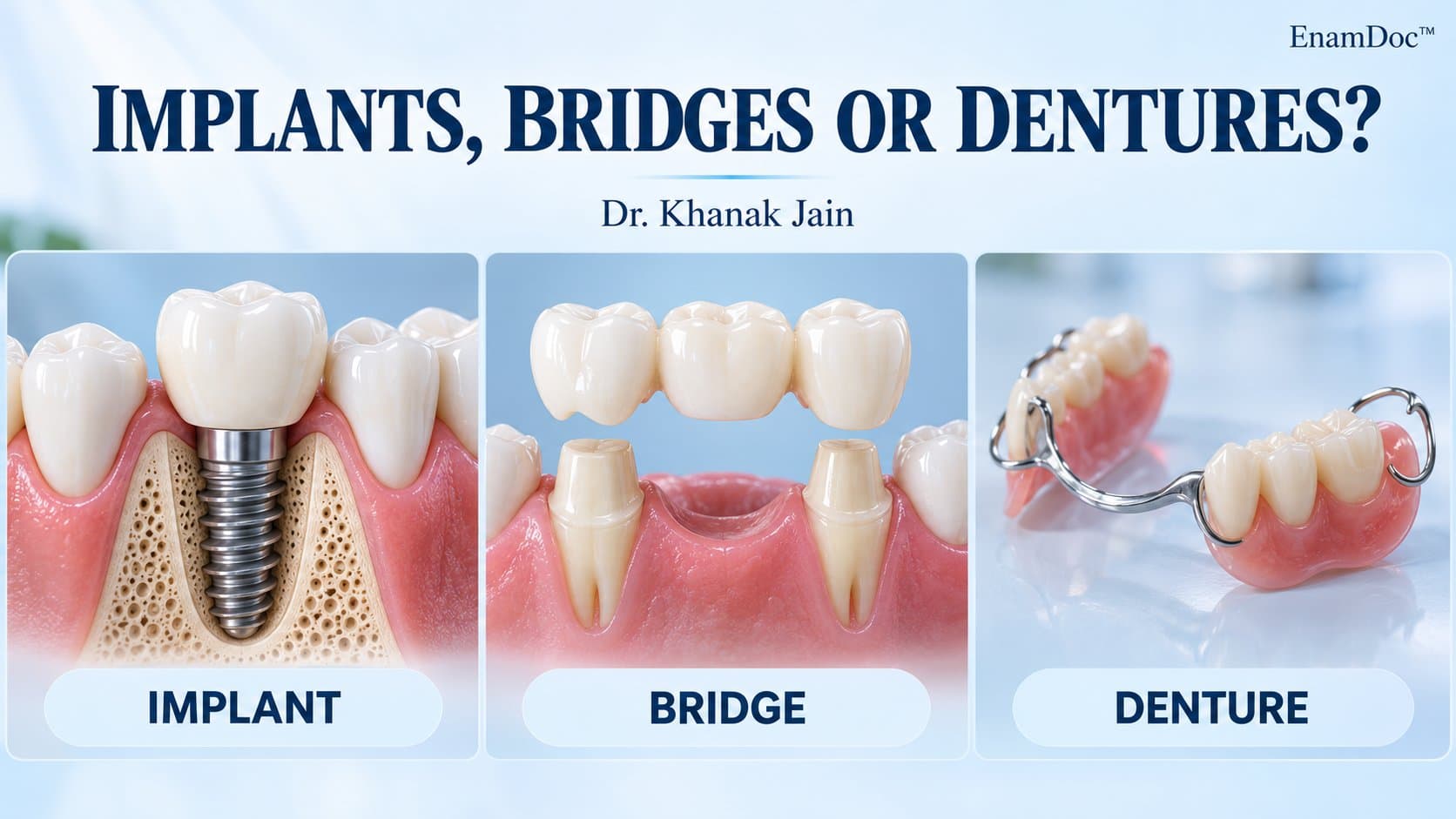
Losing a tooth — whether from an accident, decay, or extraction — leaves you with a gap that affects your confidence, your bite, and your long-term oral health. The good news is that modern dentistry offers three reliable options to fill that space: dental implants, bridges, and dentures. The challenge is figuring out which one is right for you.
Each has real advantages, real trade-offs, and a very different price point. This guide walks you through all three so you can have an informed conversation with your dentist.
Understanding the Three Options
Dental Implants
A dental implant is a titanium post surgically placed into your jawbone, where it fuses with the bone over a period of three to six months (a process called osseointegration). Once integrated, a crown is placed on top. The result looks, feels, and functions almost exactly like a natural tooth.
Best for: People with good bone density and healthy gums who want a permanent, low-maintenance solution.
Pros:
- Lasts 20–30 years or more with proper care
- Preserves jawbone — prevents the bone loss that occurs after extraction
- Does not affect adjacent teeth
- Easy to clean — brush and floss normally
- Looks and feels natural
Cons:
- Higher upfront cost (₹25,000–₹1,00,000+ per tooth in India depending on the brand and clinic)
- Requires surgery and a healing period of 3–6 months
- Not suitable if you have significant bone loss, uncontrolled diabetes, or are a smoker (though exceptions exist)
Dental Bridges
A dental bridge literally "bridges" the gap by anchoring an artificial tooth (called a pontic) to the two healthy teeth on either side of the gap. These anchor teeth (abutments) are filed down to accommodate the crowns that hold the bridge in place.
Best for: People replacing one or two adjacent teeth who want a fixed (non-removable) option at a lower cost than implants.
Pros:
- Lower cost than implants (₹8,000–₹40,000 per unit)
- No surgery required
- Completed in two to three appointments
- Fixed in place — no removal needed
Cons:
- Requires shaving down two healthy adjacent teeth, which is irreversible
- Does not prevent bone loss in the gap area
- Harder to clean — requires a floss threader or water flosser under the bridge
- Lifespan of 10–15 years before replacement is typically needed
Dentures
Dentures are removable appliances that replace multiple missing teeth (or all of them). Partial dentures replace some missing teeth while resting on remaining natural teeth. Complete dentures replace a full arch. Modern dentures are far better than their reputation — well-fitted ones are comfortable and functional.
Best for: People missing many teeth, those who are not candidates for implants, or those seeking the most affordable option.
Pros:
- Most affordable option (₹5,000–₹30,000+ depending on material and type)
- No surgery
- Can replace multiple teeth at once
- Can be adjusted as gums change over time
Cons:
- Removable — must be taken out at night and cleaned
- Can slip or shift, especially lower dentures
- Accelerates bone loss in the jaw over time
- May feel less natural, particularly for eating hard foods
- Need relining or replacement every 5–7 years
Side-by-Side Comparison
Here is a quick look at how the three options stack up:
Permanence: Implants are fixed permanently. Bridges are fixed but involve adjacent teeth. Dentures are removable.
Bone preservation: Only implants actively preserve the jawbone. Bridges do not prevent bone loss. Dentures accelerate it.
Longevity: Implants can last a lifetime. Bridges typically last 10–15 years. Dentures need replacement every 5–7 years.
Surgery required: Yes for implants. No for bridges and dentures.
Cost: Implants are highest. Bridges are moderate. Dentures are lowest.
Which One Should You Choose?
Choose implants if...
You are replacing one or two teeth, have adequate bone density, and can afford the upfront cost. Over 15–20 years, implants often work out to be the most cost-effective option because they do not need replacement and do not damage adjacent teeth. They are also the only option that preserves your jawbone, which matters for your facial structure as you age.
Choose a bridge if...
You need a fixed, non-removable option but cannot afford implants or are not a surgical candidate. A bridge is also a reasonable choice when the adjacent teeth already have large fillings or crowns and would benefit from the additional support anyway. Just be prepared for lifelong cleaning vigilance under the pontic.
Choose dentures if...
You are missing many teeth, cannot afford implants or bridges, or are not suitable for surgery. Dentures remain an effective and dignified option — modern materials and custom fitting have improved significantly. Some people also combine implants with dentures: "implant-supported dentures" use two to four implants to anchor a full denture securely, giving you the best of both options.
Questions to Ask Your Dentist
Before deciding, discuss the following with your dental professional:
- Do I have enough bone for an implant, or would I need a bone graft first?
- Are my adjacent teeth healthy enough to support a bridge without damage?
- What is my risk for further tooth loss — should I plan for multiple replacements?
- What are the total long-term costs (including maintenance and replacement) for each option?
The Bottom Line
There is no universally "best" option — the right choice depends on how many teeth you are replacing, your overall oral health, your budget, and your lifestyle. Dental implants offer the closest thing to a natural tooth and preserve your jawbone, but they require surgery and cost more. Bridges are a solid fixed alternative when implants are not feasible. Dentures serve patients replacing many teeth or those who need the most affordable path forward.
A thorough examination — including an X-ray or CBCT scan to assess bone levels — is the starting point. Armed with that information, your dentist can give you a personalised recommendation rather than a one-size-fits-all answer.
Frequently asked
Frequently asked questions
Which is cheaper long-term — implants or dentures?
Dentures have a lower upfront cost, but they need relining or replacement every 5–7 years and can accelerate bone loss, leading to further dental costs. Implants cost more initially but can last 20–30 years with minimal maintenance, often making them more cost-effective over a lifetime.
Can a dental bridge be done without touching adjacent teeth?
In some cases, a Maryland bridge (also called a resin-bonded bridge) uses minimal preparation and metal wings to bond to adjacent teeth without major shaping. However, this type is less durable and works best for front teeth where biting forces are lower. Your dentist can advise whether it is suitable for your situation.
How soon after tooth extraction can I get an implant?
It depends on your healing and bone condition. In some cases, an "immediate implant" can be placed on the same day as extraction. More commonly, dentists wait 6–12 weeks for initial healing before placing the implant. If significant bone loss is present, a bone graft may be needed first, adding 3–6 months to the timeline. Your dentist or oral surgeon will advise based on your X-rays.
- dental implants
- dental bridge
- dentures
- tooth replacement
Keep reading