Dental Implants vs Bridges: The Real Cost Difference in India (2025 Guide)
Confused between a dental implant and a bridge? Here's an honest comparison of costs, longevity, and what Indian patients actually need to know before deciding.
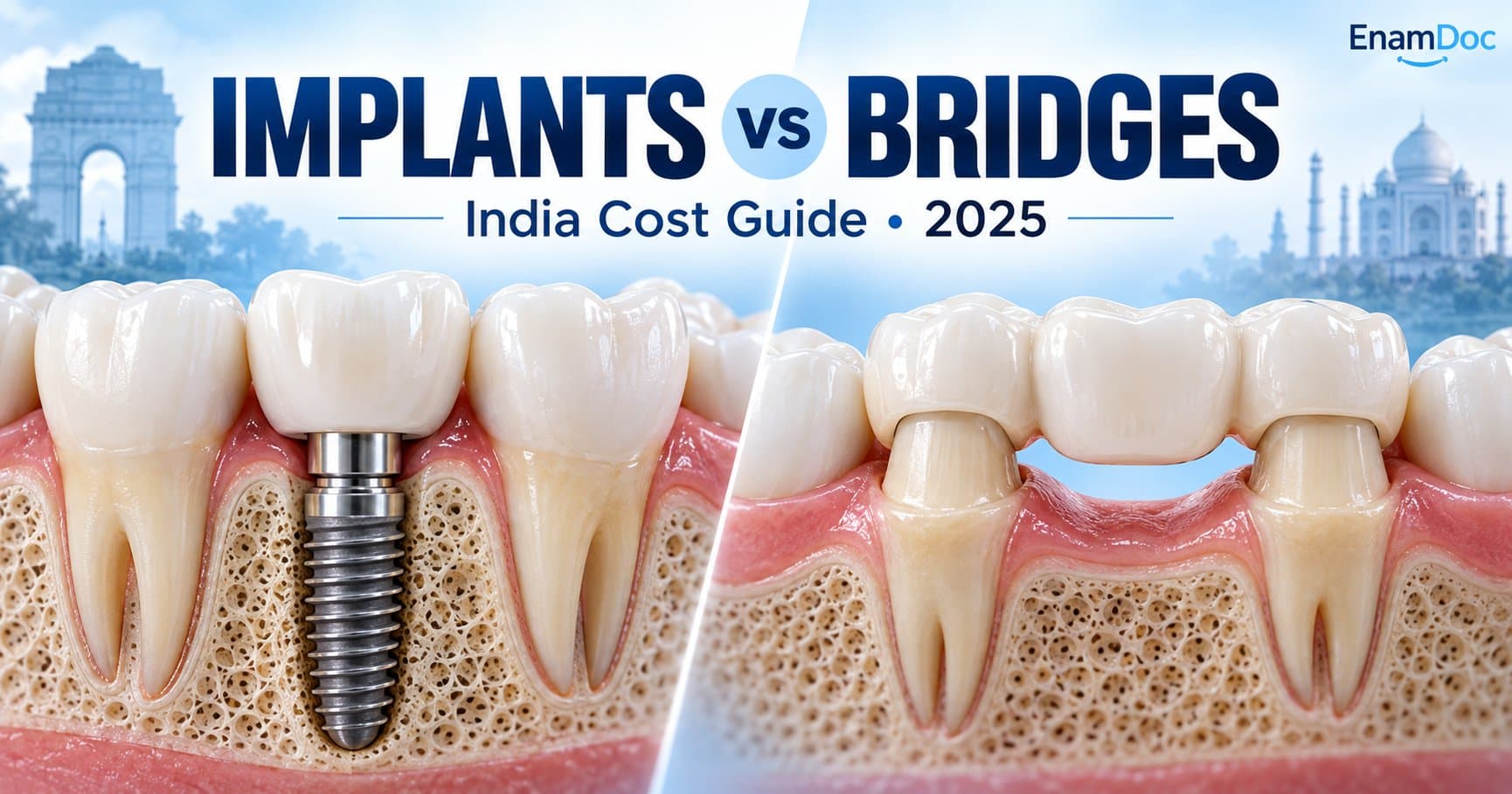
Losing a tooth is stressful enough. But the real confusion usually starts when your dentist says: “You have two main options — an implant or a bridge.”
Both restore your smile. Both function reasonably well. But they are fundamentally different in how they work, how long they last, and what they cost. This guide breaks it all down without jargon, so you can walk into your next appointment knowing exactly what to ask.
What Is a Dental Implant?
A dental implant is a titanium screw surgically placed into your jawbone. It acts as an artificial tooth root. Once it integrates with the bone over 3–6 months, a ceramic crown is placed on top. The result looks and functions almost identically to a natural tooth.
Key characteristics:
- Involves minor surgery under local anaesthesia
- Takes 4–9 months from start to finish
- Does not require touching adjacent teeth
- Stimulates jawbone, preventing bone loss
- Success rate: 95–98% at 10 years
What Is a Dental Bridge?
A dental bridge literally “bridges” the gap where a tooth is missing. The two teeth on either side of the gap are shaped down and capped. A false tooth (pontic) is suspended between them, attached to those crowns.
Key characteristics:
- No surgery required
- Completed in 2–3 appointments over 2–3 weeks
- Requires grinding down two healthy adjacent teeth
- Does not prevent bone loss in the gap area
- Typical lifespan: 10–15 years with good care
Cost Comparison: What You’ll Pay in India
| Dental Implant | Dental Bridge | |
|---|---|---|
| Average cost (India) | ₹25,000 – ₹80,000 per implant | ₹12,000 – ₹35,000 per unit |
| Total for one missing tooth | ₹25,000 – ₹80,000 | ₹24,000 – ₹70,000 (3 units) |
| Replacement needed? | Rarely, if ever | Every 10–15 years |
| 30-year total cost estimate | ₹30,000 – ₹90,000 | ₹50,000 – ₹1,50,000+ |
Note: Costs vary significantly by city, clinic, implant brand, and crown material. Always get a written treatment plan.
The implant looks expensive upfront. But over a lifetime, many patients end up spending more on repeated bridge replacements, especially if adjacent teeth are also affected over time.
Which One Is Better for You?
Choose a dental implant if:
- Your jawbone density is adequate (your dentist will check)
- You want a permanent, independent solution
- The adjacent teeth are healthy and you’d prefer not to alter them
- You can manage the longer treatment timeline
- You want to prevent future bone loss
Choose a dental bridge if:
- You cannot undergo surgery (medical conditions, medications)
- You need a faster solution
- Your budget is tighter right now
- The adjacent teeth already need crowns anyway
- The bone loss in the area is too significant for an implant
What Dentists Usually See in Indian Patients
Patients often come in asking for the “cheaper option” — and then make the same decision again in 12 years when the bridge needs replacing. A dentist’s job is not to sell you the expensive option, but to show you the full picture including long-term costs and risks.
One useful conversation to have: ask your dentist to calculate the 20-year scenario for both options, including maintenance.
How EnamDoc Helps
Whether you’re consulting a dentist about implants or bridges, EnamDoc’s digital consultation records ensure your treatment plan, X-rays, cost estimates, and follow-up appointments are all stored and accessible. No more searching for old prescriptions before your next appointment.
Frequently asked
Frequently asked questions
Is a dental implant painful?
The surgery is done under local anaesthesia and most patients report the procedure was less uncomfortable than expected. Post-surgery soreness usually resolves within 3–5 days.
Can a dental bridge be done in a single visit?
No. A bridge typically requires at least 2 visits: one to prepare the teeth and take impressions, and one to cement the final bridge. Some clinics use CAD/CAM same-day technology, but this isn’t widely available everywhere.
What happens to the bone under a bridge?
Without a tooth root (or implant), the jawbone in that area gradually resorbs (shrinks) over years. This doesn’t cause immediate problems but can affect the fit of the bridge and your facial appearance over time. An implant prevents this.
- dental implants
- dental bridge
- tooth replacement
- India dental cost
- implant vs bridge
Keep reading