Flossing vs. Water Flossers: Which One Is Actually Worth Your Money?
Compare string floss vs. water flossers on cleaning efficiency, ease of use, cost, and ideal dental profiles to find out which tool fits your oral care routine best.
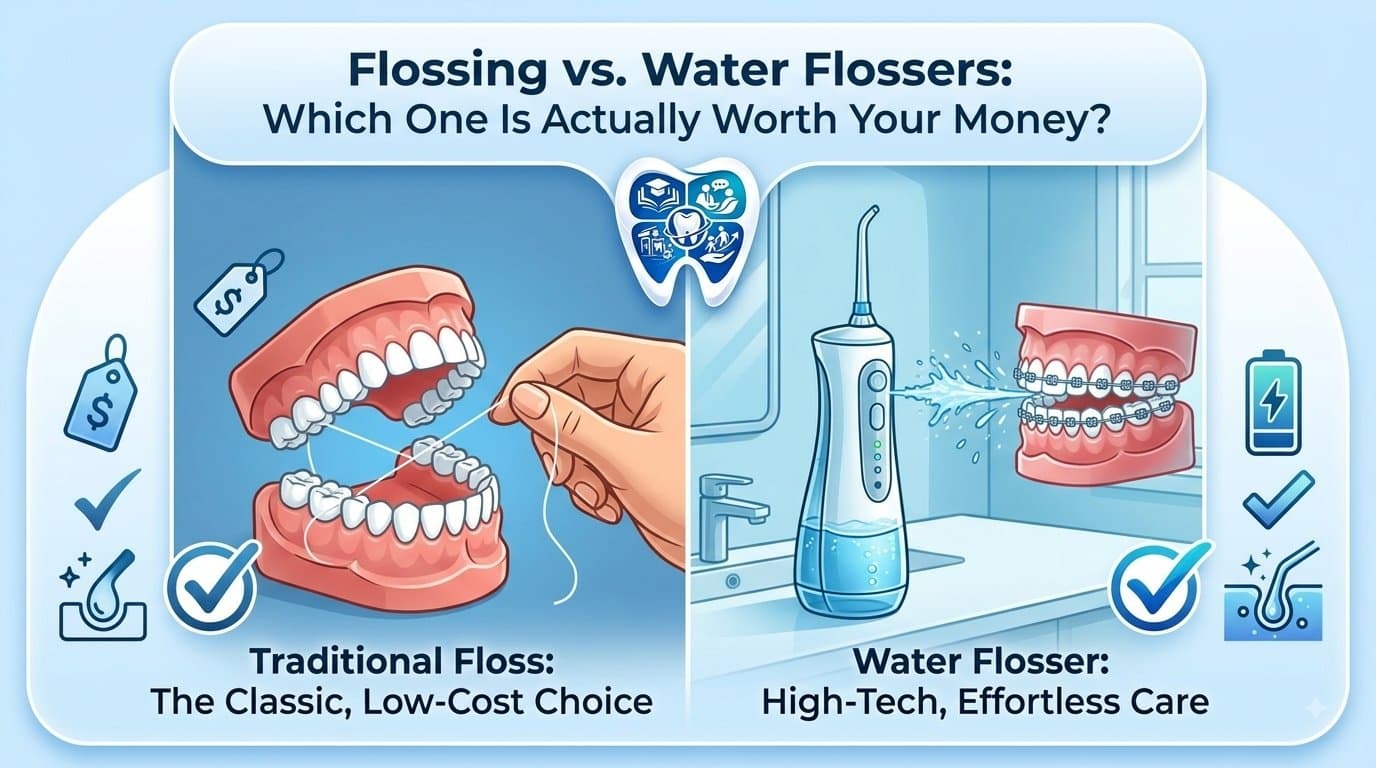
Brushing twice a day only cleans about 60% of your tooth surfaces. The remaining 40% lies in tight interdental spaces and along the gumline—the exact breeding ground for plaque, tartar, and gingivitis. To clean these hard-to-reach areas, the dental world offers two primary champions: traditional string floss and motorized water flossers (oral irrigators).
With water flossers gaining massive popularity, many patients ask: Are water flossers truly superior, or are you paying a premium for a high-tech gadget when simple thread does the job? Let’s break down their efficiency, ease of use, cost, and specific dental suitability.
How They Work: Mechanical Scraping vs. Hydrodynamic Pulsation
Understanding the fundamental mechanism helps explain why both tools excel in different ways:
- Traditional Floss: Relies on mechanical scraping. When curved in a "C-shape" against the tooth, string physically dislodges the sticky bio-film (plaque) adhering to tooth enamel and slips slightly beneath the gingival margin.
- Water Flossers: Utilize pressurized, pulsating streams of water (hydrodynamic action) to flush out trapped food debris, bacteria, and loose plaque from between teeth and periodontal pockets.
1. Cleaning Efficiency: Plaque vs. Gum Health
When evaluated strictly on plaque removal versus gum inflammation reduction, the clinical results show an interesting divide:
- Plaque Biofilm Removal: Traditional string floss remains the gold standard for scraping sticky, adherent plaque directly off tight contact points where teeth touch. Water flossers can rinse away unattached bacteria and loose debris effectively, but may not fully dislodge sticky bio-film without mechanical friction.
- Gingival Health & Bleeding: Clinical studies consistently demonstrate that water flossers are exceptionally effective at reducing gingivitis and gum bleeding. The pulsating stream massages the gingival tissue, improves circulation, and cleans deep inside periodontal pockets that string cannot reach.
2. Ease of Use and Compliance
The best oral hygiene tool is ultimately the one you actually use every day.
- String Floss: Requires high manual dexterity. Wrapping string around fingers, reaching back molars, and maintaining a proper "C-shape" curve without snapping the thread against sensitive gums is challenging for many users. This leads to low patient compliance.
- Water Flossers: Significantly easier and gentler to navigate. Pointing a nozzle along the gumline requires minimal finger acrobatics, making it approachable for almost everyone. However, it can be messy and wet until you master keeping your mouth slightly closed over the sink.
3. Cost and Longevity Comparison
| Feature | Traditional String Floss | Water Flosser |
|---|---|---|
| Initial Cost | Low (₹100 – ₹250 per spool) | Moderate to High (₹1,800 – ₹7,000+) |
| Ongoing Expenses | Continuous replacement spools | Replacement tip nozzles (every 3–6 months) & electricity/batteries |
| Portability | Extremely compact, fits anywhere | Bulkier; requires charging or bathroom counter space |
4. Ideal Dental Profiles: Which One Is Best for You?
Choose Traditional String Floss if:
- You have tightly spaced, natural teeth with no extensive restorations.
- You have good manual dexterity and already have a consistent daily flossing habit.
- You are looking for an affordable, pocket-sized oral hygiene tool for travel and work.
Choose a Water Flosser if:
- You wear orthodontic braces: Threading string through brackets and wires is tedious; water flossers flush around brackets in seconds.
- You have bridges, dental implants, or crowns: Water jets safely navigate underneath prosthetics and around implant margins without shredding or damaging sensitive tissue.
- You experience arthritis or limited hand mobility: The ergonomic handle makes interdental cleaning effortless compared to string manipulation.
- You suffer from chronic gingivitis or deep gum pockets: Pulsating water flushes out anaerobic bacteria hidden deep below the gum line.
The Verdict: Which One Is Worth It?
If you already floss daily with proper C-shape technique and your dentist reports healthy gums, traditional floss is completely sufficient and cost-effective.
However, if you struggle with compliance, wear braces, have dental implants, or deal with bleeding gums, a water flosser is 100% worth the investment. In fact, for optimal oral health, many periodontists recommend using string floss to scrape contact surfaces and following up with a water flosser to flush out the loosened debris.
Frequently asked
Frequently asked questions
Can a water flosser completely replace regular dental floss?
While water flossers are superior for gum health, braces, and bridges, string floss provides mechanical scraping against sticky plaque. For the most thorough hygiene, dentists recommend using both, though a water flosser alone is far better than not flossing at all.
Can water flossers damage teeth or gums?
When used at recommended pressure settings, water flossers are very safe. Starting at a low pressure helps prevent gum sensitivity or irritation, especially for beginners.
How often should I use a water flosser?
You should use your water flosser at least once a day, preferably during your nighttime oral care routine right before or after brushing.
- flossing
- water flosser
- oral hygiene
- dental care
- braces
- gum health
- preventative dentistry
Keep reading