How Digital Patient Records Are Changing Dental Clinics in India
Paper files are being replaced by digital patient records in dental clinics across India. Here is how practice management software is changing the way dentists work — and why switching matters now.
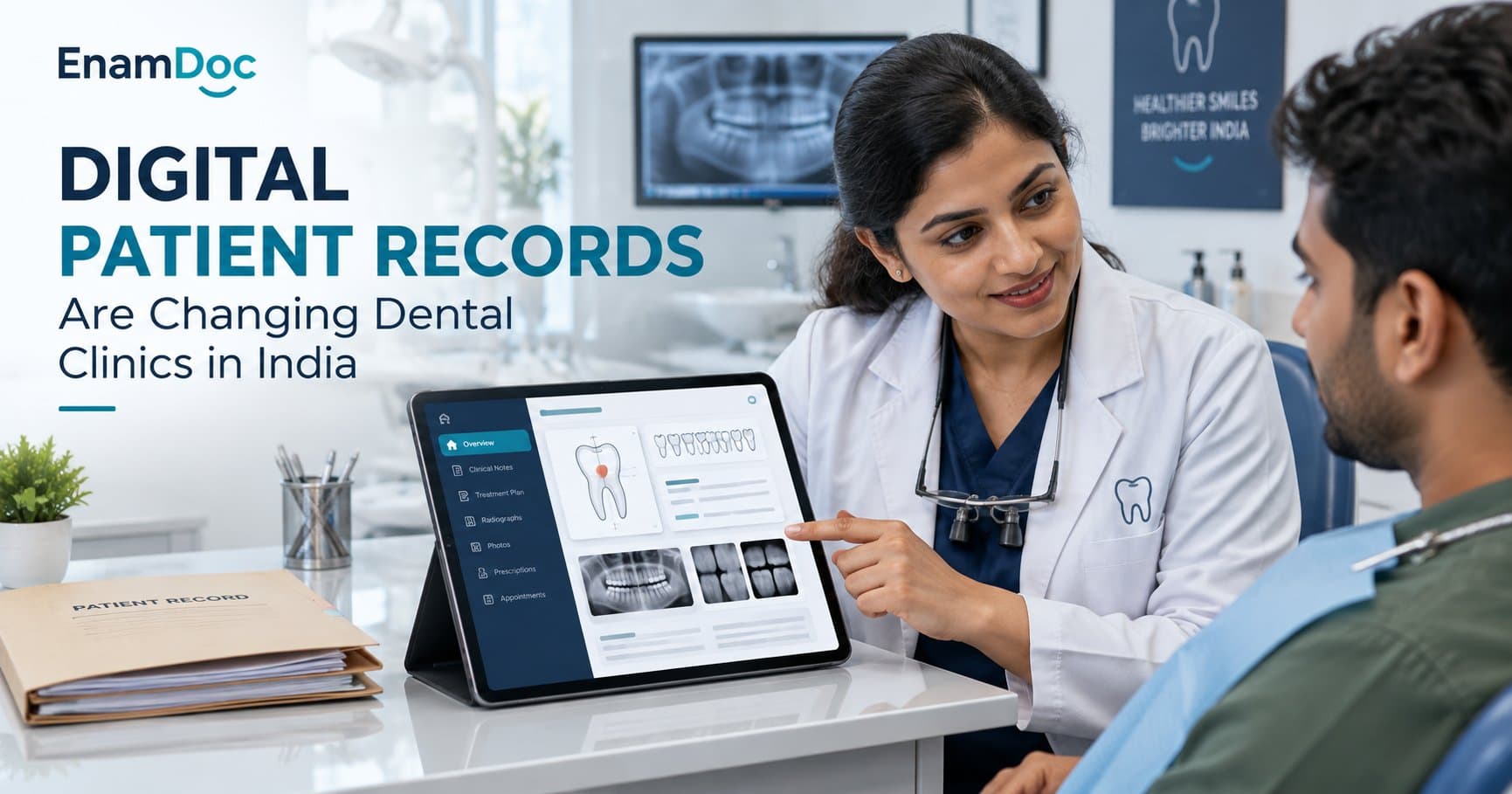
The State of Patient Records in Indian Dental Clinics
Walk into most dental clinics in India today and you will find a mix: some still rely on thick paper files, prescription pads, and handwritten treatment notes crammed into metal almirahs. Others have made the switch to digital — storing X-rays, treatment histories, consent forms, and billing records in cloud-based software that any team member can pull up in seconds.
The shift to digital patient records is not just a tech trend. It represents a fundamental change in how dental practices operate — one that improves efficiency, protects patient data, reduces errors, and increasingly, determines whether a clinic can scale or not. Here is what Indian dentists need to know about this transition.
What Are Digital Patient Records?
A digital patient record (also called an Electronic Health Record or EHR in clinical settings) is a secure, structured digital file that contains all the information about a patient's dental history — past treatments, X-rays, consent forms, allergies, appointment notes, billing records, and communication logs — stored in practice management software rather than on paper.
In a dental context, comprehensive digital records typically include:
- Personal and contact information
- Medical and dental history
- Chief complaint and treatment notes per visit
- Clinical charts (charting of existing restorations, missing teeth, caries)
- X-rays and intraoral photographs
- Treatment plans and case presentations
- Prescriptions issued
- Billing and payment history
- Appointment history and upcoming schedule
- Signed consent forms
How Digital Records Are Changing Day-to-Day Practice
Faster Patient Retrieval
With paper files, finding a patient's history could take several minutes — especially in a busy clinic with hundreds of physical folders. With digital records, a dentist or receptionist can retrieve a complete patient profile in under five seconds by searching by name, phone number, or patient ID. This alone saves clinics significant time across hundreds of appointments each month.
Better Clinical Decision-Making
When a patient returns after six months, digital records give the dentist an instant, structured view of the last visit's findings, the treatment provided, the X-rays taken, and any notes on patient behaviour or preferences. This continuity of information reduces diagnostic errors and ensures treatment planning is always grounded in complete data — rather than the patient's memory of what was done.
Seamless Handover Between Clinics and Associates
For dentists running multiple branches or working with associates, digital records mean that a patient who visited one branch can be seen at another without the need to physically transfer files or repeat diagnostic workup. The treating associate sees the same complete history regardless of which branch they are operating from.
Automated Reminders and Patient Recall
Digital systems can automatically send appointment reminders via SMS or WhatsApp, flag patients who are overdue for a recall, and track treatment plan completion. This has a direct impact on patient retention and revenue — clinics using automated recall systems report 20–35% higher patient return rates compared to those relying on manual follow-up.
Medicolegal Protection
This is increasingly critical. In cases of patient complaints or litigation, a properly maintained digital record — with timestamped entries, signed digital consent forms, and traceable edits — provides far stronger legal protection than handwritten notes that can be altered or lost. The Dental Council of India's guidelines and broader consumer protection laws expect dental records to be maintained properly; digital systems make compliance easier to demonstrate.
Billing Accuracy and Revenue Cycle Management
Manual billing is one of the most common sources of revenue leakage in dental clinics. Digital systems integrate treatment planning with billing, so every procedure added to the treatment plan is automatically reflected in the invoice. Outstanding balances, advance payments, and payment histories are tracked in real time — which reduces disputes and makes monthly accounting far simpler.
What to Look for in Dental Practice Management Software
Not all practice management software is equal. When evaluating options for your clinic, these are the features that matter most in the Indian context:
- Cloud-based access: Accessible from any device, backed up automatically, with no dependency on a single computer.
- WhatsApp and SMS integration: Automated reminders and recall messages sent through channels patients actually use in India.
- X-ray and photograph storage: DICOM-compatible image storage with the ability to compare baseline and follow-up radiographs side by side.
- Multi-branch support: A single dashboard to manage patient records, appointments, and revenue across multiple clinic locations.
- Consent form management: Digital consent forms that patients can sign on a tablet or phone, with the signed document automatically stored in their record.
- Data security: Encryption, access controls by role, and audit logs so you know who accessed or edited a record and when.
- Offline mode: The ability to continue working during internet outages, syncing data once connectivity is restored.
Common Objections — And Why They Do Not Hold Up
"Our staff is not tech-savvy"
Modern dental software is designed to be intuitive. Most platforms offer on-boarding training, video tutorials, and dedicated support teams. The learning curve is real but short — typically one to two weeks for most clinic staff to become comfortable with day-to-day operations.
"What if we lose all our data?"
Cloud-based software is significantly more secure than paper files, which can be lost in a flood, fire, or simply misplaced. Reputable platforms maintain redundant backups, often in multiple data centres, and send regular backup confirmations. Your data is actually safer in the cloud than in a filing cabinet.
"It's too expensive"
Practice management software in India is available at a wide range of price points — from a few hundred to a few thousand rupees per month. The time saved, errors prevented, and revenue recovered from better billing and follow-up systems typically far exceed the subscription cost within the first few months.
The Regulatory Direction of Travel
India's National Digital Health Mission (NDHM) and the Ayushman Bharat Digital Mission (ABDM) are building infrastructure for interoperable digital health records across the country. While mandatory compliance for dental clinics is still evolving, clinics that invest in digital record-keeping now will be far better positioned when regulatory frameworks around health data management tighten — as they inevitably will.
Making the Switch: A Practical Starting Point
The most common barrier to switching is not cost or technology — it is the perceived complexity of migrating existing patient data. The good news is that you do not need to migrate everything at once. Start by entering all new patients digitally from day one, and only digitise historical paper records for active patients who return for appointments. Within six to twelve months, the majority of your active patient base will be on the digital system.
Choose a platform that offers an implementation team to help with onboarding, data migration, and staff training. Trial periods and free demos are standard in the industry — use them.
Final Thoughts
Digital patient records are no longer a luxury for large hospital-based dental departments. They are a practical necessity for any clinic that wants to run efficiently, retain patients, reduce administrative errors, and protect itself legally. The Indian dental market is moving in this direction — and practices that lead this transition will be better positioned to grow, attract associates, and deliver consistently high-quality care.
Frequently asked
Frequently asked questions
Is it safe to store patient records in the cloud?
Yes, reputable cloud-based dental practice management software is highly secure — typically more secure than paper files stored in a clinic. Trusted platforms use end-to-end encryption, role-based access controls, and maintain automated backups across multiple servers. Paper files can be lost to floods, fires, theft, or misplacement. The key is to choose a software provider transparent about its security architecture, data residency, and backup policies — and one that complies with India's Digital Personal Data Protection Act (DPDPA).
How long does it take to switch a dental clinic to digital records?
The transition timeline depends on clinic size and volume of existing paper records. For a single-dentist practice, most of the active patient base can be on the digital system within three to six months — by entering all new patients digitally from day one and only migrating historical records when patients return. A larger multi-chair clinic may take six to twelve months. The critical step is choosing a platform with a strong implementation team that can train your staff and assist with data migration. Most reputable software providers offer a free trial or demo period — use it to evaluate the setup experience before committing.
Will switching to digital records affect patient confidentiality?
Not if done correctly — and in many ways, digital records offer stronger confidentiality protections than paper. With paper files, any staff member with access to the storage area can read any patient file. Digital systems allow role-based access: a receptionist can see appointment history but not clinical notes, while the dentist sees the full record. Every access and edit is logged with a timestamp and user ID. When evaluating software, look for providers compliant with India's DPDPA and who can clearly explain how they handle data subject requests and breach notifications.
- digital patient records
- dental software
- EHR
- clinic management
- dentists
- practice management
Keep reading