How to Set Up a New Dental Clinic: A Step-by-Step Checklist for Dentists
Setting up your first dental clinic in India involves far more than buying equipment. Dr. Khanak Jain walks through every stage — from registration and layout to equipment procurement and staffing — so you can open confidently.
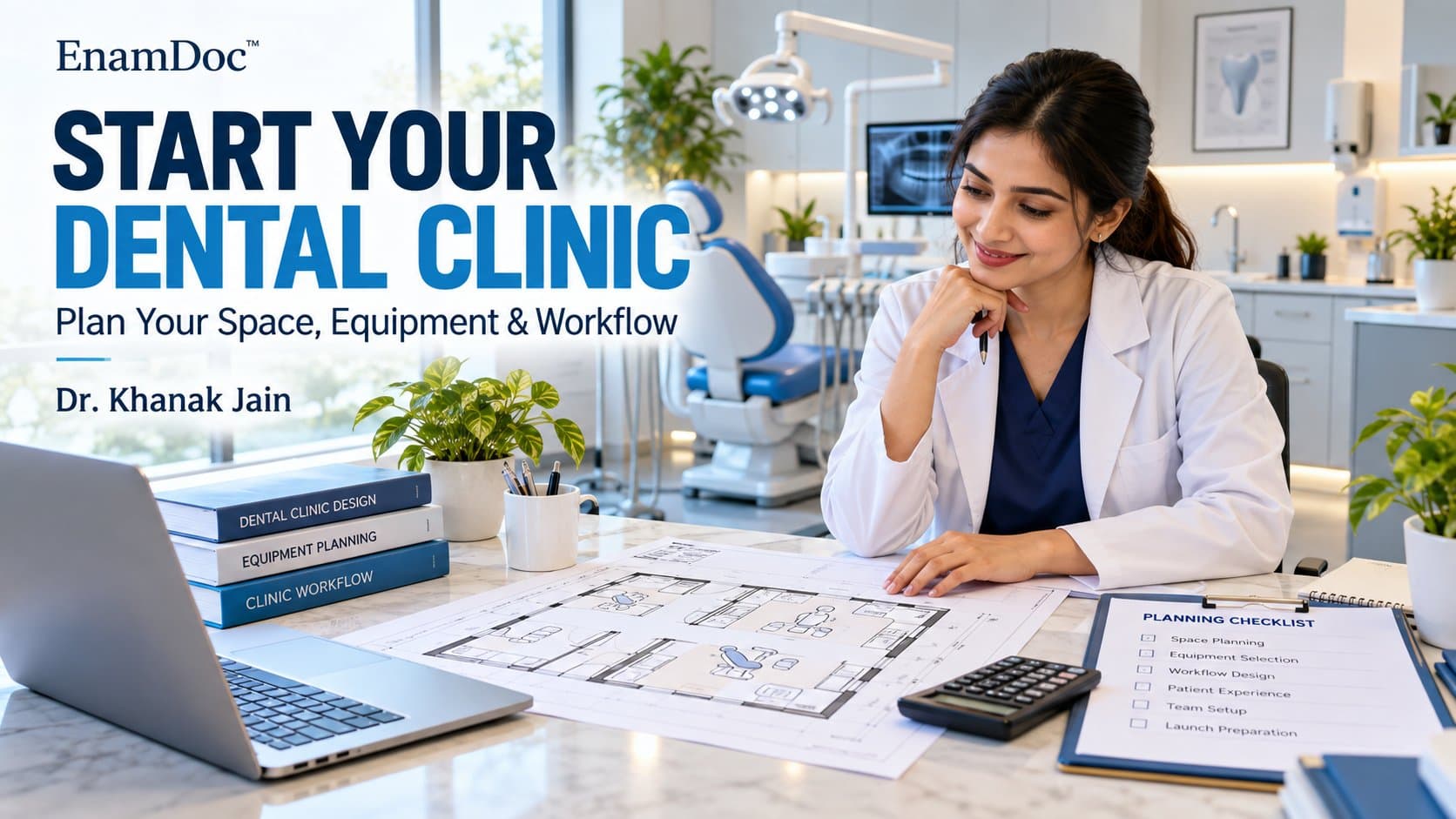
Opening your first dental clinic is one of the most significant professional decisions you will make. Done well, it can be deeply rewarding — both clinically and financially. Done poorly, it can drain your resources for years. The challenge is that dental school prepares you to be a clinician, not a business owner. Most dentists figure out the setup process by trial and error, asking colleagues, or working with consultants who often charge substantial fees for information you could have found with better preparation.
This checklist covers the full lifecycle of setting up a new dental clinic in India — from the first bureaucratic steps to opening day and beyond.
Phase 1 — Legal Registration and Compliance
Before anything else, get your registrations in order. Trying to shortcut this phase creates problems later that are harder to fix than if you had done it correctly from the start.
Dental Council Registration
You must be registered with your State Dental Council. If you completed your degree in a different state, ensure your registration is active and valid in the state where you intend to practice. The Dental Council of India (DCI) sets the standards; state councils handle local registration.
Clinical Establishment Act Registration
Under the Clinical Establishments (Registration and Regulation) Act, 2010, dental clinics in notified states must register as a clinical establishment. Check whether your state has adopted the Act and register accordingly. Some states have their own parallel laws.
GST Registration
Dental services provided to patients are generally GST-exempt for healthcare. However, if you sell dental products, have a lab, or provide non-healthcare services, GST registration may be required. Consult a CA with healthcare practice experience — this is not the area to guess.
Shops and Establishments Act
Register under your state's Shops and Establishments Act. This covers basic labour law compliance if you employ staff.
Biomedical Waste (BMW) Authorisation
Every clinical establishment generating biomedical waste must obtain BMW authorisation from the State Pollution Control Board and ensure waste is handled and disposed of according to the Biomedical Waste Management Rules, 2016. This is legally mandatory and inspected.
Phase 2 — Location, Space, and Layout
Your clinic's location will determine your patient demographics more than any other factor. A ground-floor clinic on a residential street serves families differently from a clinic in a commercial complex near offices. Decide your target patient base first, then select the location.
Minimum space guidelines: The DCI recommends a minimum of 10 square metres per dental chair. In practice, a single-chair clinic needs at least 200–300 square feet to function comfortably with a waiting area, reception, and sterile zone. Two chairs and a small lab require 400–600 square feet.
Layout priorities: The operatory (treatment room) must have direct access to the sterilisation area. The patient flow from entrance to waiting to operatory should not cross the sterilisation path. Good zoning is both an infection control requirement and a comfort factor for patients.
Phase 3 — Equipment Procurement
Equipment is the largest capital expenditure in clinic setup. The temptation to buy the most advanced equipment available should be balanced against clinical need and projected patient volume.
Essential equipment for a primary care clinic:
- Dental chair and unit (with integrated light, handpiece connections, spittoon, and suction)
- Intraoral X-ray machine (digital sensor or phosphor plate preferred over traditional film — faster, lower radiation dose, and no chemical processing)
- Autoclave steriliser (Class B recommended)
- Ultrasonic scaler
- Compressor (oil-free preferred for dental use)
- Light cure unit
- Apex locator (essential for endodontics)
- Basic surgical kit
Financing options: Many equipment suppliers offer EMI plans. Compare the total cost of ownership including maintenance contracts, not just the purchase price. Domestic brands have improved significantly and are worth evaluating before assuming imported equipment is necessary for all categories.
Phase 4 — Infection Control Infrastructure
A sterilisation protocol is not optional. Indian dental regulations and international guidelines both require that instruments are properly decontaminated, cleaned, sterilised, and stored before reuse.
Your sterilisation area needs: a sink for instrument washing, an ultrasonic bath for pre-cleaning, a packing station for pouch sealing, the autoclave, and a sterile storage area. Instrument tracking using autoclave batch records is considered standard of care.
Single-use items — needles, suction tips, saliva ejectors, air/water syringe tips — must be discarded after each patient. This is non-negotiable from both an infection control and a legal standpoint.
Phase 5 — Staffing
For a solo practice, a minimum of one trained dental assistant and one receptionist is typically needed to maintain patient flow. A dental assistant helps with chairside tasks, instrument preparation, and sterilisation. The receptionist handles appointments, billing, and patient communication.
Consider training staff specifically for your practice — general dental assistant training programs are available through institutions across India, and some states have formal certification tracks. Untrained staff who learn entirely on the job create inconsistency in protocols.
Phase 6 — Software and Systems
Practice management software is one of the best investments a new clinic can make. It handles appointment scheduling, patient records, billing, and follow-up reminders. Many newer platforms integrate with WhatsApp for automated appointment reminders, which significantly reduces no-shows.
Digital X-ray software, if you are using a digital sensor or phosphor plate system, usually comes bundled with the hardware. Ensure it integrates with your records system or can export images easily.
Phase 7 — Building a Patient Pipeline
A new clinic with no established patient base needs active outreach. Word of mouth is powerful but slow. In parallel:
- List your clinic on EnamDoc — it connects patients actively looking for dentists with verified practitioners. A complete profile with your qualifications, services, and location significantly improves your discoverability.
- Set up a Google Business Profile and ensure your clinic address and hours are accurate — this drives local search visibility.
- Connect with general physicians, ENT specialists, and paediatricians in your area — inter-specialty referrals are a stable source of new patients for any dental practice.
Phase 8 — Financial Planning
Build a financial model before you commit to your lease. Know your break-even number — the minimum number of procedures per month required to cover fixed costs (rent, EMI, staff salaries, utilities) — and be realistic about how long it will take to reach that number.
New clinics typically take 6–18 months to reach sustainable profitability. Having 6 months of operating expenses in reserve before you open significantly reduces the pressure that forces poor clinical or business decisions in the early months.
Fee setting: Research the prevailing market fees in your area, but do not set fees purely to undercut competitors. Patients associate fee level with quality. Setting fees too low from the start creates a perception that is difficult to reverse later and attracts price-sensitive patients who switch easily.
A Final Note
Clinic setup is genuinely difficult and the process rarely goes exactly to plan. Equipment arrives late, contractors overrun, registrations take longer than expected. Build buffer into your timeline and budget. The dentists who open successfully are typically not the ones who had the smoothest setup — they are the ones who planned carefully enough that the inevitable setbacks did not derail them.
Frequently asked
Frequently asked questions
How much does it cost to set up a dental clinic in India?
The total investment for a basic single-chair dental clinic in India ranges from approximately ₹15–25 lakhs for a well-equipped setup, and ₹25–50 lakhs or more for a multi-chair practice with advanced equipment. The largest variables are the dental chair and unit (₹2–10 lakhs depending on brand and specification), digital X-ray equipment (₹3–8 lakhs), interior fit-out, and the location's deposit and advance rent. Equipment financing and EMI plans from major dental suppliers can significantly reduce the upfront cash requirement.
Do I need to register under the Clinical Establishments Act to open a dental clinic?
This depends on your state. The Clinical Establishments (Registration and Regulation) Act, 2010, is a central act but requires state adoption. As of 2024, many major states have adopted it or have equivalent state-level clinical establishment laws. States like Haryana, Uttar Pradesh, and several North-Eastern states are notified; states like Maharashtra and Kerala have their own parallel legislation. Check with your State Dental Council or State Health Department before opening — the penalties for operating without required registration can include fines and forced closure.
How long does it realistically take to open a dental clinic from scratch in India?
From the decision to open to actually seeing patients, plan for 4–8 months minimum if you are starting from scratch — finding and negotiating the space, completing fit-out, ordering and receiving equipment, completing all registrations, and hiring staff. Many dentists underestimate how long equipment procurement and custom interior work take. If you are taking over an existing space that is already fitted out, this timeline can compress to 2–3 months. Delays in equipment delivery (especially imported items) and registration processing are the most common causes of timeline overrun.
- dental clinic setup
- how to open dental clinic India
- dental practice management
- clinic registration
Keep reading