How to Get More Google Reviews for Your Dental Clinic — And Handle the Negative Ones
Google reviews are now the single most influential factor in where patients choose to book. Dr. Aditya Swami explains how to ethically build your review count and respond to negative feedback without making it worse.
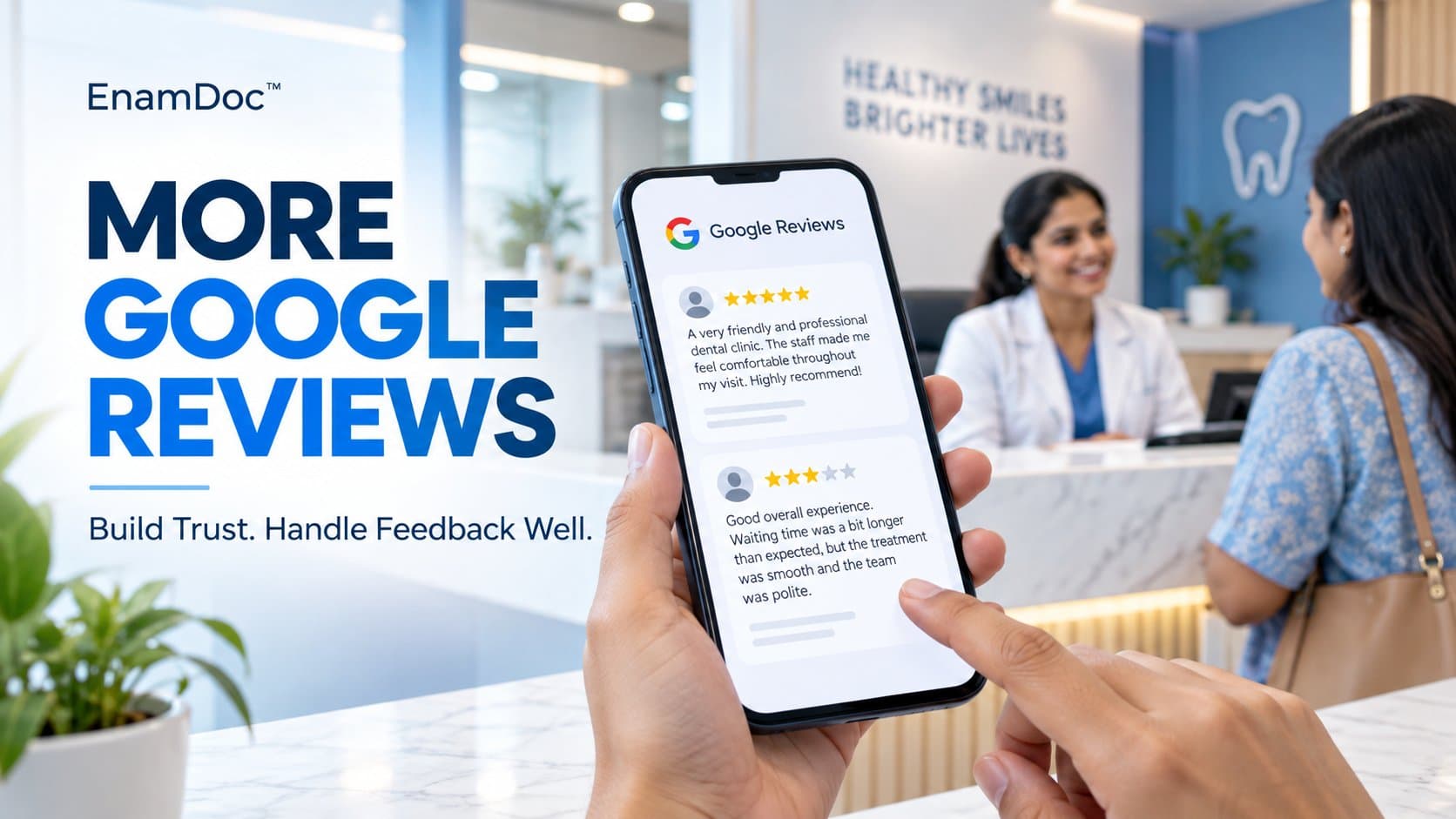
You can have the best clinical skills in your city — but if your Google profile shows 3 stars and a string of unanswered complaints, patients will choose the clinic down the road instead.
Google reviews have become the single most influential factor in where patients book their first dental appointment. Understanding how to ethically build your review count and how to respond to negative feedback without making it worse is now a core part of running a dental practice in India.
Why Google Reviews Matter More Than Any Other Marketing
When a patient searches "dentist near me" or "best dental clinic in [city]," Google's local ranking algorithm considers relevance, distance, and prominence. Your review count and average star rating are a significant component of prominence — they directly affect whether you appear in the top results.
Even more importantly: patients make their booking decision based on reviews. Research consistently shows that the large majority of patients read online reviews before choosing a healthcare provider, and most will not book with a clinic that has fewer than 4 stars or fewer than 10 reviews. Your Google Business Profile is often the first — and most critical — impression you make.
How to Ethically Build Your Review Count
There is no legitimate shortcut. Buying or incentivising reviews violates Google's policies, is ethically problematic in a medical context, and risks having your listing removed entirely. The only sustainable approach is earning real reviews from real patients — and it's simpler than most dentists realise.
Ask at the Right Moment
The best time to ask for a review is immediately after a patient expresses satisfaction — at the front desk or chairside after a procedure that went well. A patient who just told you "this was much better than I expected" is far more likely to leave a review than one you follow up with weeks later. Train your front desk team to ask confidently, not just to hand out a card silently.
Make It Frictionless
Most patients who intend to leave a review never do, simply because they forget or don't know how to navigate to the right page. Create a QR code that links directly to your Google review submission page (not just your Maps listing). Place this at your reception desk, on checkout receipts, and on appointment reminder cards. The fewer steps between intention and action, the higher your conversion rate.
Send a Follow-Up WhatsApp or SMS
A message sent 24–48 hours after a successful appointment, with a direct link to your review page, is one of the most effective tactics available to Indian dental clinics. Keep it personal: "Hi [Name], it was great seeing you today. If you have a moment, a Google review means a lot to us — here's the link: [link]. Thank you." Patients who feel a genuine relationship with their dentist are significantly more likely to act.
Reply to Every Existing Review
Responding to your positive reviews encourages other patients to leave one — people like acknowledgement. It also signals to potential patients that your clinic is attentive and professional. Keep replies brief, genuine, and specific where possible (without compromising patient privacy).
How to Handle Negative Reviews
Negative reviews are inevitable in any practice that sees enough patients. What matters is not whether you receive them, but how you respond. A professionally handled negative review often builds more trust than five consecutive five-star ratings — it demonstrates that you're a real clinic, that you take concerns seriously, and that you operate with integrity.
Respond Quickly and Without Defensiveness
Aim to respond within 24 hours. Never get into a public argument, never reveal clinical details about the patient's treatment (this raises serious confidentiality concerns under India's medical ethics guidelines), and never offer a refund or compensation publicly. Your goal is not to "win" the exchange — it's to show every future patient reading this thread that you handle criticism with professionalism.
A Framework That Works
Here's a template you can adapt: "Thank you for sharing your experience. We're sorry to hear that your visit didn't meet your expectations — this is not the standard we hold ourselves to. We'd like to understand what happened and make it right. Please contact us directly at [number] so we can speak with you. We take all feedback seriously."
This response acknowledges the concern without admitting wrongdoing, takes the conversation offline where you can speak freely, and signals to future readers that you respond rather than ignore. It works whether the review is legitimate or not.
Fake or Defamatory Reviews
If a review is clearly from someone who was never your patient, contains factually false information, or includes personal attacks, you can flag it for removal through Google Maps. This process is slow and not always successful, but it is the correct route. Continue responding as you would to a genuine review — future patients should see only professionalism from your side, regardless of what the reviewer has said.
Building a System That Compounds Over Time
The clinics in India that consistently hold 4.5 stars with hundreds of reviews aren't doing anything complex. They have a consistent system: the front desk asks every satisfied patient, there's a QR code at checkout, follow-up messages go out within 48 hours, and every review gets a reply within a day.
Set concrete targets. If you have fewer than 20 reviews, your first goal is 50. If you have 50, aim for 100. Each milestone makes you more visible in Google's local results and more credible to prospective patients — and the compounding effect over 12 to 24 months is substantial. This is the most cost-effective marketing investment most dental clinics in India can make.
Frequently asked
Frequently asked questions
Can I ask patients to leave a Google review for my dental clinic?
Yes, and you should. Ethically asking satisfied patients for a Google review is entirely appropriate and is standard practice for businesses in India. Ask at the right moment — when a patient has just expressed satisfaction with their treatment — and make it easy by giving them a direct link or QR code. What you cannot do is offer incentives in exchange for reviews, as this violates Google's policies and professional ethics.
How should I respond to a negative Google review of my dental clinic?
Respond within 24 hours, professionally and without defensiveness. Acknowledge the concern, express genuine regret that the experience didn't meet expectations, and invite them to contact you directly to resolve it. Never reveal clinical details about their treatment, never argue publicly, and never offer a refund publicly. Your response is not for the reviewer — it's for every future patient reading the exchange, and what they should see is that you handle criticism with maturity and care.
- google reviews dental clinic
- dental clinic reviews India
- get more patient reviews
- handle negative reviews
- dental practice management
Keep reading