Infection Control and Sterilisation Standards in Dental Clinics: A Practical Guide for Dentists
Maintaining rigorous infection control is both a clinical and regulatory requirement. Dr. Khanak Jain outlines the current sterilisation protocols, instrument decontamination cycles, and surface disinfection standards every dental practice should be meeting.
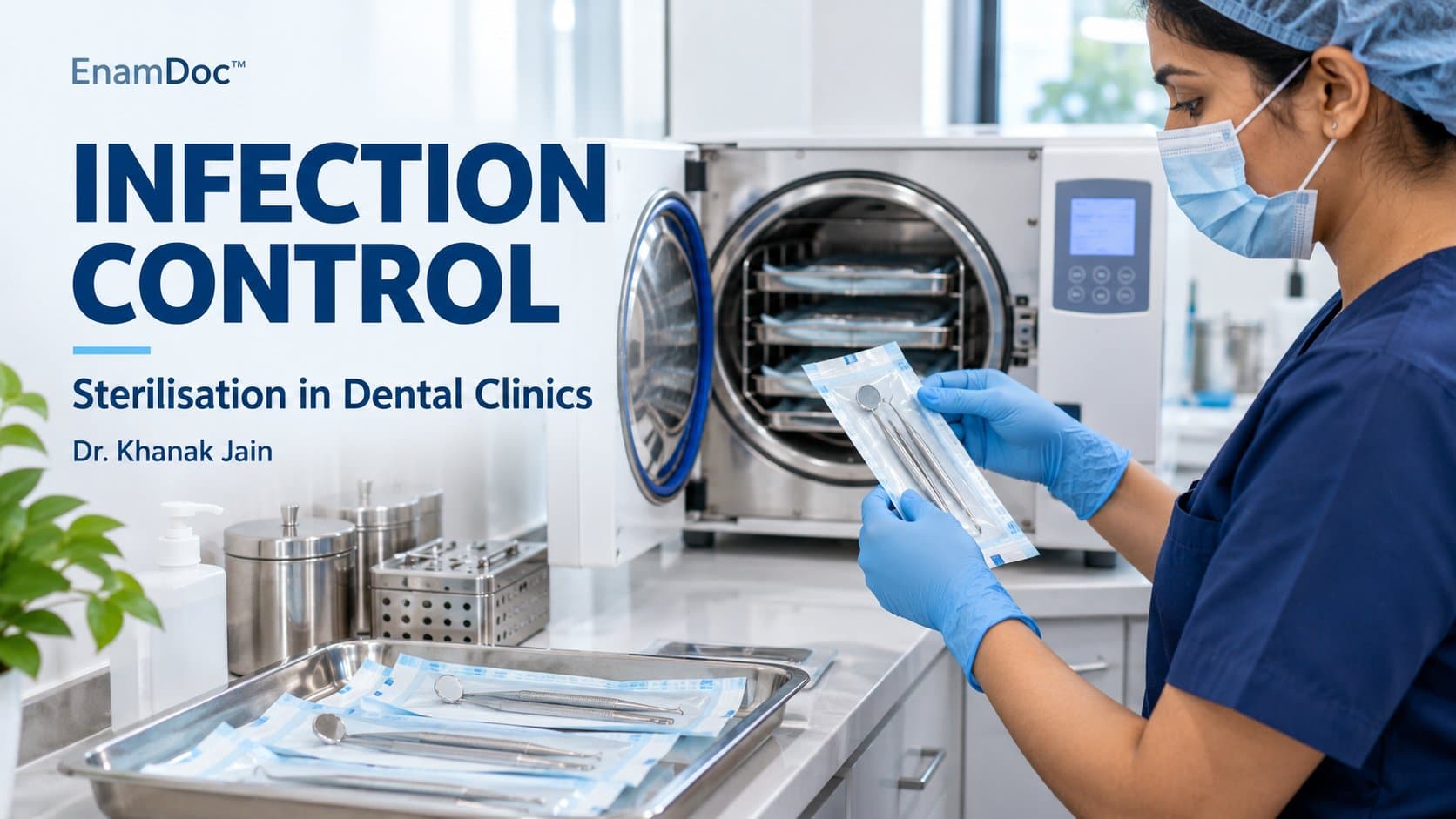
Infection control is not an optional extra in dentistry — it is a fundamental clinical requirement, a patient safety obligation, and in many jurisdictions, a regulatory condition of practice. Yet in the day-to-day pressure of a busy clinic, standards can slip in ways that feel invisible until they cause a serious incident.
This guide covers the essential infection control and sterilisation protocols every dental practice should have in place, from instrument decontamination to surface disinfection to personal protective equipment.
Understanding the chain of infection in dental settings
Dental treatment involves direct contact with blood, saliva, and mucosal tissue. It generates aerosols containing oral bacteria, blood, and other biological material. Instruments are inserted into soft tissue and hard tissue, including bone. The infection risk in dentistry is therefore real and multidirectional — from patient to practitioner, from practitioner to patient, and from one patient to the next via contaminated equipment or surfaces.
Effective infection control breaks this chain at every link. It does not rely on any single step; it depends on a layered system where each element reinforces the others.
Personal protective equipment: the first barrier
PPE is the foundation of infection control for clinical staff. Standard requirements for dental procedures include:
Gloves: Non-sterile examination gloves for routine procedures; sterile gloves for surgical procedures. Gloves must be changed between patients, must not be worn in non-clinical areas, and must be disposed of as clinical waste. Latex-free options should be available for both patients and staff with latex sensitivity.
Masks: Fluid-resistant surgical masks for all procedures. For aerosol-generating procedures (high-speed handpieces, ultrasonic scalers, air-water syringes), FFP2 or FFP3 respirators provide higher filtration. Masks must fit snugly, must be changed between patients or when damp, and must not be touched on the outer surface.
Eye protection: Safety glasses or a face shield must be worn during any procedure where aerosols or splatter are generated. Patient eye protection should also be provided.
Protective clothing: A clean clinical tunic or gown provides a barrier between the practitioner's clothing and potential contamination. Clinical clothing must not be worn outside the practice.
Instrument decontamination: the three-stage cycle
Every reusable dental instrument must go through a validated three-stage decontamination process: cleaning, disinfection, and sterilisation. Skipping or combining stages is not acceptable.
Stage 1: Cleaning
Instruments must be cleaned to remove organic debris before sterilisation can be effective. This is typically done using an ultrasonic cleaner or a washer-disinfector. Manual scrubbing is a higher-risk alternative that exposes staff to sharps injuries and is considered best practice to avoid.
Stage 2: Inspection
After cleaning, instruments should be inspected under magnification for residual debris, damage, or corrosion. Instruments that cannot be adequately cleaned or that are visibly damaged must be taken out of service.
Stage 3: Sterilisation
The standard sterilisation method in dentistry is the autoclave (steam steriliser). Dental autoclaves fall into three classes under European and British standards:
Class N autoclaves sterilise only solid, non-porous unwrapped instruments. They are not suitable for wrapped instruments, hollow items, or porous loads.
Class B autoclaves use a fractional vacuum cycle that penetrates hollow instruments, porous loads, and wrapped instruments. Class B is the required standard for most dental practices, as it handles the full range of instrument types used in clinical dentistry.
Class S autoclaves are intermediate and suited to specific instrument types as defined by their specification.
All autoclaves must be validated when installed, maintained regularly, and tested daily, weekly, and at periodic intervals according to the manufacturer's guidance and applicable standards. Testing records must be kept.
Single-use instruments
Many instruments used in dentistry are designed for single use and must never be reprocessed — needles, cartridges, saliva ejectors, matrix bands, endodontic files in many protocols, and numerous other items. Reprocessing single-use instruments is clinically unsafe and, in most jurisdictions, a regulatory violation. Single-use items should be clearly identified and disposed of as clinical waste after each patient.
Surface decontamination
Clinical surfaces that may be contaminated during treatment — the dental chair, headrest, bracket table, light handles, switches, and spittoon — must be decontaminated between every patient. This involves:
Using disposable covers (barrier protection) on high-touch surfaces that are difficult to clean, changed between patients; wiping down hard surfaces with an appropriate chlorine-releasing disinfectant or a validated surface disinfectant spray or wipe; allowing adequate contact time as specified by the product's instructions for use; and cleaning the floor and other environmental surfaces at the end of each clinical session.
Waste management
Clinical waste must be segregated at the point of generation. Sharps — needles, scalpels, burs — must be placed immediately into a compliant sharps container that is never overfilled. Contaminated soft waste (gloves, masks, swabs) must be disposed of in yellow-lidded clinical waste bags. Non-contaminated packaging and disposables may be discarded as general waste.
Water line maintenance
Dental unit water lines can harbour biofilm, including Legionella and other bacteria, if not maintained correctly. Protocols must include flushing handpieces and air-water syringes for at least two minutes at the start of each day and for at least 30 seconds between patients, treating water lines with appropriate microbial agents, and testing water quality at defined intervals.
Documentation and audit
A written infection control policy specific to your practice is a regulatory requirement in most jurisdictions. It should detail every procedure, assign responsibilities, and be reviewed annually. Autoclave cycles must be logged, including the date, cycle number, temperature, pressure, and result. Staff infection control training should be documented. Regular audits of compliance — ideally by an external reviewer annually — identify gaps before they become incidents.
Infection control is never a one-person responsibility, and it is never finished. Making it a systematic, documented, and regularly reviewed part of practice operations is what keeps patients, staff, and the practice itself safe.
Frequently asked
Frequently asked questions
What is the difference between Class B and Class N autoclaves in dentistry?
Class B (vacuum) autoclaves are the gold standard in dentistry: they use a pre-vacuum cycle to remove air from hollow instruments, wrapped loads, and porous items, ensuring steam penetrates to all surfaces. Class N (gravity) autoclaves are suitable only for unwrapped, solid, non-hollow instruments because they rely on gravity displacement to remove air — steam cannot reliably reach the lumens of handpieces or the interior of tubing. Most dental regulatory bodies now require Class B for practices that process hollow or wrapped instruments, which includes all standard rotary handpieces.
How often should dental unit waterlines be flushed?
Dental unit waterlines (DUWLs) should be flushed for at least 20–30 seconds at the start of each clinical day and for 20–30 seconds between patients to purge patient material and reduce microbial counts. In addition, most guidelines recommend a weekly or monthly chemical treatment — using approved waterline maintenance tablets or shock treatments — to control biofilm build-up within the narrow-bore tubing. Microbial testing of water output is recommended at least quarterly to verify that colony-forming unit (CFU) counts remain below the 200 CFU/mL threshold for dental irrigation water, or below 100 CFU/mL in jurisdictions that follow European standards.
- infection control
- dental sterilisation
- autoclave
- decontamination
- cross-infection prevention
- dentists
- clinical practice
Keep reading