Pit and Fissure Sealants: The Simple Procedure That Protects Your Child's Teeth From Cavities
Dental sealants are one of the most cost-effective and painless ways to prevent cavities in children — yet most parents have never heard of them. Here's what they are, how they work, and whether your child needs them.
Medically reviewed by Dr. Aditya Swami, BDS
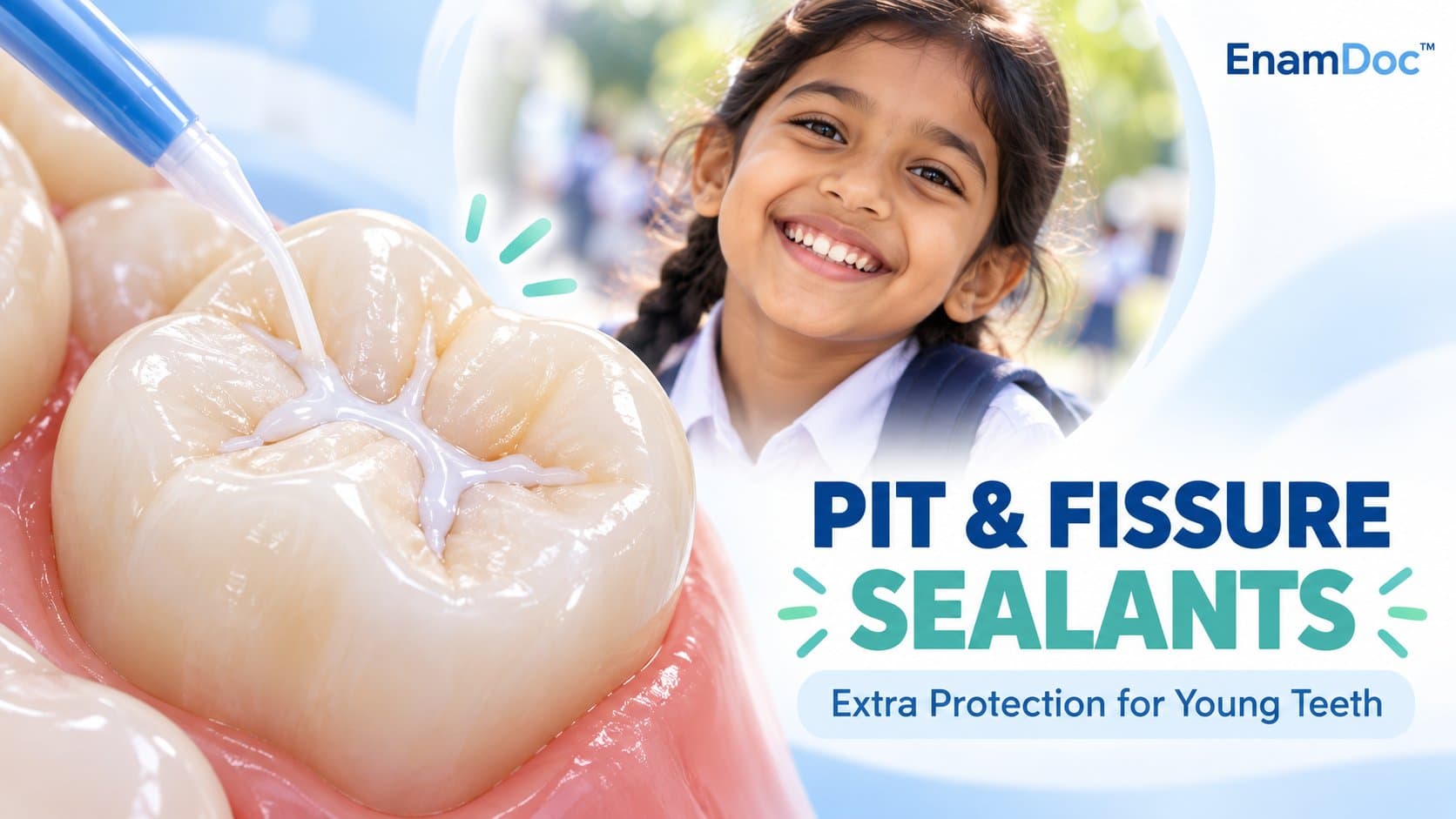
Your child's back teeth — the molars — are full of tiny grooves and pits that are almost impossible to clean properly with a toothbrush. Food and bacteria get trapped in these crevices, and cavities form. Pit and fissure sealants are thin protective coatings applied to the chewing surfaces of these teeth to seal out the threat entirely. The procedure takes about 15 minutes per tooth, requires no drilling, and can prevent up to 80% of cavities in the back teeth.
What Are Pit and Fissure Sealants?
A dental sealant is a thin, plastic-like resin that is painted onto the deep grooves (pits and fissures) on the biting surfaces of back teeth — primarily the premolars and molars. Once applied and hardened with a special curing light, it acts as a physical barrier that prevents food particles and bacteria from settling into those crevices where a toothbrush simply cannot reach.
Sealants have been used in dentistry since the 1960s and are endorsed by the Indian Dental Association, the American Dental Association, and virtually every paediatric dental body worldwide. They are one of the most evidence-backed preventive procedures in all of dentistry.
Who Should Get Dental Sealants?
Sealants are primarily recommended for children and teenagers because the risk of developing cavities in the back teeth is highest in the first few years after those teeth erupt. The typical treatment timeline looks like this:
- Age 6–7: First permanent molars erupt. Sealants should ideally be applied within 1–2 years of eruption, before any early decay begins.
- Age 11–13: Second permanent molars erupt. A second round of sealants is typically recommended at this stage.
- Teenagers and young adults: Anyone with deep grooves and no existing decay or fillings may benefit from sealants.
Adults can also receive sealants if their back teeth have deep grooves and are free of existing decay or large fillings. However, the benefit is greatest when applied early — before cavities have a chance to develop.
The Sealant Procedure: Step by Step
One of the biggest advantages of dental sealants is how quick and painless the procedure is. Here is exactly what happens during a sealant appointment:
- Cleaning: The tooth is thoroughly cleaned and dried. No anaesthetic is required — there is no drilling or cutting of tooth structure.
- Etching: A mild acidic gel is applied to the tooth surface for about 15 seconds to create a slightly rough surface that helps the sealant bond properly. The gel is rinsed off and the tooth is dried again.
- Sealant application: The liquid sealant resin is painted into the grooves and pits of the tooth. It flows into all the tiny crevices.
- Curing: A blue curing light is held over the tooth for about 30 seconds to harden the sealant completely.
- Check and polish: Your dentist will check your bite to make sure the sealant isn't too high, and do a quick polish. That's it.
The entire process for one tooth takes roughly 15 minutes. Multiple teeth are often treated in the same visit.
How Effective Are Sealants?
The evidence is remarkably strong. Studies have consistently found that dental sealants can prevent up to 80% of cavities in the back teeth for the first two years after application, and up to 50% of cavities for up to four years. A 2016 report by the CDC found that school-age children without sealants had nearly three times more cavities in their back teeth than children with sealants.
In India, where sugar consumption has increased significantly over the past two decades and access to regular dental care is uneven, sealants represent a particularly high-value preventive investment. A single sealant application costs a fraction of what even a small filling costs — and far less than a root canal.
How Long Do Sealants Last?
Dental sealants typically last between 5 and 10 years with normal use. They can chip or wear down over time, especially if the child grinds their teeth or bites on very hard foods. Your dentist will check the condition of the sealants at each routine visit and can reapply them if needed — the touch-up process is just as quick and painless as the original application.
Are Sealants Safe?
Sealants are extremely safe. They are made from materials similar to composite (tooth-coloured) filling material. There have been some questions in the past about BPA (bisphenol A) content in early sealant formulations, but modern sealants contain minimal to no BPA, and the trace amounts that may exist are far below any level considered harmful. Dozens of dental and health authorities worldwide have reviewed the research and concluded that sealants pose no meaningful health risk.
Some sealants are tooth-coloured and virtually invisible; others are slightly white or off-white and may be visible when the child laughs or yawns — but they are not noticeable in normal conversation.
Sealants vs Fluoride: Do You Still Need Both?
Yes — sealants and fluoride serve different functions and work together. Fluoride strengthens the entire tooth surface and protects the smooth surfaces between teeth from decay. Sealants specifically protect the deep grooves on the chewing surfaces. Neither replaces the other. Children should receive both fluoride applications (through toothpaste, fluoride treatments, or fluoridated water) and sealants on their back teeth for optimal cavity prevention.
Brushing, flossing, and regular dental check-ups remain essential. Sealants reduce the risk of cavities on the chewing surface — they do not protect the spaces between teeth, which is where flossing does its job.
Finding a Dentist for Dental Sealants
Any general dentist or paediatric dentist (pedodontist) can apply sealants. If your child has not had their back teeth sealed, it is worth raising the topic at your next routine appointment — especially if your child is between 6 and 14 years old.
On EnamDoc, you can find verified paediatric dentists and general dentists near you who offer preventive treatments including dental sealants. Booking takes a minute, and protecting your child's teeth for years costs far less than you might expect.
Frequently asked
Frequently asked questions
At what age should my child get dental sealants?
The best time to apply sealants is shortly after the back teeth erupt — typically around age 6–7 for the first permanent molars and age 11–13 for the second molars. Applying sealants early, before any decay develops, gives you the maximum preventive benefit. That said, children and teenagers up to age 18 (and even some adults) can benefit from sealants if their back teeth are groove-heavy and cavity-free.
Do dental sealants hurt?
No — sealants are completely painless. There is no drilling, no anaesthetic injection, and no removal of tooth structure. The procedure involves cleaning the tooth, applying a mild etching gel (which you barely feel), painting on the sealant liquid, and shining a curing light on it. Most children tolerate the procedure without any discomfort at all. The whole process for one tooth takes about 15 minutes.
How much do dental sealants cost in India?
The cost of dental sealants in India typically ranges from ₹500 to ₹1,500 per tooth, depending on the city, the clinic, and the dentist's experience. Sealing all four first molars at once might cost ₹2,000–₹5,000 in total. Compare this with the cost of even a small filling (₹1,000–₹3,000 per tooth) or a root canal (₹5,000–₹15,000+), and sealants represent outstanding value for money as a preventive measure.
- dental sealants
- pit and fissure sealants
- children's dentistry
- cavity prevention
- pediatric dentistry
Keep reading