Receding Gums: Why It Happens, How Far It Can Go, and What Actually Helps
Gum recession is gradual and often painless until it's already advanced. Here's what causes it, how far it can progress if left untreated, and what treatments actually work — based on how severe the recession is.
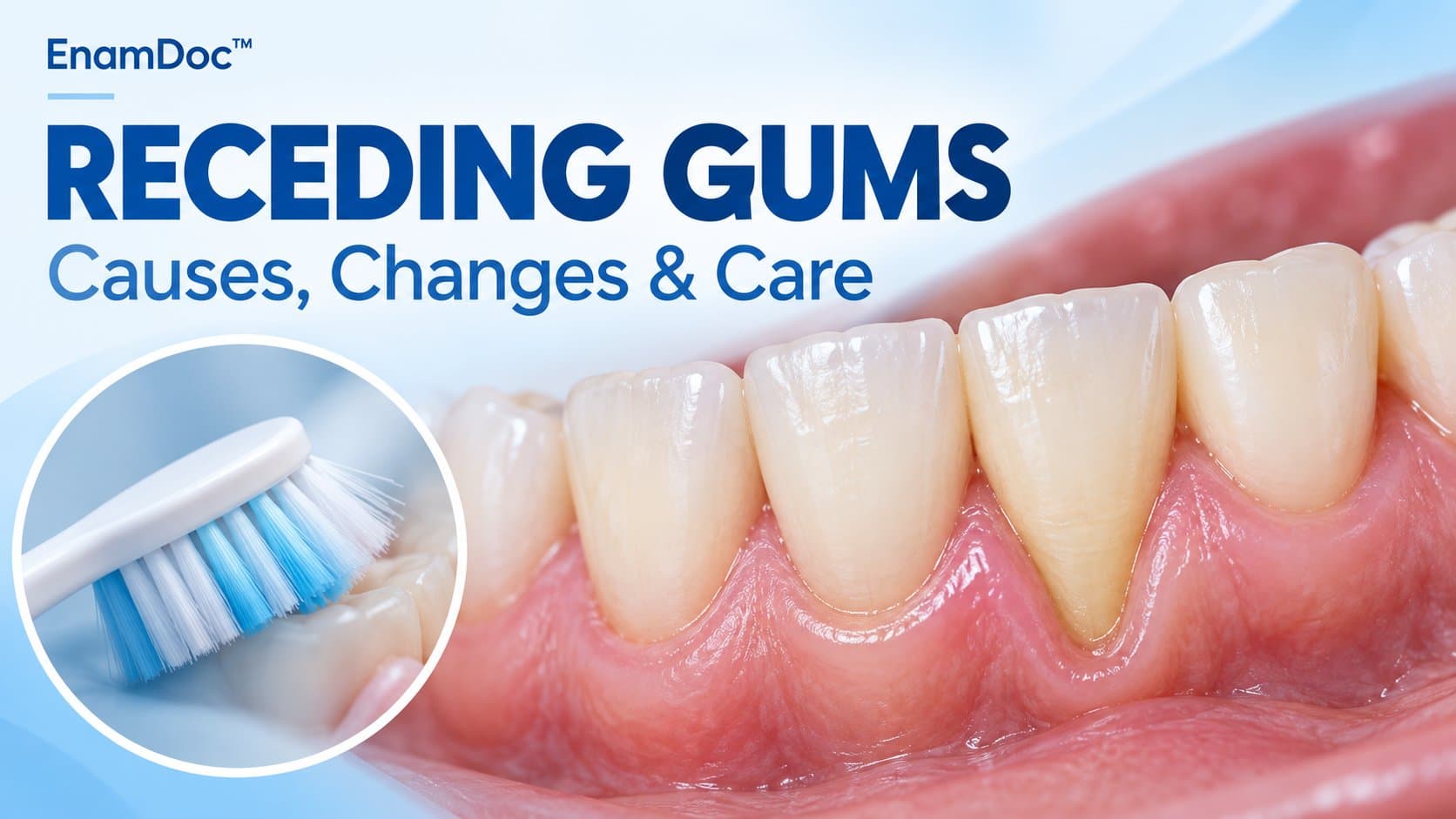
Your gums look a little lower than they used to. A tooth that once felt solid now has a longer-looking crown. Maybe you've noticed some sensitivity at the gumline — cold water, a cold breath of air. Receding gums are easy to miss until the recession is already significant, which is part of what makes them tricky to manage.
This guide explains what gum recession actually is, why it happens, what the progression looks like, and what works to slow or reverse it — based on how far it's advanced.
What Is Gum Recession?
Gum recession is the gradual pulling back of the gum tissue from the teeth, exposing more of the tooth root. Unlike bone loss, which is invisible from the outside, recession can be seen in the mirror — but because it's slow and often painless at first, most people don't notice it until a dentist points it out or until sensitivity develops.
The exposed root surface (called dentine) is softer than enamel and more sensitive. It's also at higher risk of decay and erosion because it lacks the protective enamel layer that covers the crown of the tooth.
What Causes Gum Recession?
Several different things can cause recession, and they often overlap:
Gum Disease (Periodontitis)
The most common cause in adults over 40. Bacterial plaque and tartar build up below the gumline, triggering an inflammatory response that gradually destroys the gum tissue and the bone beneath it. The gums recede as the supporting structures break down. Without treatment, this progresses — and it's irreversible once the tissue is gone.
Aggressive Tooth Brushing
Brushing hard with a medium or firm-bristled toothbrush causes physical wear on the gum tissue over years. The recession that results tends to appear on the outer (buccal) surfaces of teeth, particularly on the prominent canines. This is one of the most preventable causes — switching to a soft-bristled brush and a gentle technique (small circular strokes rather than horizontal scrubbing) stops the progression.
Thin Gum Tissue (Gingival Biotype)
Some people are born with naturally thin gum tissue. Thin-biotype gums are more fragile and more likely to recede in response to inflammation, friction, or orthodontic treatment. This is partly genetic — if your parents had receding gums, your risk is higher.
Teeth That Are Outside the Arch (Tooth Position)
A tooth that juts outward (labially) sits with less bone and gum tissue covering its root. Recession is more likely at these teeth, both due to anatomy and because the gum tissue is stretched thin over the prominence.
Orthodontic Treatment
Moving teeth with braces or aligners can cause recession, particularly if the tooth is moved too rapidly or outside the bounds of the bone. This is more common with thin gum biotypes. It's not universal — many orthodontic patients have no recession — but it's a risk that should be discussed before treatment begins, especially if you already have minimal gum tissue.
Piercings and Habits
Lip and tongue piercings can rub against gum tissue and cause localised recession. Nail-biting, pen-chewing, and similar habits can do the same at specific teeth.
How Far Can Recession Go?
Recession is measured in millimetres from the cementoenamel junction (CEJ — the boundary between the crown and root) to the gum margin. Early recession might be 1–2 mm. Moderate is 3–4 mm. Severe recession can reach 5 mm or more, exposing a significant portion of the root surface.
Left untreated — particularly when caused by gum disease — recession progresses. The rate varies considerably: active periodontitis can cause measurable tissue loss in months, while recession from brushing technique may develop slowly over years. In severe, long-standing cases, teeth can eventually become mobile and may be lost.
Bone loss accompanies gum recession when the cause is periodontitis. Recession from brushing technique may not involve bone loss, which changes the treatment options and prognosis.
What Treatments Actually Work
Treating the Cause First
No recession management is effective if the underlying cause is still active. Gum disease must be treated (scaling and root planing, possibly surgery) before gum grafting can succeed. Brushing technique must be corrected before grafted tissue will be maintained. The first conversation with your periodontist is about identifying and addressing the cause.
Scaling and Root Planing (Deep Cleaning)
For recession caused by gum disease, professional debridement of the root surfaces is the foundational treatment. It removes the bacterial deposits that drive inflammation, allowing the gum tissue to stop receding. Scaling and root planing doesn't restore lost tissue, but it stops the progression.
Gum Grafting (Connective Tissue Graft / Free Gingival Graft)
For recession of 2 mm or more where root coverage is desired — either for aesthetics or to reduce sensitivity — a gum graft can add tissue back. The most common technique is a connective tissue graft: a small piece of tissue is taken from the roof of the mouth (palate) and placed over the exposed root, where it attaches and covers the recession.
Results are good in the right cases — most well-executed grafts achieve partial or complete root coverage. The procedure is done under local anaesthesia and causes soreness at both the donor and recipient sites for a week or two afterward.
Not every case of recession needs a graft. Mild, stable recession with no sensitivity or aesthetic concern may be monitored rather than treated immediately.
The Pinhole Surgical Technique
A newer, less invasive alternative to traditional grafting for suitable cases. Gum tissue is repositioned through a small pinhole opening rather than through a conventional incision, with no donor site on the palate. Recovery is faster. It's not available everywhere, but it's an option worth asking about.
Addressing Soft Tissue without Grafting
Where recession is mild and stable and no graft is being planned, the goal is preventing further loss: impeccably gentle brushing, regular scaling to control any gum disease, and monitoring at dental visits. Some early recession does remain stable for years with good technique.
What Doesn't Work
- Oil pulling — no clinical evidence for reversing recession
- Aloe vera or herbal rinses — may have mild anti-inflammatory effects but won't regrow lost tissue
- Changing toothpaste alone — sensitivity toothpaste reduces symptoms but doesn't address the structural loss
- "Gum-regenerating" products from pharmacies — no over-the-counter product regenerates gum tissue; these are marketing claims
When Should You Seek Evaluation?
If you notice any of the following, book a dental appointment:
- Teeth that appear longer than before
- Sensitivity at the gumline, especially to cold
- Gums that bleed with brushing (more likely early gum disease than recession)
- A visible notch or groove at the root of any tooth
Your dentist or periodontist can measure the recession, identify the cause, and decide whether active treatment or monitoring is appropriate. Using EnamDoc to track your dental appointments means the clinical measurements made at each visit can be compared over time — important for detecting whether recession is stable or progressing.
The Bottom Line
Gum recession doesn't reverse on its own, and it doesn't stop without addressing the cause. But caught early and managed properly, its progression can be halted — and where necessary, gum grafting can restore lost tissue. The key is not waiting until the recession is severe before seeking an evaluation.
Frequently asked
Frequently asked questions
Can receding gums grow back on their own?
No — gum tissue that has already receded does not regenerate on its own. Once the gum margin has moved downward, it stays there unless surgically repositioned or augmented with a gum graft. What can be achieved without surgery is halting further recession by addressing the cause — treating gum disease, correcting brushing technique, or removing the source of trauma. Early, stable recession with no sensitivity or aesthetics concern is often managed by monitoring and preventive care rather than grafting.
Does brushing too hard cause gum recession?
Yes — aggressive brushing with a medium or hard-bristled brush is one of the most common causes of gum recession, particularly on the outer surfaces of prominent teeth like the canines. The mechanical friction wears the gum tissue away over time. Switching to a soft-bristled brush and using a gentle technique — small circular or sweeping motions rather than horizontal scrubbing — stops this type of recession from progressing. An electric toothbrush with a pressure sensor can also help people who habitually brush too hard.
What is a gum graft, and does it hurt?
A gum graft (most commonly a connective tissue graft) involves taking a small piece of tissue from the roof of your mouth (palate) and stitching it over the area of recession, where it heals into place and covers the exposed root. The procedure is performed under local anaesthesia, so you won't feel pain during it. Afterward, you'll typically have soreness at both the palate (donor site) and the grafted area for 1–2 weeks. Most people manage this with over-the-counter pain relief. The results are generally good — when done at the right time and for the right case, grafts often achieve partial or complete root coverage.
- receding gums
- gum recession
- periodontitis
- gum graft
- gum disease
Keep reading