Root Canal vs Tooth Extraction: Which Should You Actually Choose?
If your dentist says you have two options — save the tooth or remove it — here's how to think through that decision without regret.
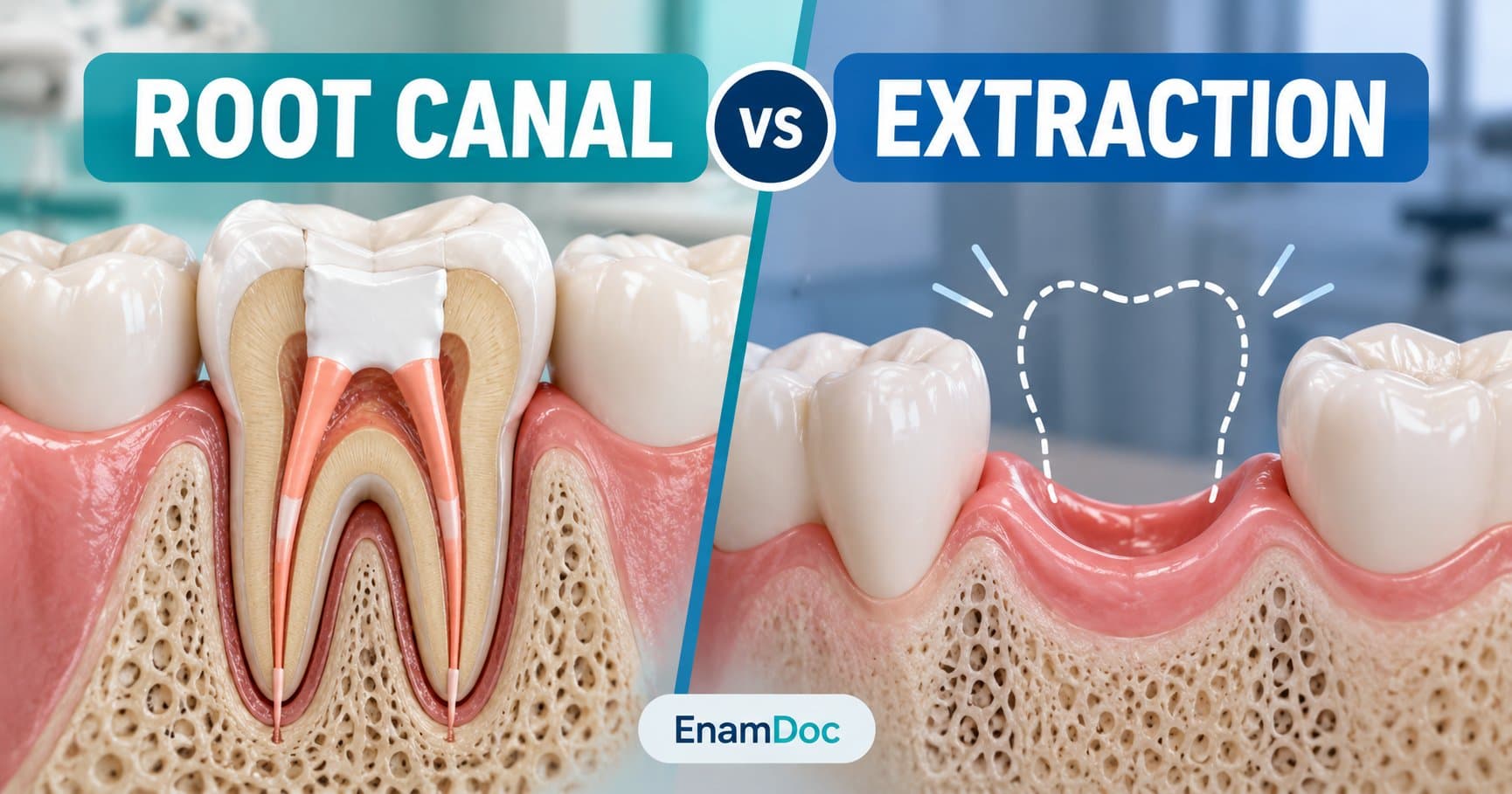
This is one of the most common decisions patients face in a dental chair: your dentist has told you the tooth is badly infected or damaged, and now you need to choose between saving it with a root canal or removing it altogether.
Both options end your toothache. But they have very different long-term consequences — and the "cheaper" option now can become the more expensive one over time.
Here's the honest breakdown.
Understanding Root Canal Treatment (RCT)
A root canal (endodontic treatment) removes the infected pulp tissue from inside the tooth — the nerves and blood vessels in the root canals. The canal is then cleaned, shaped, disinfected, and sealed. A crown is placed afterward to protect the tooth structure.
The result: The tooth is biologically dead (no more nerve) but fully functional. It stays in your mouth, holds its space in the jaw, and you can chew on it normally.
Timeline: 1–3 appointments (sometimes more for complex cases)
Cost in India: ₹3,000 – ₹15,000 for RCT + ₹5,000 – ₹20,000 for crown
Understanding Tooth Extraction
Extraction removes the entire tooth. The gap left behind requires a replacement — a dental implant, a bridge, or a removable partial denture — to maintain function and prevent neighbouring teeth from shifting.
Timeline: Single appointment in most cases
Extraction cost: ₹500 – ₹3,000
But replacement costs: ₹15,000 – ₹80,000+ depending on what you choose
The Critical Thing People Miss: Replacement Costs
A tooth extraction looks dramatically cheaper at first glance. But most people eventually need to fill that gap — especially for back teeth used in chewing.
If you don't replace the tooth:
- Adjacent teeth gradually drift into the space
- The opposing tooth "supererupts" (grows further out of the gum)
- Jawbone in the gap begins to resorb
- Bite changes, which can cause jaw pain and affect other teeth
So a ₹2,000 extraction that ultimately leads to a ₹60,000 implant isn't actually cheaper than a ₹20,000 root canal + crown that lasts 15+ years.
When Dentists Recommend Root Canal
Root canal is generally preferred when:
- The tooth structure above the gumline is salvageable
- There is no vertical root fracture
- Adequate bone support remains
- The patient wants to preserve their natural tooth
- Cost over the long term is being considered
Most dentists consider saving a natural tooth the first priority. Nothing replaces a natural tooth perfectly.
When Extraction Makes More Sense
Extraction is recommended when:
- The tooth is cracked vertically through the root (unfixable)
- Severe bone loss means the tooth cannot be saved
- The root canals cannot be accessed or cleaned (extreme calcification)
- The patient's systemic health makes prolonged treatment inadvisable
- The tooth is a wisdom tooth causing issues (often not replaced)
A Quick Comparison
| Factor | Root Canal + Crown | Extraction |
|---|---|---|
| Preserves natural tooth | ✅ Yes | ❌ No |
| Prevents bone loss | ✅ Yes | ❌ No |
| Upfront cost | Higher | Lower |
| Long-term cost (with replacement) | Often lower | Often higher |
| Appointments | 2–4 | 1 |
| Pain during procedure | Minimal (anaesthesia) | Minimal (anaesthesia) |
| Recovery | 1–3 days sensitivity | 3–7 days healing |
The Fear Factor
Root canals have a terrible reputation for pain, mostly from procedures done decades ago with older techniques. Modern root canal treatment performed under local anaesthesia is no more uncomfortable than getting a filling. What hurts is the infection — not the treatment.
How EnamDoc Supports Your Decision
EnamDoc's digital patient records allow dentists to share X-rays, treatment plans, and cost breakdowns with patients clearly before any decision is made. You can review your options, ask questions, and book follow-up appointments all in one place — making the treatment decision less rushed and more informed.
Frequently asked
Frequently asked questions
Does a root canal hurt more than an extraction?
Both procedures are done under local anaesthesia, so neither should hurt during treatment. Post-procedure discomfort is typically higher after extraction than after root canal. Most patients who say root canals hurt are recalling pre-treatment pain from the infection, not the procedure itself.
If I extract the tooth, do I need to replace it?
Yes, in almost every case. A missing tooth leads to drifting of adjacent teeth, bone loss in the jaw, and changes in your bite. You will likely need an implant or bridge later — which costs more than the extraction itself. Factor that into your decision.
Can a tooth that needs extraction be saved with a root canal instead?
Not always. If the tooth is severely cracked below the gum line, has a fracture through the root, or the bone support is too compromised, a root canal cannot save it. Your dentist will assess with X-rays whether the tooth is restorable.
- root canal
- tooth extraction
- dental treatment
- save tooth
- RCT
Keep reading