Wisdom Tooth Pain: When You Need It Removed and When You Can Wait
Not all wisdom tooth pain means extraction. This guide explains when removal is genuinely necessary, when monitoring is fine, and what to expect from the procedure if you do need it.
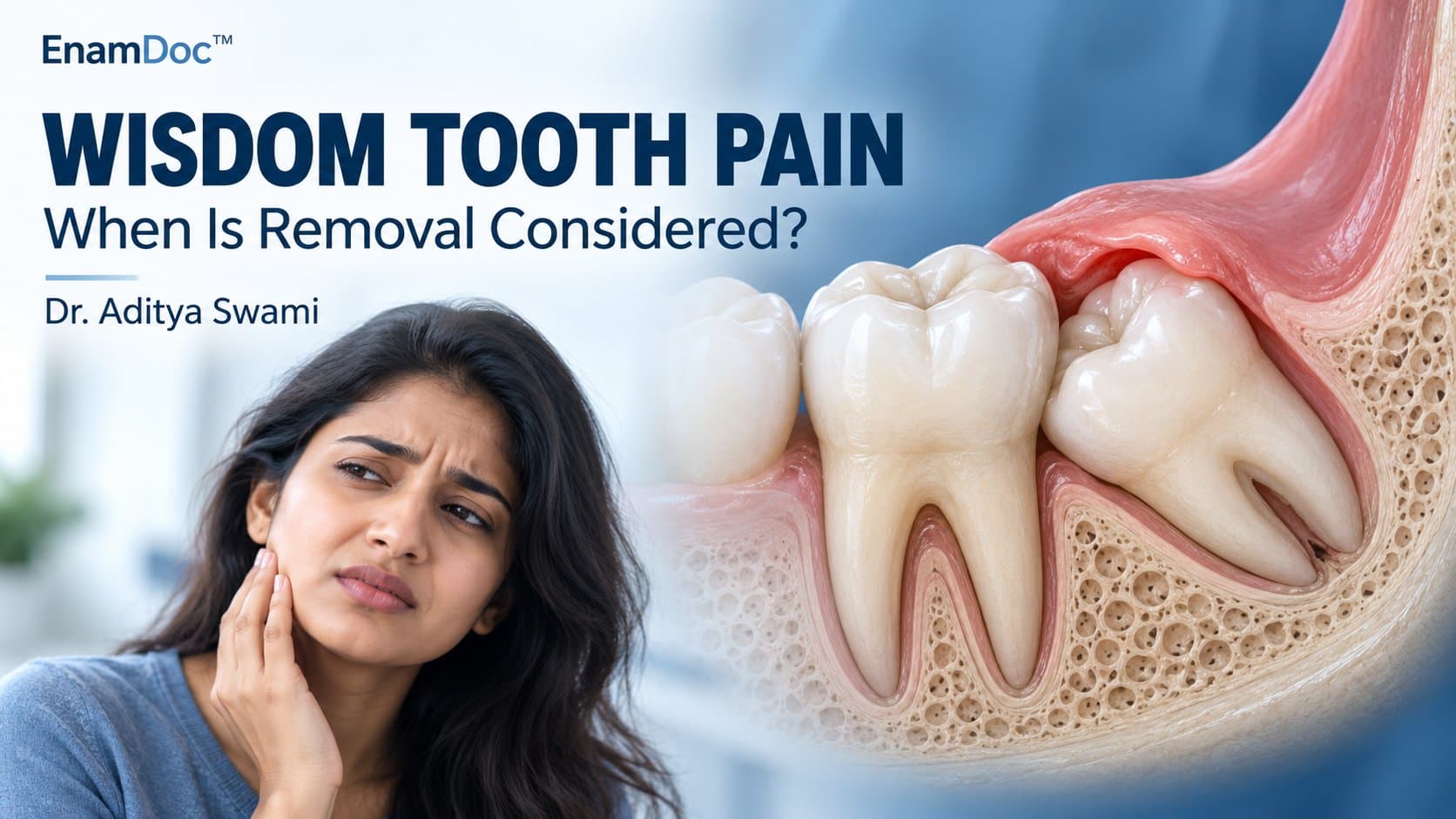
Wisdom tooth pain is one of the most common reasons adults visit a dentist or head to an emergency room. But here is something many people do not know: the pain does not automatically mean you need surgery. Whether removal is necessary depends on why the tooth is causing problems — and that requires a proper examination and X-ray, not just a judgment call made on discomfort alone.
This guide explains when wisdom tooth removal is the right call, when watchful waiting is acceptable, and what to expect if you do go ahead with extraction.
What Are Wisdom Teeth and Why Do They Cause Problems?
Wisdom teeth — also called third molars — are the last set of permanent teeth to emerge, typically between the ages of 17 and 25. Most adults have four (one in each corner), though some people have fewer or none at all.
Problems arise when there is not enough space in the jaw for them to come in fully. This can result in:
- Impaction — the tooth is blocked by bone, gum, or the adjacent tooth and cannot fully erupt
- Partial eruption — the tooth breaks through the gum but only partially, leaving a flap of gum tissue that traps food and bacteria
- Crowding — the emerging tooth pushes other teeth out of alignment
- Cysts — a fluid-filled sac forms around an unerupted tooth, potentially damaging surrounding bone and teeth
When You Definitely Need Extraction
Removal is clearly indicated in the following situations:
1. Pericoronitis (Gum Infection Around the Tooth)
This is the most common reason for urgent wisdom tooth removal. When a tooth is partially erupted, the gum flap over it becomes a breeding ground for bacteria. Symptoms include swelling, pain, difficulty opening the mouth, and sometimes fever or swollen lymph nodes. A single episode of pericoronitis may be managed with antibiotics and cleaning — but if it keeps recurring, removal is the definitive solution.
2. Decay in the Wisdom Tooth
Wisdom teeth are difficult to clean thoroughly because of their position at the back of the mouth. If a wisdom tooth has developed significant decay, especially if it cannot be restored with a filling, removal makes more sense than repeated dental work on a tooth that is likely to cause problems again.
3. Decay in the Adjacent Second Molar
An impacted wisdom tooth leaning against the tooth in front of it can cause decay or damage at the contact point of the second molar — a tooth that is far more valuable. This is one of the stronger arguments for removing an asymptomatic wisdom tooth proactively.
4. A Cyst or Tumour Has Formed
An unerupted wisdom tooth can occasionally trigger the formation of a dentigerous cyst. Left untreated, these can expand, damage the jawbone, and affect adjacent teeth. Cysts discovered on X-ray are a clear indication for removal, regardless of whether the tooth is causing pain.
5. Orthodontic or Surgical Reasons
If you are having orthodontic treatment or jaw surgery, your orthodontist or surgeon may request wisdom tooth removal to prevent them from interfering with tooth movement or healing.
When You Can Wait (or Possibly Never Remove Them)
Not every wisdom tooth needs to come out. Monitoring is entirely appropriate in these situations:
Fully Erupted, Healthy, and Functional
If your wisdom teeth have erupted completely, are in a good position, and you can clean them properly — there is no reason to remove them. Some people keep all four wisdom teeth for life with no issues whatsoever.
Impacted But Causing No Problems
A deeply impacted wisdom tooth that shows no signs of decay, infection, or cyst formation on X-ray may be safely monitored, especially in older patients where surgery carries higher risk. The evidence for preventive removal of asymptomatic impacted wisdom teeth is less clear-cut than it used to be — many dental guidelines no longer recommend routine prophylactic extraction.
The Patient Has Medical Risk Factors
For elderly patients, those on blood thinners, or those with conditions that complicate wound healing, the benefits of removal must be weighed carefully against surgical risk. A dentist experienced in oral surgery will guide this decision.
What Happens During Wisdom Tooth Extraction?
Simple extractions (fully erupted teeth) are often done under local anaesthetic by a general dentist and take just a few minutes. Surgical extractions (impacted teeth requiring incision and possibly bone removal) may be done by an oral surgeon and take longer — typically 20–45 minutes per tooth. Most patients receive local anaesthesia; sedation is an option for anxious patients or complex cases.
Recovery: Most people return to normal within 3–5 days for simple extractions, and 7–10 days for surgical cases. Swelling peaks at around 48–72 hours. Soft foods, ice packs in the first 24 hours, and avoiding smoking or straws (to prevent dry socket) are the key aftercare points.
The Dentist Is Right to Look at X-Rays First
Pain alone is not sufficient to decide on extraction. The position of the tooth relative to the jaw nerve (the inferior alveolar nerve), the proximity to the second molar, the degree of impaction, and your overall bone structure all matter. A periapical or panoramic X-ray is essential before any recommendation is made.
Bottom Line
Wisdom tooth pain is common, but removal is not always the answer. Extraction is clearly the right call when there is infection, decay, damage to adjacent teeth, or a cyst. But a fully impacted, asymptomatic wisdom tooth in a patient with no clear risk factors may be better left alone with regular monitoring. The key is getting a proper assessment — not just paracetamol and a referral by default.
Frequently asked
Frequently asked questions
What is dry socket and how do I avoid it?
Dry socket (alveolar osteitis) occurs when the blood clot that forms in the extraction site dislodges or dissolves before healing is complete, exposing the bone. To avoid it: do not smoke for at least 72 hours after extraction, avoid using a straw (the suction can dislodge the clot), and do not spit forcefully. Dry socket causes significant pain starting 2–4 days after extraction — if you experience this, return to your dentist, who will place a medicated dressing in the socket.
Is it normal for a wisdom tooth to cause ear pain?
Yes — referred pain from a wisdom tooth can radiate to the ear, jaw, or throat. This is because the nerves supplying the lower wisdom tooth area are closely connected to those that serve the ear. Ear pain without any ear infection or hearing issue, especially when it coincides with jaw discomfort or difficulty opening your mouth, is worth having your dentist evaluate.
At what age is wisdom tooth removal most straightforward?
Generally, younger patients (late teens to mid-20s) recover faster and have fewer complications because the roots are not fully formed and the bone is less dense. Removal in older adults is still done routinely but may involve more complex surgery, longer recovery, and slightly higher risk of nerve proximity issues. That said, age alone is never the deciding factor — the reason for removal and the individual anatomy matter most.
- wisdom tooth
- wisdom tooth removal
- third molar extraction
- impacted wisdom tooth
Keep reading