Wisdom Tooth Removal in India: Cost, Process & Recovery
Wisdom tooth pain doesn't always mean you need surgery — but sometimes it does. Here's how to know, what removal costs in India, and what the recovery actually involves.
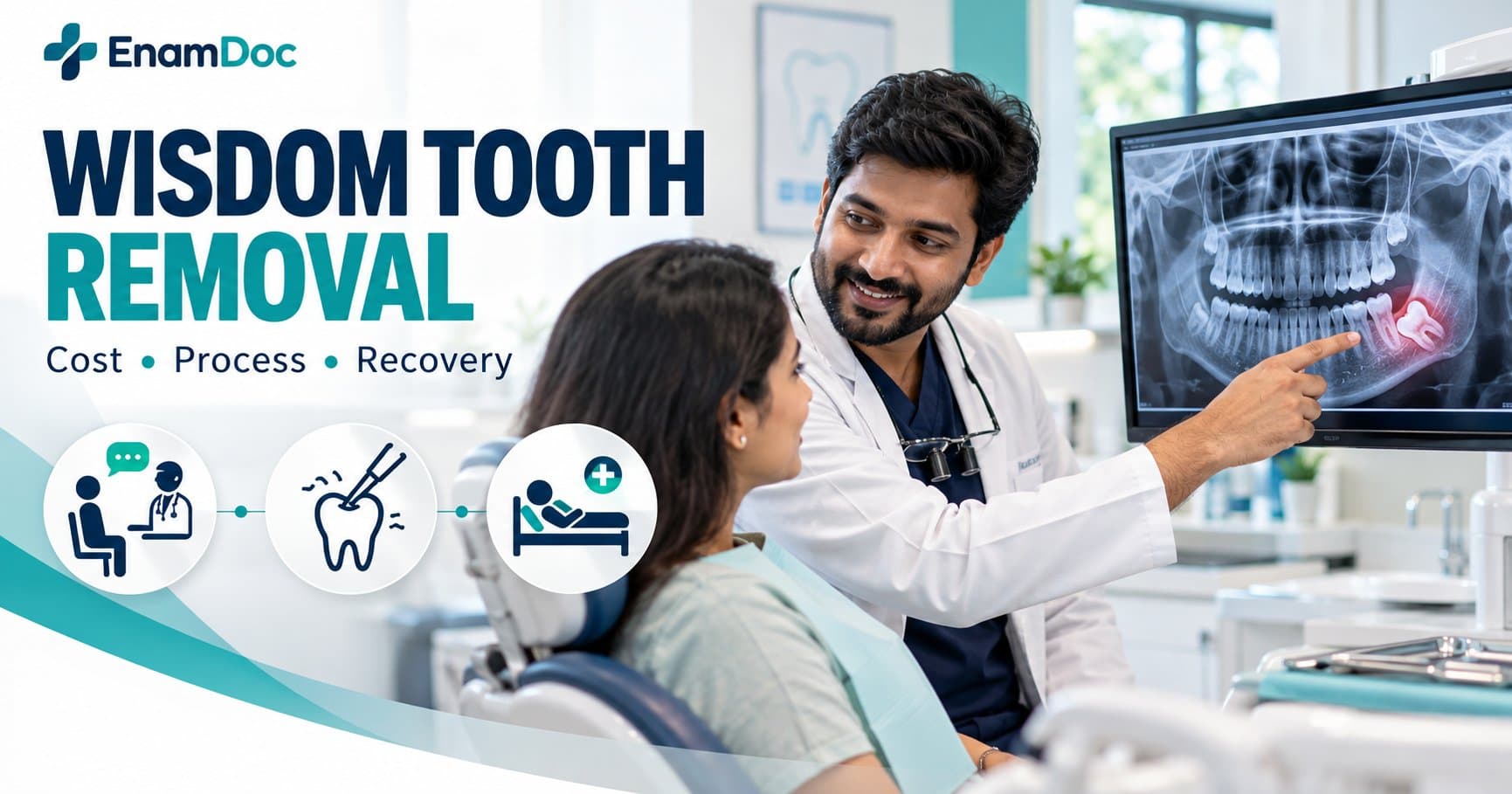
Do You Actually Need Your Wisdom Teeth Removed?
Not everyone does. That's the first thing to understand. In some people, wisdom teeth erupt fully, align well, and cause no problems whatsoever. In others, they remain partially or fully trapped beneath the gum — a condition called impaction — which leads to pain, infection, and pressure on neighbouring teeth.
The decision to remove a wisdom tooth isn't automatic. It comes down to what your X-rays show and what symptoms, if any, you're experiencing. Your dentist or oral surgeon will typically recommend extraction when:
- The tooth is impacted and cannot emerge properly
- There's recurrent infection or swelling around a partially erupted tooth (pericoronitis)
- The wisdom tooth is causing crowding or pushing against the second molar
- A cyst or other pathology has developed around the impacted tooth
- Decay has set in that can't be treated easily due to the tooth's position
If none of these apply, a "watchful waiting" approach is perfectly reasonable — provided you keep up with regular dental X-rays to monitor for changes.
Types of Wisdom Tooth Impaction
Understanding what type of impaction you have gives you context for why one removal might be simpler than another:
- Soft tissue impaction – The tooth has broken through bone but remains partially covered by gum. Relatively straightforward to remove.
- Partial bony impaction – Part of the tooth is still enclosed in the jawbone. Requires more work.
- Full bony impaction – The tooth is completely surrounded by bone. Typically the most complex and time-consuming procedure.
- Horizontal impaction – The tooth is growing sideways, directly into the second molar. Usually requires surgical extraction.
Your X-ray (typically a panoramic or OPG X-ray) will show the type of impaction and the position of the roots relative to nerves and sinuses — both of which affect the surgical plan.
What Happens During Wisdom Tooth Removal
The procedure is done under local anaesthesia in most Indian dental clinics. Here's what to expect:
Step 1: Numbing the Area
The surgeon injects a local anaesthetic around the tooth and jaw. Within a few minutes, you'll feel pressure and movement but no sharp pain. For very anxious patients, mild sedation (oral or IV) is sometimes offered at select clinics.
Step 2: Opening the Gum (If Needed)
For impacted teeth, the surgeon makes a small incision in the gum tissue to expose the tooth and any overlying bone.
Step 3: Removing Bone (If Needed)
If the tooth is encased in bone, the surgeon carefully removes enough bone to access the tooth — using a drill or surgical handpiece.
Step 4: Tooth Sectioning
Complex impactions are often divided into sections. Removing each piece separately is safer and causes less trauma than trying to extract the whole tooth at once.
Step 5: Extraction
Each section (or the whole tooth, for simpler cases) is gently loosened and lifted from the socket.
Step 6: Closing Up
The site is cleaned, any bone edges are smoothed, and the gum is sutured closed. A gauze pad is placed over the socket to control bleeding.
The whole procedure typically takes 20 to 60 minutes depending on the complexity. Impacted lower wisdom teeth generally take longer than upper teeth.
Wisdom Tooth Removal Cost in India
Cost varies significantly by city, clinic type, and complexity of the impaction. Here are general ranges:
- Simple erupted tooth extraction: ₹500 – ₹2,000
- Soft tissue impaction: ₹2,000 – ₹5,000
- Partial bony impaction: ₹4,000 – ₹10,000
- Full bony or complex impaction: ₹8,000 – ₹20,000+
These figures are approximate. Costs at corporate dental chains in metros like Mumbai, Delhi, or Bengaluru tend to sit at the higher end. Independent clinics in smaller cities may charge significantly less. Always ask for a clear breakdown of what the quoted price includes — X-rays, surgeon fee, anaesthesia, medications, and follow-up visits.
If all four wisdom teeth require removal (common when done prophylactically), each tooth is typically priced separately, though some surgeons offer a package discount.
What Recovery Actually Looks Like — Day by Day
Recovery is the part most people underestimate. Here's what's genuinely normal:
Day 1
Expect bleeding, which is controlled by biting firmly on gauze. Swelling begins, peaking at around 48–72 hours. Pain increases once the local anaesthesia wears off — usually 3 to 5 hours post-procedure. Take prescribed painkillers proactively, before the numbness fully fades. Rest. Don't rinse, spit, or drink through a straw — these can dislodge the blood clot in the socket.
Days 2–3
This is typically when swelling and pain peak. Ice packs applied to the outside of the jaw (20 minutes on, 20 off) help. Soft foods only — yoghurt, dal, mashed rice, khichdi. Avoid anything hard, crunchy, or very hot. Mild bruising on the jaw or neck is normal.
Days 4–7
Swelling gradually decreases. Sutures (if dissolvable) begin to loosen. Pain should reduce significantly by day 5. You can start gently rinsing with warm salt water from Day 2 or 3 as directed by your surgeon. Most people can return to work after 3 to 5 days.
Weeks 2–4
The socket slowly fills in with new tissue. Avoid smoking and hard foods until your surgeon gives the all-clear. Complete soft tissue healing typically takes 3 to 4 weeks; full bone healing takes several months.
Watch Out for Dry Socket
The most common post-extraction complication is dry socket (alveolar osteitis) — when the blood clot that forms in the socket becomes dislodged or dissolves prematurely, leaving raw bone exposed. Signs include a throbbing pain that starts 2 to 4 days after extraction, a foul smell, and sometimes a visible grey-white socket with no dark clot visible.
Dry socket occurs in roughly 5–10% of lower wisdom tooth extractions and needs to be treated by your dentist — usually with a medicated dressing placed in the socket to protect it while it heals. It is not serious if managed promptly but is very uncomfortable if left alone.
Risk is higher in smokers, women on oral contraceptives, and those who don't follow post-operative care instructions carefully.
When to Call Your Dentist After Removal
Contact your surgeon if you notice:
- Bleeding that won't stop after 30–45 minutes of firm pressure
- Severe, worsening pain 3 or more days after the procedure
- Fever, chills, or difficulty swallowing
- Numbness or tingling that persists beyond the expected anaesthesia period (rare but worth flagging)
- Pus or unusual discharge from the socket
Find the Right Oral Surgeon on EnamDoc
If you've been told your wisdom tooth needs to come out, the next step is finding a skilled oral surgeon — ideally someone with experience handling impacted cases specifically. On EnamDoc, you can search verified clinics in your city, filter by specialty (oral and maxillofacial surgery), and compare patient reviews before booking. No unnecessary referrals, no guesswork on pricing.
A wisdom tooth removal that's planned carefully and done by the right surgeon is far more manageable than most people expect. The discomfort is temporary — the relief is lasting.
Frequently asked
Frequently asked questions
Is wisdom tooth removal very painful?
The procedure itself is done under local anaesthesia, so you won't feel pain — just pressure and vibration. Post-operative discomfort peaks around Day 2–3 and is well managed with prescribed painkillers. Most patients rate the experience as manageable. The fear is usually worse than the reality, especially for simple extractions. Complex impactions involve more recovery, but good pre- and post-operative care makes a significant difference.
Can I eat normally after wisdom tooth removal?
For the first 24–48 hours, stick to soft, cool foods — curd, dal, mashed rice, bananas, khichdi. Avoid anything hard, crunchy, chewy, or very hot. As healing progresses (around Day 4–7), you can gradually reintroduce softer cooked foods. Most people return to a near-normal diet within 1 to 2 weeks, but stay away from very hard or sharp foods (like hard toast or chips) until the socket is fully healed, usually 3 to 4 weeks post-extraction.
How do I know if I have dry socket after wisdom tooth removal?
Dry socket typically presents as a dull, throbbing pain that starts 2 to 4 days after extraction — not day one, but later. The pain often radiates to the ear or jaw. When you look in the mirror, the socket may appear empty, greyish-white, and foul-smelling rather than showing a dark blood clot. If this sounds like what you're experiencing, contact your dental clinic promptly. Dry socket is treated with a medicated dressing and resolves in a few days with proper care.
- wisdom tooth removal
- wisdom tooth pain
- tooth extraction
- oral surgery
- dental cost India
- patients
Keep reading