Can Cavities Heal on Their Own? What the Science Says About Tooth Remineralisation
Early-stage cavities can actually reverse — but only under specific conditions. Here is what the science says about remineralisation, when it works, what accelerates it, and the point at which a cavity absolutely requires a dentist.
Medically reviewed by Dr. Khanak Jain, BDS
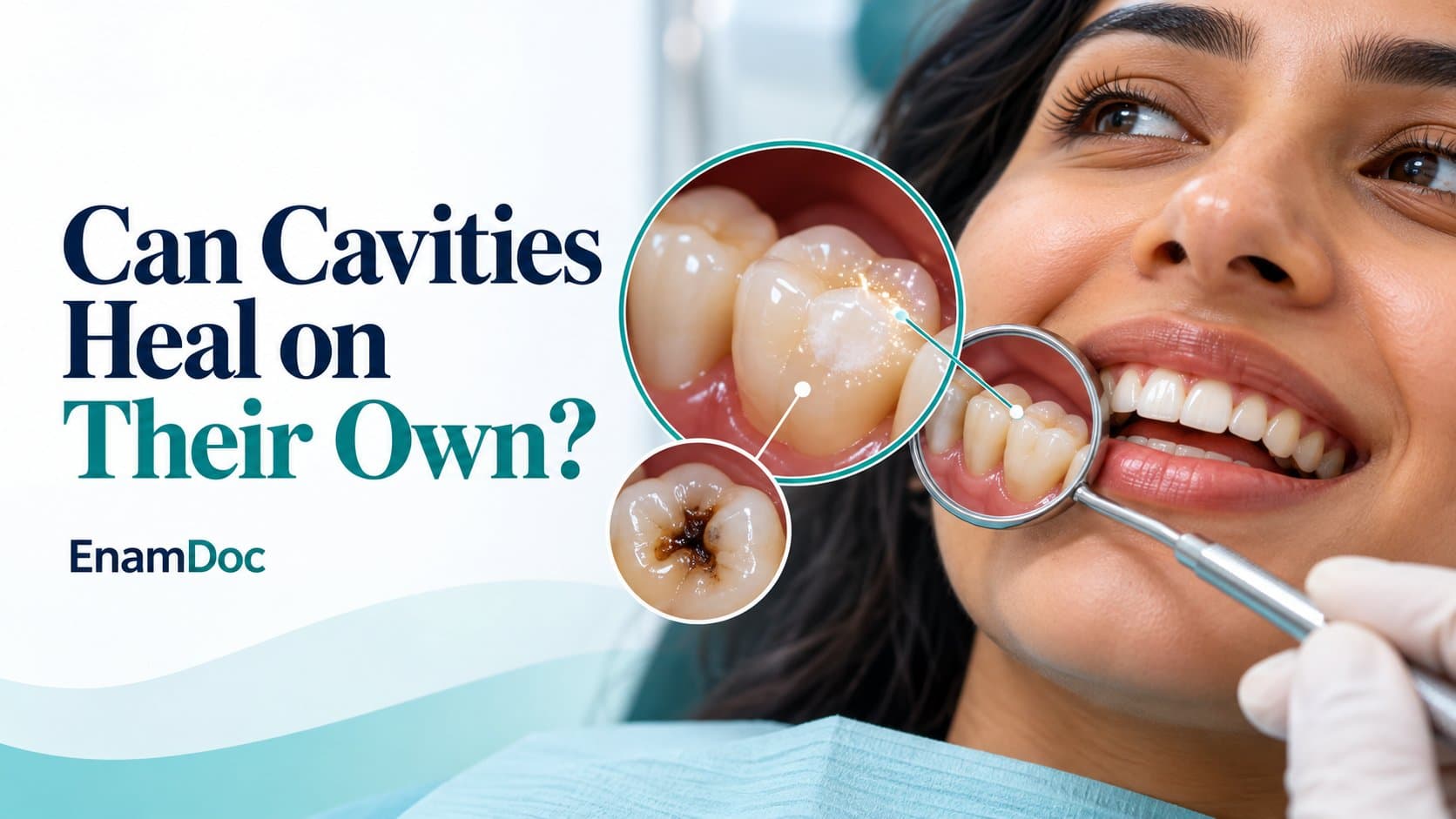
If you have ever been told by a dentist that you have a "watch area" or "early decay," you may have wondered whether your tooth can fix itself if you just brush better. The answer, perhaps surprisingly, is: sometimes yes — but only in the earliest stage of decay, and only with the right conditions. Understanding when remineralisation works, and when it does not, could save you from unnecessary fillings on one end and unnecessary tooth loss on the other.
How Tooth Decay Actually Begins
Tooth decay is not a single event — it is a process that unfolds in stages over weeks, months, or years. It begins when bacteria in your mouth feed on sugars and produce acids. These acids dissolve the minerals (primarily calcium and phosphate) out of your tooth's outer layer, the enamel. This process is called demineralisation.
Crucially, demineralisation is reversible — at least initially. Your saliva naturally contains calcium and phosphate ions that can re-deposit into the partially dissolved enamel, a process called remineralisation. Fluoride, when present (from toothpaste or professional treatments), accelerates this remineralisation dramatically by forming a stronger, more acid-resistant mineral called fluorapatite.
The battle between demineralisation and remineralisation is constant and ongoing in your mouth. A cavity forms only when demineralisation wins consistently over time.
Stages of Tooth Decay
Understanding the stages of decay is essential to understanding what can and cannot heal:
- Stage 1 — White spot lesion (early enamel demineralisation): This is the first visible sign of decay — a chalky white or off-white spot on the tooth surface. At this stage, the enamel surface is still intact; only the subsurface has lost minerals. This stage is reversible with fluoride, improved oral hygiene, and dietary changes. No drilling required.
- Stage 2 — Enamel cavity: The surface of the enamel has broken down. A physical hole has formed. This stage is NOT reversible through remineralisation alone — the structure is gone and a filling is required. However, the decay has not yet reached the dentine.
- Stage 3 — Dentine cavity: Decay has progressed through the enamel and into the softer layer underneath (dentine). Dentine decays much faster than enamel because it is softer and has tiny channels that bacteria can colonise. A filling is mandatory; if untreated, this progresses to the pulp.
- Stage 4 — Pulp involvement: Decay has reached the dental pulp (the nerve and blood supply of the tooth). At this point, root canal treatment or extraction is necessary. Pain is common but not always present — some people have no symptoms even at this stage.
- Stage 5 — Abscess: Infection has spread from the pulp into the surrounding bone. This is a dental emergency requiring urgent treatment.
The key takeaway: Only Stage 1 — the white spot lesion — can heal without dental treatment. Once a physical hole has formed (Stage 2 onwards), remineralisation cannot rebuild the lost structure.
What Accelerates Remineralisation?
If you have been told you have an early white spot lesion, the following approaches significantly accelerate remineralisation:
- Fluoride toothpaste (1,000–1,500 ppm fluoride): The single most effective and accessible remineralisation tool. Brush twice daily, spit but do not rinse (letting fluoride remain on the teeth maximises contact time). Standard adult toothpastes available in India (Colgate Total, Sensodyne, Pepsodent Germicheck) contain adequate fluoride levels.
- Professional fluoride treatments: High-concentration fluoride varnish (5% sodium fluoride) or silver diamine fluoride (SDF) applied by a dentist can rapidly remineralise early lesions. A single professional application is more effective than months of toothpaste alone.
- Reducing sugar frequency: It is not just the amount of sugar you eat — it is how often. Every sugar exposure triggers an acid attack lasting 20–30 minutes. Five small sugary snacks spread through the day causes more demineralisation than one larger serving eaten at mealtimes. Reducing snacking frequency matters more than cutting sugar entirely.
- Saliva stimulation: Saliva is your mouth's natural remineralisation system. Chewing sugar-free gum (look for xylitol) stimulates saliva flow and actively helps repair early enamel damage.
- Casein phosphopeptide-amorphous calcium phosphate (CPP-ACP): Found in products like GC Tooth Mousse (available in India), this is a milk-derived compound that delivers calcium and phosphate directly to the tooth surface, directly supporting remineralisation. Particularly useful for patients with high decay risk or those undergoing orthodontic treatment.
What Prevents Remineralisation?
Even with good intentions, certain habits actively block the remineralisation process:
- Frequent sugar or acid exposure: Soft drinks, fruit juices, sports drinks, and even healthy foods like citrus fruits and kombucha are highly acidic and prevent enamel from repairing between exposures.
- Dry mouth (xerostomia): Certain medications (antihistamines, antidepressants, blood pressure drugs) reduce saliva flow, removing the mouth's key natural defence. If you take medications that cause dry mouth, your decay risk increases significantly and remineralisation is slower.
- Rinsing immediately after brushing: Rinsing your mouth with water right after brushing washes away the fluoride before it can work. Spit, but wait at least 30 minutes before rinsing or eating after brushing.
- Inconsistent brushing: Plaque that is not disrupted twice daily maintains a constantly acidic environment at the tooth surface, tipping the balance towards demineralisation.
When to See a Dentist — and Not Wait
The frustrating thing about tooth decay is that it is almost entirely painless until it reaches the pulp. By the time you feel a toothache, the cavity is already Stage 3 or Stage 4. Regular dental check-ups every 6 months exist precisely because dentists can catch Stage 1 and Stage 2 lesions before they become symptomatic — when they are either reversible or at least much cheaper and simpler to treat.
See a dentist promptly if you notice:
- A visible white, brown, or black spot on a tooth
- Sensitivity to cold, sweet, or heat that lingers more than a few seconds
- A visible hole or rough area you can feel with your tongue
- Any toothache — this indicates advanced decay
Do not wait to see if a toothache resolves on its own. Once the pulp is involved, the infection will worsen without treatment, and the risk of abscess formation — which can spread to surrounding tissues and even become systemic — increases every day you delay.
The Bottom Line
Your tooth can heal itself — but only in its earliest stage of damage, only with the right conditions, and only with consistent effort over weeks to months. Once a physical hole forms, remineralisation has no power to rebuild structure; a filling is necessary. The most powerful thing you can do is catch decay early, which means regular dental check-ups are not optional if you want to avoid fillings.
On EnamDoc, you can find qualified dentists near you who offer comprehensive check-ups and early decay management including professional fluoride treatments. Catching a white spot lesion today is infinitely better — and cheaper — than treating a root canal next year.
Frequently asked
Frequently asked questions
Can a cavity go away with better brushing and diet?
Only a very early-stage cavity — specifically a white spot lesion, which is the first stage of enamel demineralisation before a physical hole forms — can reverse with improved brushing (using fluoride toothpaste), reduced sugar intake, and in some cases professional fluoride treatment. Once the enamel surface breaks and a visible cavity forms, remineralisation cannot rebuild the missing tooth structure. At that point, a filling is necessary. This is why regular dental check-ups matter so much — catching decay at the white spot stage means it may not need a drill at all.
How long does remineralisation take?
Remineralisation of early enamel lesions is a slow process — it typically takes weeks to months of consistent effort to see meaningful reversal of a white spot lesion. This means brushing twice daily with fluoride toothpaste without rinsing, reducing sugar frequency, and ideally receiving a professional fluoride varnish treatment from your dentist. Do not expect overnight results, and do not use slow progress as a reason to delay a dental check-up. If you have a white spot lesion your dentist is monitoring, they will reassess every 3–6 months and may recommend a filling if the lesion shows signs of progressing rather than stabilising.
Is it safe to delay treating a cavity?
It depends entirely on the stage. A confirmed white spot lesion that your dentist is monitoring is safe to manage without drilling for a defined period, with close follow-up. But any cavity that has progressed beyond the enamel surface — meaning there is an actual hole in the tooth — should not be delayed. Untreated cavities progress, often faster than people expect. Dentine decays much more rapidly than enamel, and once bacteria reach the pulp (nerve) of the tooth, you are looking at root canal treatment rather than a simple filling. The cost and complexity of treatment increases at every stage. Treating early is almost always safer, cheaper, and less painful.
- cavities
- remineralisation
- tooth decay
- can cavities heal
- fluoride
- early decay
Keep reading