Understanding Cavities: How They Form and How Fillings Actually Work
Learn how tooth decay progresses through 5 distinct stages and discover how modern dental restorations—composite vs. amalgam fillings—protect your teeth.
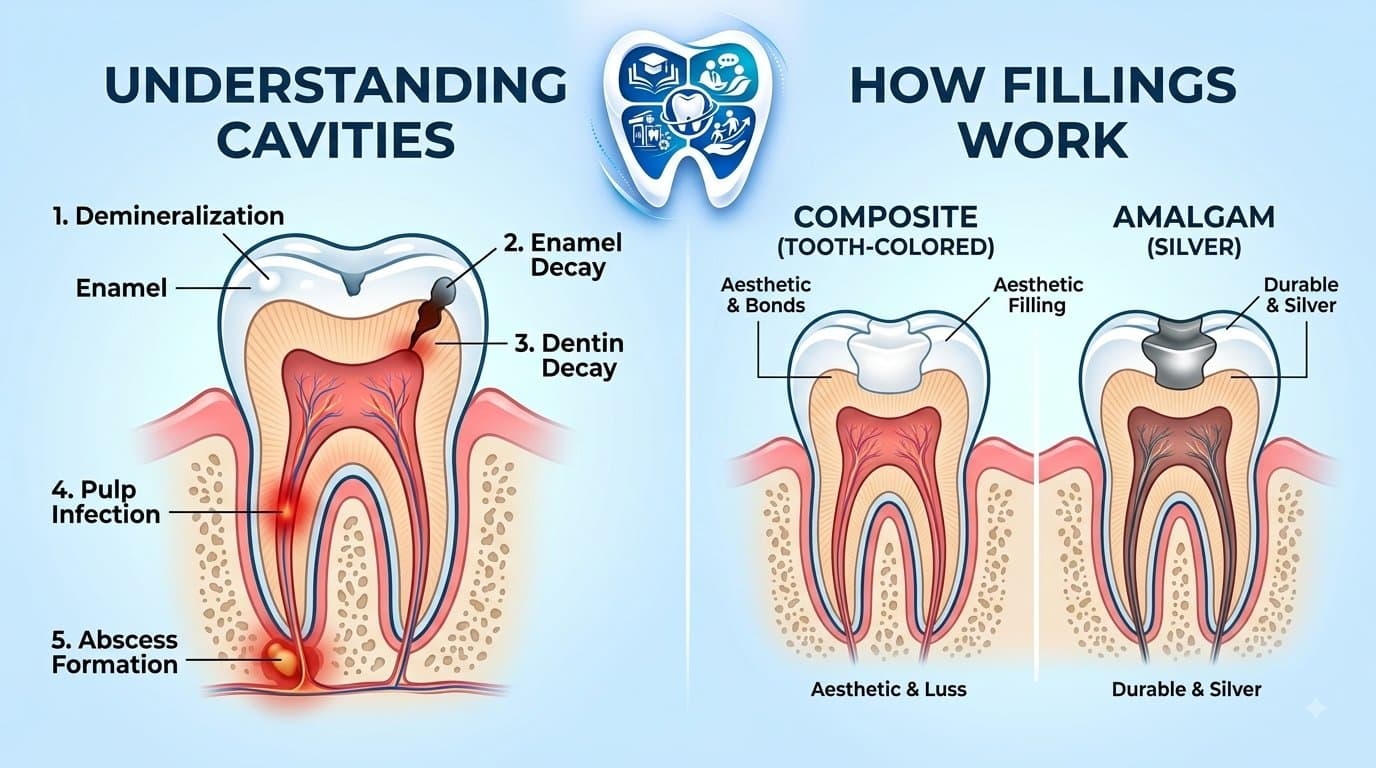
Tooth decay is one of the most common health conditions in the world, yet many people do not realize a cavity is developing until they feel sudden sensitivity or a sharp ache. A cavity doesn’t happen overnight—it is the end result of an active, progressive process called tooth decay (dental caries).
Understanding how a cavity forms, how it moves through your tooth's layers, and how modern dental fillings repair the damage is essential for protecting your smile before minor decay turns into an emergency root canal.
The Anatomy of Tooth Decay: How Cavities Actually Form
Your mouth hosts hundreds of types of bacteria. When you eat carbohydrates or sugary foods, these bacteria feed on residual food particles and produce acids as a byproduct. This acid gradually dissolves the protective minerals in your tooth structure.
The decay process develops across five distinct stages:
- Demineralization (Initial Stage): Acid exposure leaches calcium and phosphate from the enamel, often appearing as a chalky white spot on the tooth surface. At this early stage, decay is still reversible with fluoride therapy and remineralization.
- Enamel Decay: If demineralization continues, the enamel breaks down completely, forming a permanent micro-hole or physical cavity. Because enamel has no nerves, you likely will not feel any pain yet.
- Dentin Decay: Once through the enamel, bacteria enter the softer dentin layer. Dentin contains microscopic tubules leading directly to the tooth nerve, which is why hot, cold, or sweet foods start causing noticeable sensitivity.
- Pulp Infection: If left untreated, decay breaches the innermost chamber—the dental pulp—containing living nerves and blood vessels. This triggers intense throbbing pain, inflammation, and requires a root canal rather than a simple filling.
- Abscess Formation: Uncontrolled bacterial infection spreads beyond the root tip into surrounding bone and gum tissue, forming a painful, pus-filled abscess that can lead to systemic health risks and tooth loss.
How Fillings Actually Work: The Restoration Process
A dental filling stops the spread of decay and restores the structural integrity, bite function, and appearance of your tooth. The procedure typically takes 30 to 60 minutes:
- Numbing & Isolation: Local anesthesia is applied around the affected tooth to ensure total comfort throughout the treatment.
- Decay Removal: The dentist uses precise instruments to gently remove all decayed, softened tooth structure and bacteria, leaving behind only healthy enamel and dentin.
- Disinfection & Conditioning: The cavity preparation is thoroughly cleaned, disinfected, and chemically etched or primed to prepare the surface for bonding.
- Filling Placement & Curing: The restorative material is placed into the space in layers. For composite materials, a special blue curing light hardens each layer in seconds.
- Bite Adjustment & Polishing: The dentist shapes the restoration to match your natural tooth anatomy, checks your bite alignment, and buffs the surface smooth.
Composite vs. Amalgam Fillings: Key Differences
| Feature | Composite (Tooth-Colored) | Amalgam (Silver) |
|---|---|---|
| Material | Blend of resin matrix and microscopic ceramic/glass particles | Alloy of metals including silver, tin, copper, and elemental mercury |
| Aesthetics | Blends seamlessly with natural tooth shade (ideal for front and visible teeth) | Dark metallic silver appearance (visible during speaking or laughing) |
| Tooth Preservation | Bonds directly to tooth structure, requiring less removal of healthy enamel | Relies on mechanical undercuts, requiring more healthy tooth removal |
| Durability & Strength | High strength; typically lasts 7–10 years depending on location and bite force | Extremely durable; often lasts 10–15+ years under heavy chewing pressure |
| Thermal Sensitivity | Low conductivity; insulates tooth nerve against sudden temperature changes | Conducts thermal energy; higher initial sensitivity to very hot or cold foods |
Preventing Decay Before It Reaches the Filling Stage
The best filling is the one you never need. To halt acid demineralization early:
- Brush twice daily with a fluoride toothpaste for at least two minutes.
- Clean interdental spaces daily using dental floss or a water flosser.
- Limit frequency of sugary, sticky snacks and acidic sodas that prolong acid exposure.
- Visit your dentist every 6 months for cleanings and early radiographic detection.
Frequently asked
Frequently asked questions
Can an early cavity heal on its own without a filling?
Yes, but only in stage one (enamel demineralization) before a physical hole forms. Fluoride treatments, improved oral hygiene, and remineralizing pastes can rebuild weakened enamel. Once the cavity creates a physical pit or penetrates dentin, a dental filling is required.
Do dental fillings hurt to get?
No. Dentists administer local anesthesia to completely numb the area surrounding the affected tooth. Patients typically only feel slight vibration and water pressure during the procedure.
How long do composite tooth-colored fillings last?
With good oral hygiene and routine dental checkups, modern composite restorations generally last between 7 to 10 years or longer before requiring replacement or touch-ups.
- cavities
- tooth decay
- dental fillings
- composite filling
- amalgam
- enamel restoration
- oral health
- restorative dentistry
Keep reading