What Happens If You Don’t Treat a Cavity? The Real Consequences, Stage by Stage
Skipping that dental appointment might seem harmless. Dr. Aditya Swami explains the five-stage progression of an untreated cavity — from a small enamel lesion to tooth loss — and what you can realistically do at each stage.
A dentist tells you that you have a cavity. You have no pain, no visible problem, and a busy schedule. So you decide to come back "in a few months." It is one of the most common decisions patients make — and one of the most consequential.
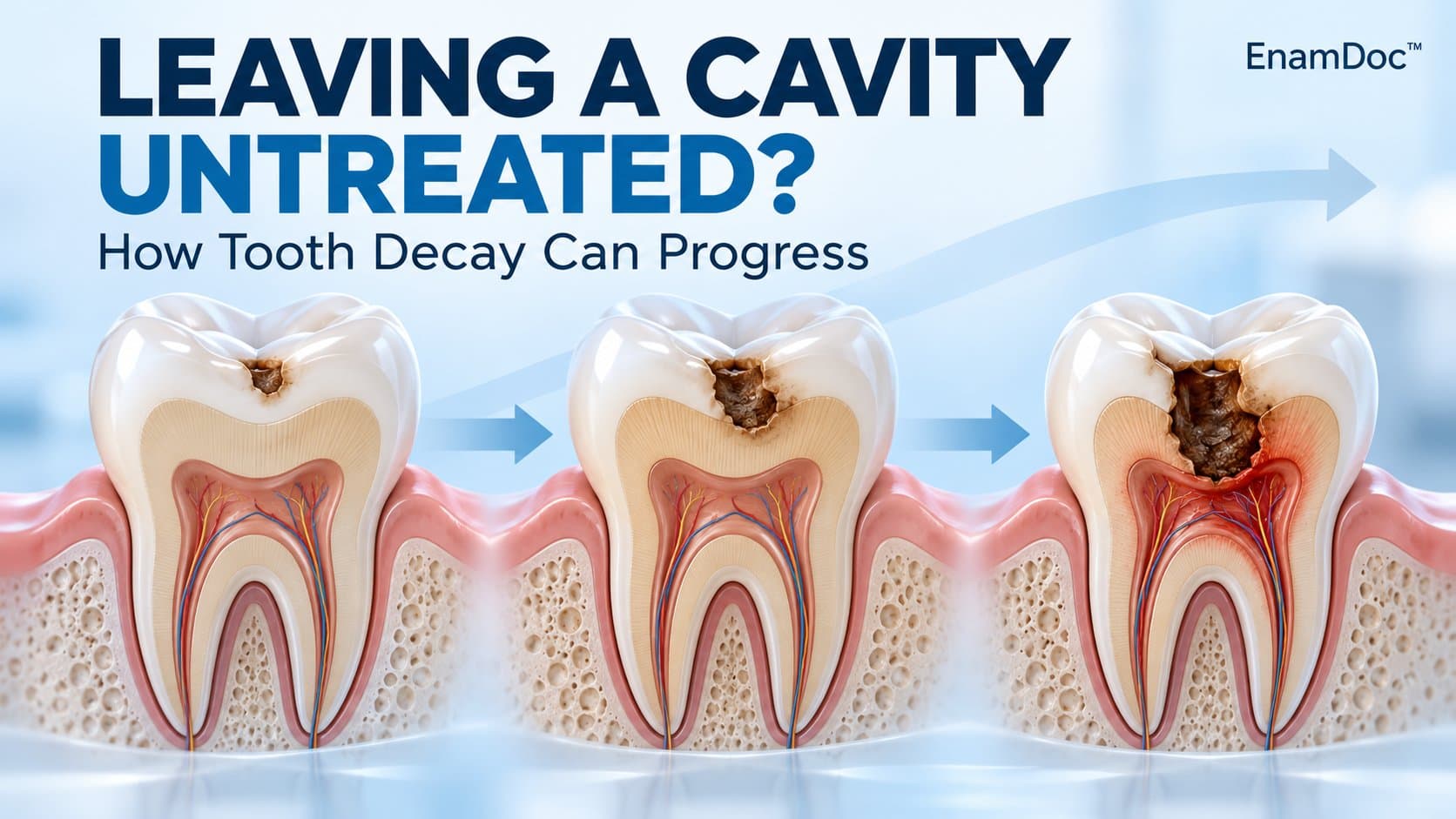
Tooth decay does not pause while you wait. It progresses through distinct stages, and each stage that passes quietly closes off the simpler options and opens the door to more complex, more expensive, and more uncomfortable ones. Here is what actually happens, stage by stage.
Stage 1: Early Enamel Lesion (The White Spot)
The very beginning of a cavity is a demineralisation of the enamel — the hard outer layer of the tooth. At this stage, bacteria in your mouth are producing acids that leach calcium and phosphate out of the enamel surface. You cannot feel it. You would not know it was happening without a dental examination.
What you can do at this stage: essentially reverse it. Fluoride — from toothpaste, professional application, or fluoridated water — can remineralise the enamel and arrest the process entirely. Good brushing, dietary changes (less sugar), and a fluoride varnish from your dentist may be all that is needed. No drilling, no filling.
What happens if you skip this stage: the acid exposure continues, and the enamel breaks down further.
Stage 2: Enamel Cavity
The demineralisation has progressed to the point where a physical hole — a cavity — has formed in the enamel. Still no pain in most cases, because enamel has no nerve supply. You might notice discolouration, a visible pit, or your dentist may catch it on X-ray.
What you can do at this stage: a small composite resin filling, completed in a single appointment. The decay is removed, the hole is cleaned, and the tooth is sealed. Treatment is quick and the tooth remains strong.
What happens if you skip this stage: the decay reaches the inner layer of the tooth — the dentine.
Stage 3: Dentine Involvement
Dentine is softer than enamel and decays faster. It also contains tiny tubules that transmit sensation to the nerve, which is why this stage often produces the first real symptoms: sensitivity to cold, sweet foods, or air. Pain may be brief but noticeable.
Decay spreads more rapidly here. A cavity that took months to move through enamel can progress through dentine in weeks. The filling needed at this point is larger and the procedure more involved, but a standard filling can still work if the pulp — the living tissue at the centre of the tooth — has not been affected.
What happens if you skip this stage: the decay reaches the pulp.
Stage 4: Pulp Involvement (Pulpitis and Abscess)
The pulp contains the nerves and blood vessels that keep the tooth alive. Once bacteria reach it, the result is pulpitis — inflammation of the pulp. At this point, pain changes character: it becomes spontaneous (not just triggered by temperature), throbbing, and often worse at night. The tooth may be exquisitely tender to touch. Many patients describe this as some of the worst pain they have experienced.
From here, two things can happen. The pulp may die, temporarily reducing pain — which some patients mistakenly interpret as the problem resolving. But the bacteria continue to multiply in the now-dead tissue, often spreading into the bone at the root tip and forming a periapical abscess. This is a collection of pus that can cause facial swelling, fever, and in rare but serious cases, can spread to surrounding tissues.
What you can do at this stage: root canal treatment. The infected pulp is removed, the canals are cleaned and shaped, and the tooth is sealed with a crown. Root canal treatment has an unfair reputation — performed under local anaesthesia, it is typically no more uncomfortable than a filling. But it involves multiple appointments, a crown placement, and significantly higher cost than what a filling would have been two stages earlier.
What happens if you skip this stage: the infection is at risk of spreading, and the tooth may no longer be salvageable.
Stage 5: Tooth Loss
If the abscess or structural destruction is too advanced, or if the patient cannot access treatment in time, the tooth may need to be extracted. Extraction is the end of the road for that tooth — but it is not the end of the problem. A missing tooth changes how surrounding teeth distribute bite forces. Adjacent teeth drift into the gap over time. Bone loss begins in the area where the root used to provide stimulation. Replacing the tooth with an implant or bridge involves significant expense and complexity.
An extraction costs less than a root canal and crown in the short term. But the long-term cost — financial and clinical — of replacing that tooth, or of managing the consequences of not replacing it, is considerably higher.
The Pattern in Dental Practice
Dentists see this progression constantly. A patient comes in with tooth pain, X-rays show deep decay close to or into the pulp, and the only options are root canal treatment or extraction. The conversation often includes the phrase, "If you had come in six months earlier, this would have been a simple filling." It is not said to make anyone feel guilty — it is said because it is true, and because the options genuinely were different then.
Monitoring Your Dental Records
One of the practical challenges with cavity progression is that most people do not realise how far along a cavity is between appointments. EnamDoc's patient record system lets your dentist document cavity status, annotate X-ray findings, and flag teeth that need monitoring. When you attend a check-up, that history is available — your dentist is not starting from scratch, and early lesions flagged at a previous visit can be tracked for change rather than discovered in a worse state.
When to Book That Appointment
If your dentist has mentioned a cavity at any stage — even a "small one that we can watch" — take their advice on the timing of the next visit seriously. Watching a cavity is not the same as the problem going away. It means keeping an eye on something that has a predictable tendency to get worse. The earlier you act, the simpler and less costly the solution.
Frequently asked
Frequently asked questions
Can a cavity heal on its own?
Early-stage demineralisation (before a hole forms) can be reversed with fluoride and improved brushing, but once a physical cavity has formed in the enamel or deeper, it cannot heal by itself. The hole will only grow without treatment.
How quickly does a cavity progress?
The rate varies depending on diet, saliva quality, oral hygiene, and the position of the tooth. A small enamel cavity can remain stable for months, but once it reaches the dentine, it often progresses much faster — sometimes through to the pulp in a matter of weeks to a few months.
Is it safe to delay a root canal?
Briefly delaying is sometimes unavoidable, but it is not without risk. An infected tooth can develop an abscess quickly, which may cause facial swelling and, in rare cases, spread to nearby structures. If your dentist has recommended a root canal, booking promptly is the safer choice.
- cavity
- tooth decay
- untreated cavity
- dental health
- tooth extraction
Keep reading