Crown Lengthening: Why It's Done and What Recovery Actually Involves (Patient & Student Guide)
Not enough tooth showing above the gum to hold a crown, or a smile that shows too much gum? Crown lengthening reshapes the gum and sometimes bone to fix both. A guide for patients weighing the procedure and students learning the biologic width principle.
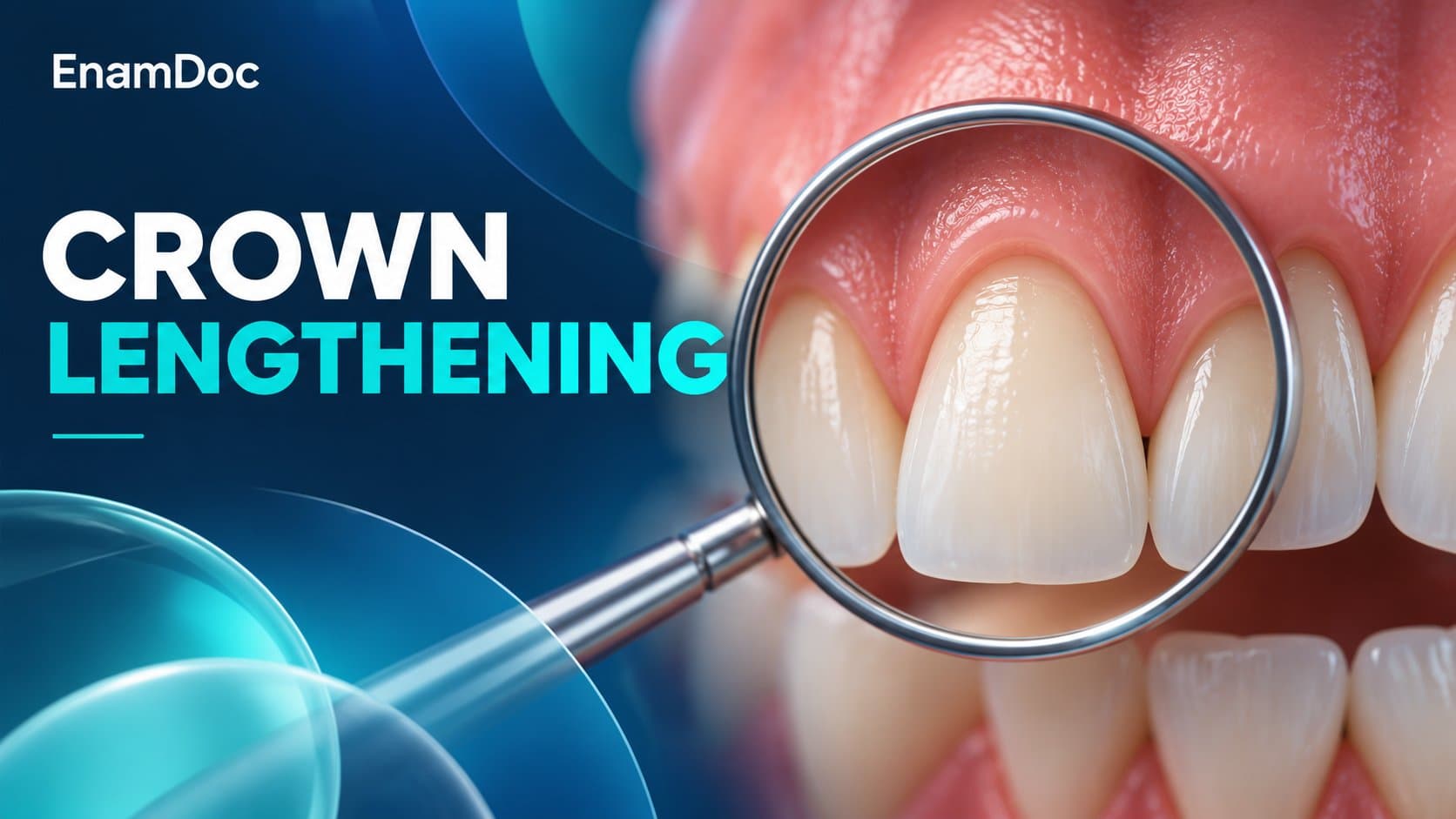
Two very different patients end up needing the same procedure: one has a tooth broken so far down at the gumline that a crown has nothing to grip onto, and the other simply shows too much gum when they smile and wants a more balanced look. Crown lengthening solves both, by changing the relationship between the gum, the bone underneath it, and the visible tooth.
What Crown Lengthening Actually Does
The procedure removes excess gum tissue and, when needed, a small amount of the underlying bone, to expose more of the tooth's natural crown — the visible part above the gumline. This can be done on a single tooth for restorative reasons, or across the upper front teeth for cosmetic reshaping.
The Two Main Reasons It's Done
Restorative Crown Lengthening
When a tooth is broken, decayed, or fractured below the gumline, there isn't enough sound tooth structure above the gum for a crown or filling to attach to securely. Crown lengthening exposes more of the tooth, giving the dentist enough surface to work with and restore the tooth properly, rather than extracting a tooth that could otherwise be saved.
Cosmetic (Aesthetic) Crown Lengthening
Some people have a "gummy smile" where excess gum tissue covers more of the tooth than average, making teeth look short and the gumline uneven. Reshaping the gum — and occasionally a small amount of bone — balances the proportion of visible tooth to gum, without touching the teeth themselves.
The Biologic Width Principle (For Students)
Any crown margin placed too close to the bone violates what periodontics calls biologic width — the combined space needed for the junctional epithelium and connective tissue attachment above the crest of bone, generally accepted as roughly 2mm, though exact measurements vary by individual anatomy. Placing a restoration margin within this zone triggers chronic inflammation, as the body cannot re-establish attachment around it. Crown lengthening surgically re-establishes adequate distance between the bone crest and the planned restoration margin, which is why it is planned before, not after, a crown preparation whenever inadequate tooth structure or a subgingival fracture is identified.
How the Procedure Works
- Local anaesthesia is administered to the area.
- The gum tissue is reshaped, either with a scalpel or a soft-tissue laser, to expose more of the tooth.
- If additional bone needs to be removed to maintain proper biologic width, a small flap is raised and a controlled amount of bone is recontoured.
- The gum is sutured back into its new position, and a periodontal dressing may be placed to protect the area.
- Sutures are typically removed after seven to ten days.
Recovery: What to Actually Expect
Mild to moderate swelling and tenderness for three to five days is normal, generally manageable with over-the-counter pain relief as directed by the dentist. A soft diet is recommended for the first week, and vigorous brushing near the surgical site should be avoided until healing is well underway — a chlorhexidine rinse is often prescribed instead during this period. Full gum healing typically takes four to six weeks, though the gum can continue to settle into its final position for up to three months, which is why a crown or veneer on that tooth is usually not placed until healing is complete.
What It Costs in India
Single-tooth restorative crown lengthening typically costs ₹3,000 to ₹8,000 per tooth, while cosmetic gum reshaping across multiple front teeth (sometimes called a gum lift) ranges from about ₹10,000 to ₹30,000 depending on the number of teeth involved and whether a laser is used.
Frequently asked
Frequently asked questions
Is crown lengthening painful?
The procedure itself is done under local anaesthesia and should not hurt. Mild to moderate soreness and swelling for a few days afterward is normal and manageable with the pain relief your dentist prescribes.
How long after crown lengthening can a crown be placed?
Most dentists wait at least four to six weeks for the gum to heal, and sometimes up to three months for cosmetic cases, since the gum can continue to settle into its final position during that time. Placing a crown too early can lead to an ill-fitting margin.
Is crown lengthening the same as a gum lift?
They use the same underlying technique, but the goals differ. Restorative crown lengthening exposes tooth structure for a filling or crown to attach to, while a cosmetic gum lift reshapes the gumline purely for a more balanced smile appearance.
- crown lengthening
- periodontal surgery
- gummy smile
- biologic width
- dental crowns
Keep reading