GST for Dental Clinics in India: What Every Dentist Needs to Know
GST rules for dental clinics in India are more nuanced than most dentists realise. Dr. Khanak Jain walks through exactly what is taxable, what is exempt, when you need to register, and what happens if you get it wrong.
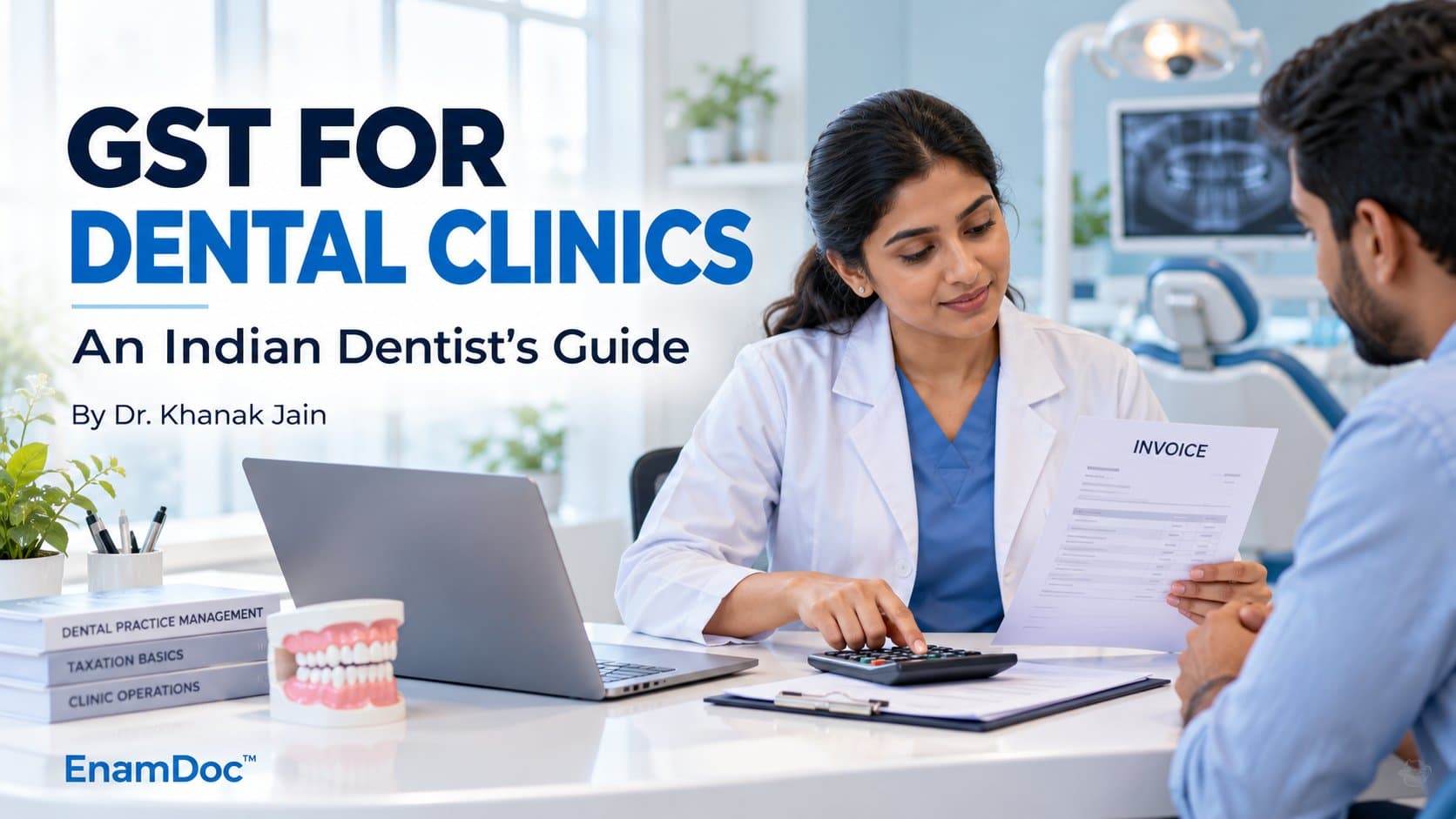
The Goods and Services Tax has been in force in India since 2017, yet many dental clinic owners still operate with significant uncertainty about their obligations. Are dental services taxable? Does selling dental products change your registration requirements? What happens if you cross the threshold mid-year? These questions matter — not just for compliance, but because the penalties for getting it wrong can be substantial.
This guide covers what every dentist running a clinic in India needs to understand about GST, without requiring you to first earn a law degree.
Are Dental Services Exempt From GST?
The short answer is yes — for purely clinical services. Healthcare services provided by a clinical establishment or an authorised medical practitioner are exempt from GST under Notification No. 12/2017 (Central Tax Rate). Dental treatment, oral surgery, periodontal procedures, orthodontic consultations, and similar clinical services fall under this exemption. Your patients do not pay GST on consultation fees, procedure charges, or treatment costs.
This exemption covers services, not goods. The distinction becomes important the moment your clinic sells or charges separately for items that are not strictly part of a treatment procedure.
When GST Does Apply to Your Clinic
The exemption has limits that catch many dentists off guard. GST applies when your clinic:
Sells dental products separately
If you sell electric toothbrushes, whitening kits, medicated mouthwashes, retainers, or any other product to patients as a separate retail transaction (not as part of a clinical procedure), those sales are taxable. Dental consumables sold to patients, as opposed to used by the dentist during treatment, are treated as goods supply and attract GST at the applicable rate (typically 12–18% depending on the product).
Provides cosmetic or aesthetic dental procedures
Cosmetic dental procedures that are not medically necessary — such as purely aesthetic teeth whitening or veneers for cosmetic purposes — may not qualify for the healthcare exemption. The GST Council has not provided exhaustive clarity here, but the principle is that procedures performed primarily for aesthetic rather than medical reasons risk being treated differently. Consult a GST-registered accountant with healthcare experience if a significant portion of your revenue comes from cosmetic procedures.
Runs a dental lab or manufactures prosthetics
Dental laboratories that manufacture dentures, crowns, bridges, or other prosthetics are in the manufacturing or job-work category, not purely in clinical services. If you operate an in-house lab that supplies to other clinics, your lab activity is taxable and requires separate consideration under GST.
GST Registration: When Is It Mandatory?
GST registration is required when your aggregate turnover in a financial year exceeds ₹20 lakhs (₹10 lakhs for some special category states). Even though clinical services are exempt, they still count toward your aggregate turnover for the purpose of calculating whether you need to register. A busy clinic crossing this threshold must register.
Once registered, you must file regular returns (GSTR-1 and GSTR-3B), even if the majority of your services are exempt and your net tax liability is zero. Non-filing attracts late fees and can result in your registration being cancelled.
Voluntary registration below the threshold is possible and has one practical benefit: registered dealers can claim Input Tax Credit (ITC) on business purchases. If you are spending significantly on clinic equipment, dental chairs, X-ray machines, or renovation, registered status allows you to offset the GST paid on those purchases against any GST you owe on taxable supplies. Weigh this against the compliance cost of quarterly and monthly return filings.
Input Tax Credit: What Your Clinic Can Claim
If your clinic is registered and makes both exempt and taxable supplies, Input Tax Credit is available only on the portion of your inputs attributable to taxable supply. The mathematical process for apportioning ITC between exempt and taxable supplies (called the common credit reversal method under Rule 42) can be complex. Most dentists with significant mixed supplies (clinical services plus product sales) are better served by engaging a GST practitioner to manage this correctly from the outset rather than attempting self-filing.
If your clinic provides exclusively exempt clinical services with no taxable supply at all, you are not entitled to claim ITC — even on equipment purchases. This is one of the genuine costs of operating in the exempt category.
Invoicing Requirements
A registered clinic must issue tax invoices for taxable supplies and bills of supply for exempt supplies. The formats differ, and issuing the wrong document type can create complications during audits. Your billing software should handle this automatically — if it does not, that is a signal to review your practice management system. Platforms like EnamDoc, designed for dental clinic administration, can assist with organised billing records, patient invoicing, and the kind of clean documentation that simplifies GST return preparation and audit responses.
Common Mistakes Dental Clinics Make With GST
Three errors come up repeatedly when dentists encounter GST scrutiny. First, treating all product sales as part of the exempt treatment without separating them in records — this collapses the distinction that protects clinical services from tax. Second, failing to register after crossing the ₹20 lakh threshold, often because the owner assumed exemption meant no GST obligation at all. Third, not filing nil returns after registration lapses in compliance, which leads to late fees that compound quickly.
The other common mistake is conflating state-specific variations. Some states have different thresholds and additional local levies that overlay GST. If you practice in a special category state or have clinics across state boundaries, the rules differ and require specific advice.
Practical Steps for Your Clinic
Start by calculating your aggregate turnover for the last financial year, including all receipts from exempt clinical services. If you are approaching ₹15–18 lakhs, prepare for registration. Engage a CA or GST practitioner who has experience with healthcare clients — the general advice that dentists do not need to worry about GST is partly true and partly dangerously incomplete.
Maintain separate accounting for clinical service revenue and any product sales or non-exempt supply. Even if your current product sales are small, clean records protect you. Review your invoicing system to ensure it issues the correct document type for each category of supply.
GST compliance for a dental clinic that sticks to clinical services is genuinely straightforward once the initial registration decision and filing rhythm are established. The complexity arrives when clinics diversify into products, labs, or cosmetic procedures without adjusting their compliance posture to match. Understanding the boundary between exempt and taxable supply is the foundation everything else rests on.
Frequently asked
Frequently asked questions
Do dental clinics need to charge GST on treatment fees?
No. Clinical dental services provided by an authorised dental practitioner are exempt from GST under Notification No. 12/2017. This covers consultations, fillings, extractions, root canal treatment, periodontal procedures, crowns, bridges, dentures, and braces when provided as part of clinical care. Patients pay no GST on treatment fees. However, if your clinic sells dental products separately or provides services deemed cosmetic rather than medical, those may attract GST.
When does a dental clinic need to register for GST in India?
GST registration is mandatory when your aggregate annual turnover exceeds ₹20 lakhs (₹10 lakhs in some special category states). Even though most dental services are GST-exempt, they still count toward your aggregate turnover for determining the registration threshold. Once registered, you must file returns regularly even if your tax liability is zero. Voluntary registration below the threshold is permitted and may be worthwhile if you incur significant GST on business purchases and want to claim Input Tax Credit.
Is selling dental products like toothbrushes or whitening kits taxable under GST?
Yes. Dental products sold to patients as separate retail transactions — electric toothbrushes, whitening kits, medicated mouthwashes, retainers sold post-treatment — are classified as goods supply and attract GST at the applicable rate (typically 12–18% depending on the product category). The GST exemption applies to clinical healthcare services, not to retail product sales. If your clinic sells dental products regularly, you should account for this supply separately and ensure your billing reflects the correct tax treatment.
- GST dental clinic
- dental practice tax
- clinic GST India
- dental billing
- practice management
Keep reading