Teeth Whitening in India: In-Chair, At-Home Trays, and OTC Strips — What Actually Works
A clear, honest guide to teeth whitening options in India — from in-chair laser treatments to at-home trays and OTC strips — including costs, results, and what actually works for different types of staining.
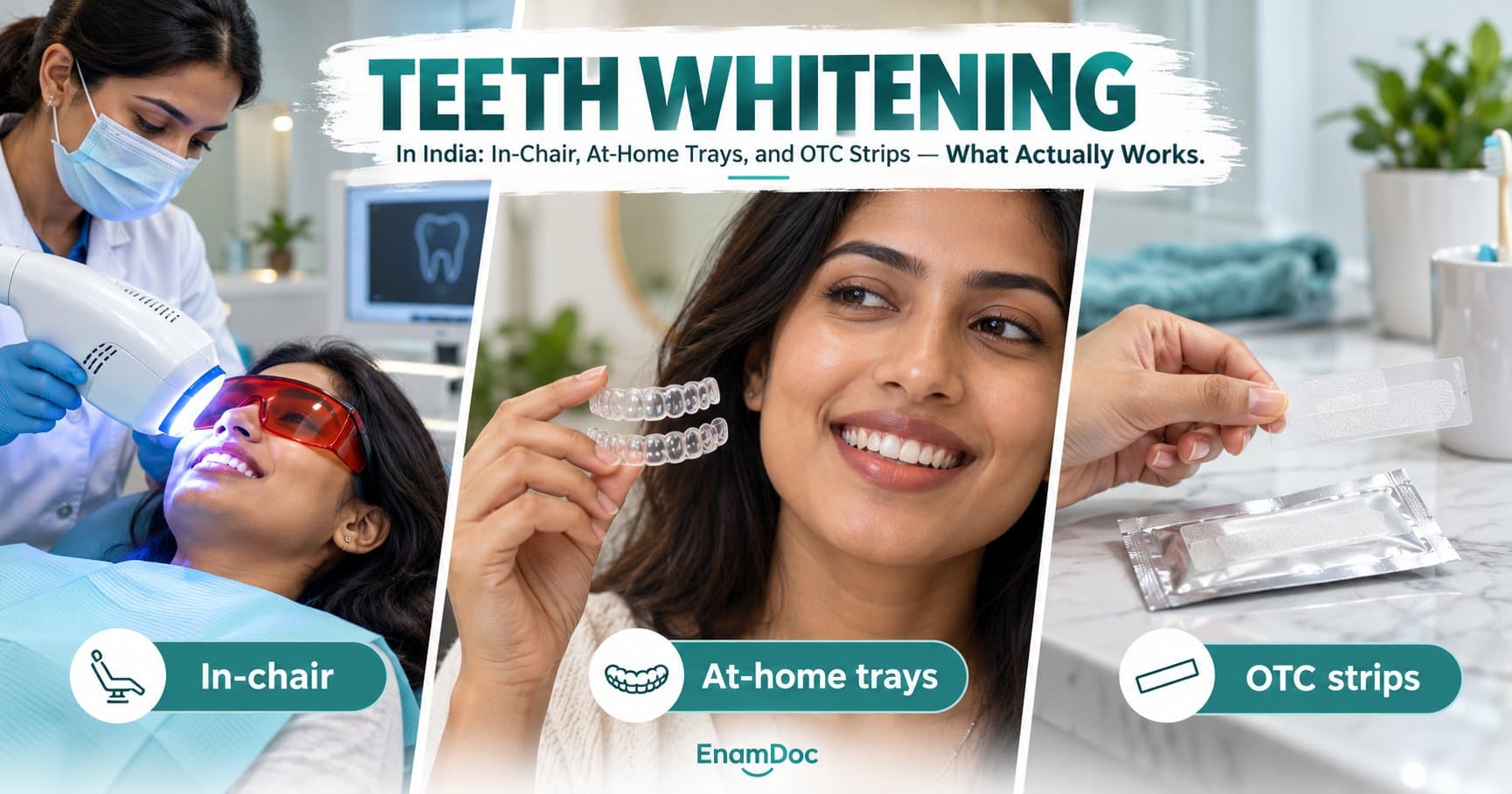
Teeth whitening is the most requested cosmetic dental procedure in India, and it's also the one with the most misinformation around it.
Ask ten people about teeth whitening and you'll get ten different answers — some enthusiastic about Rs 200 strips from the pharmacy, others insisting only laser treatment works, and someone who tried a charcoal powder that made things worse.
Here's a clear, honest guide to what's actually available in India, what the evidence says, and how to choose what's right for you.
First: What Causes Teeth to Look Yellow?
Before choosing a whitening method, it helps to know what you're dealing with. Teeth discolouration comes in two types:
Extrinsic staining: Surface stains from tea, coffee, tobacco, and food. These sit on or just inside the enamel surface and are more responsive to whitening.
Intrinsic discolouration: Staining inside the tooth structure itself — from fluorosis (too much fluoride during development), tetracycline antibiotic use in childhood, dental trauma, or natural aging. These are significantly harder to whiten and sometimes don't respond to bleaching at all.
A dentist can tell you which type you have before you spend money on a treatment that may not help.
Option 1: In-Chair Professional Whitening (Laser/LED Whitening)
How it works: A high-concentration hydrogen peroxide gel (usually 25–40%) is applied to the teeth. A light source (laser or LED — often marketed as "laser whitening") activates the gel and accelerates the chemical reaction. The process takes 60–90 minutes in the dental chair.
Results: Teeth typically lighten by 5–8 shades in a single session. Results are dramatic and immediate.
Cost in India: ₹8,000 – ₹25,000 depending on the clinic, city, and brand of whitening system used.
Durability: 1–3 years with reasonable dietary habits. Coffee, tea, tobacco, and red wine stain teeth again over time.
Considerations:
- Temporary tooth sensitivity is extremely common (usually resolves in 24–72 hours)
- Not suitable for existing crowns, veneers, or fillings (those won't whiten)
- Not recommended for patients with very sensitive teeth or gum recession without prior management
- Requires a dental consultation and usually a cleaning beforehand
Option 2: At-Home Professional Whitening Trays
How it works: Your dentist takes impressions and fabricates custom-fitted trays. A lower-concentration peroxide gel (10–15% carbamide peroxide) is provided. You wear the trays for 1–2 hours per day (or overnight) for 2–4 weeks.
Results: Similar final result to in-chair whitening, but achieved gradually over several weeks. The lighter concentration means less sensitivity.
Cost in India: ₹3,000 – ₹10,000 for the trays and initial gel supply. Refill gel is available separately.
Durability: Similar to in-chair — 1–3 years. Has the advantage that you have the trays to maintain results easily with periodic top-up treatments.
Considerations:
- Requires compliance (you have to use them consistently)
- Custom trays are far more effective than generic "boil-and-bite" trays sold online — the seal matters
- Best option for patients who want results without in-chair sensitivity
Option 3: Over-the-Counter (OTC) Whitening Products
This category includes whitening toothpastes, whitening strips, generic mouth trays, whitening pens, and various "natural" products.
Whitening Strips
Whitening strips available in India (like Oral-B 3D White strips) typically contain 6–10% hydrogen peroxide. They do work for mild extrinsic staining, but the results are subtler than professional options (typically 1–2 shade improvement). Cost: ₹400 – ₹1,200 per pack.
Whitening Toothpastes
Whitening toothpastes primarily work through mild abrasives that polish away surface stains. They do not bleach teeth. Results are very subtle. Some contain PAP (phthalimidoperoxycaproic acid), a newer non-peroxide whitening agent with modest effects.
Charcoal Toothpastes
Despite enormous marketing success, there is no reliable clinical evidence that activated charcoal effectively whitens teeth. It is mildly abrasive (which polishes surface stains like any abrasive toothpaste) but may damage enamel with long-term use. Dentists generally recommend against charcoal-based products.
Direct Comparison
| In-Chair | At-Home Trays | OTC Strips | Whitening Toothpaste | |
|---|---|---|---|---|
| Whitening level | High (5–8 shades) | High (4–7 shades) | Mild (1–2 shades) | Minimal |
| Cost | ₹8,000–₹25,000 | ₹3,000–₹10,000 | ₹400–₹1,200 | ₹150–₹500 |
| Sensitivity risk | Moderate–High | Low–Moderate | Low | Minimal |
| Duration | 1–3 years | 1–3 years | Months | Ongoing |
| Dentist needed? | Yes | Yes (for trays) | No | No |
Who Should NOT Whiten?
- Patients with active cavities or gum disease (treat these first)
- Pregnant or breastfeeding women
- Patients under 16 (teeth still developing)
- Patients with tetracycline staining (results are often disappointing; veneers may be more appropriate)
- Patients with extremely sensitive teeth (whitening is possible but needs a modified approach)
The Realistic Expectation
No whitening treatment makes teeth naturally white if they weren't to begin with. Teeth have natural colour variation and a genetic "ceiling." Whitening removes staining and can brighten your natural shade, but you won't achieve the artificially brilliant white seen in heavily edited advertisements.
For severely discoloured teeth, your dentist may discuss composite bonding or porcelain veneers as alternatives.
Frequently asked
Frequently asked questions
Does teeth whitening damage enamel?
Professional teeth whitening, when done correctly with appropriate concentrations and timings, does not damage enamel. Temporary sensitivity is common but different from damage. The key is using clinically proven products and avoiding overuse. Charcoal-based products and very abrasive whitening toothpastes carry more long-term risk than professional peroxide-based whitening.
How long does teeth whitening last in India?
Both in-chair and at-home professional whitening typically last 1–3 years, depending heavily on lifestyle. Regular tea and coffee consumption, tobacco use, and certain foods accelerate re-staining. Touch-up treatments with at-home trays can extend results. OTC strips provide results that last a few months at most.
Can I whiten my teeth at home without going to a dentist?
OTC whitening products (strips, toothpastes) are available without a prescription. They work for mild surface staining but deliver significantly less dramatic results than professional options. Before whitening by any method, it's worth having a dental check to rule out cavities, gum disease, or intrinsic staining that won't respond to bleaching — treating the wrong type of discolouration is a common and expensive mistake.
- teeth whitening
- India
- whitening strips
- at-home whitening
- dental cosmetics
Keep reading