Why Your Teeth Feel Sensitive After Whitening — And What's Normal vs. What Isn't
Tooth sensitivity after whitening is almost universal — but it should resolve within 48–72 hours. Here's the clinical picture: what's happening inside your teeth, what counts as normal, and the few signs that mean you should call your dentist.
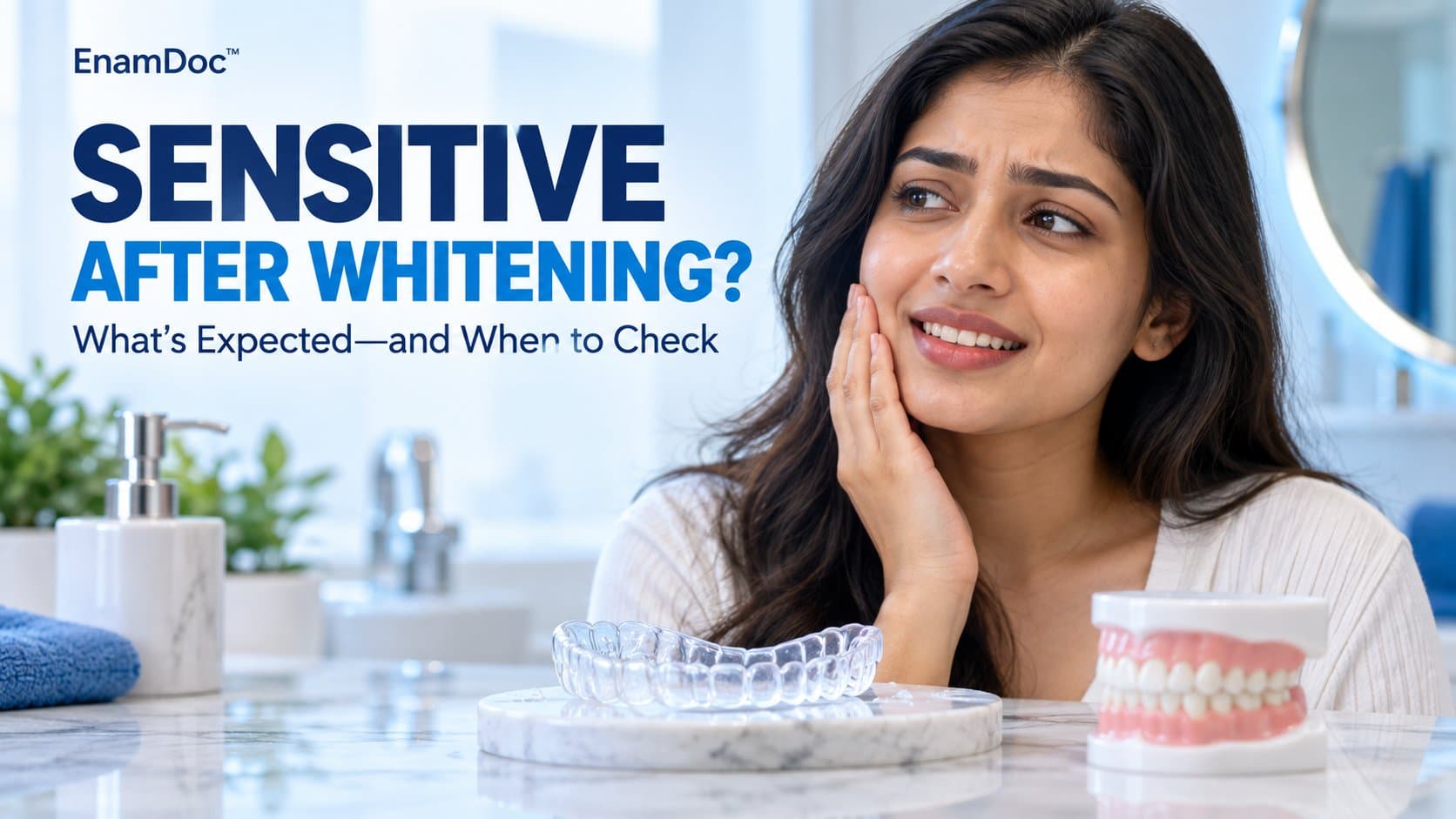
You finally did it — your teeth are visibly whiter, but now they're screaming every time you sip cold water. Tooth sensitivity after whitening is one of the most searched dental complaints online, and for good reason: almost everyone experiences some degree of it, yet almost nobody is told exactly what to expect beforehand.
Here's the honest, clinical picture — what's happening inside your teeth, how long it should last, and the situations where you should actually call your dentist.
Why Does Whitening Cause Sensitivity?
Both at-home and in-clinic whitening products use hydrogen peroxide or carbamide peroxide as the active bleaching agent. These compounds temporarily open the microscopic pores in your enamel — called dentinal tubules — to reach the staining molecules underneath. This is what makes whitening work, but those same open tubules allow temperature changes to reach the nerve inside your tooth far more easily than usual.
The result is a sharp, shooting sensitivity that dentists call "zingers." They're brief, intense, and usually triggered by cold air, cold drinks, or sometimes heat. They feel alarming but are almost always harmless.
What's Completely Normal After Whitening
These are the experiences you can expect and don't need to worry about:
- Sensitivity to cold air and drinks within 24–48 hours of whitening. This is nearly universal and typically peaks around the 6–12 hour mark.
- Brief sharp "zinger" sensations that come on suddenly and disappear within seconds. These are not a sign of nerve damage.
- Mild gum sensitivity or white spots on the gums if whitening gel briefly contacted them. These disappear within a few hours.
- Teeth that feel slightly different for a day or two. Enamel pores are temporarily more open during this period.
In the vast majority of patients, sensitivity disappears completely within 24 to 72 hours as the tubules reseal and the pulp settles.
What Is Not Normal — When to Call Your Dentist
Most post-whitening sensitivity is predictable and self-resolving. But there are genuine warning signs:
- Sensitivity that persists beyond 5–7 days without improvement. This can indicate pre-existing issues — a cracked tooth, a cavity, an exposed root, or a failing filling.
- Spontaneous throbbing pain without any cold or hot trigger, especially if it keeps you awake. This is very different from "zingers" and may indicate the pulp is under more serious stress.
- Pain that is gradually worsening day by day rather than improving.
- A single tooth dramatically more sensitive than all others. Uniform sensitivity is normal; isolated severe pain in one tooth points to a structural problem in that specific tooth.
The Most Common Mistake: Whitening Unprepared Teeth
The most preventable cause of severe whitening sensitivity is skipping a dental check-up beforehand. Whitening bleach is not selective — it penetrates through active cavities, cracked enamel, and areas where gum recession has exposed the much more porous root surface. All of these amplify sensitivity dramatically.
Before whitening, a dentist should confirm there are no untreated cavities, that existing fillings and crowns are intact (note: whitening does not change the colour of dental restorations, only natural tooth structure), and that gums are healthy. EnamDoc connects you with verified dentists who can assess your teeth before any cosmetic treatment.
How to Reduce Sensitivity Before, During, and After
- Use a sensitivity toothpaste two weeks before whitening. Products containing potassium nitrate or stannous fluoride help block dentinal tubules proactively. Apply it directly and let it sit for a few minutes rather than simply brushing and rinsing.
- Shorten your whitening sessions. Wearing at-home trays for 30–45 minutes instead of 90 minutes significantly reduces peroxide contact time and still delivers results over more sessions.
- Space out sessions. Every-other-day whitening is gentler than consecutive daily sessions.
- Avoid cold and acidic foods for 48 hours. Cold water, ice cream, citrus, and carbonated drinks aggravate the sensitivity while tubules are still partially open.
- Ask about fluoride application. A professional fluoride varnish applied after in-office whitening helps reseal enamel and dramatically reduces post-whitening sensitivity in most patients.
At-Home vs. In-Office: Which Causes More Sensitivity?
In-office whitening with higher-concentration gels (typically 25–38% hydrogen peroxide) combined with light activation tends to cause more immediate and intense sensitivity. However, dentists can apply desensitising agents before and after to manage this well.
At-home strip systems (typically 10–22% carbamide peroxide) produce slower results but gentler sensitivity. The total sensitivity experienced over a full at-home course is often comparable to or less than a single in-office session.
Neither is inherently safer — what matters far more is whether your teeth were healthy to begin with.
When Will Teeth Return to Normal?
For most people with no pre-existing dental issues, sensitivity after whitening follows this pattern: peak sensitivity 6–24 hours after whitening, significant improvement within 48–72 hours, and complete resolution within 3–5 days.
After sensitivity resolves, enamel tubules are resealed and teeth are not permanently more sensitive. Future whitening sessions may produce the same temporary effect, but they are not cumulatively damaging to a structurally healthy tooth.
The Bottom Line
Tooth sensitivity after whitening is predictable, almost universal, and usually entirely harmless. If it lasts a few days and disappears, there is nothing to worry about. If it worsens, persists beyond a week, or affects a single tooth dramatically, get it checked — not because whitening has necessarily caused permanent damage, but because there may be an underlying issue that whitening has made apparent for the first time.
If you are planning to whiten and haven't had a dental check-up recently, EnamDoc makes it simple to find and book a verified dentist near you for a pre-whitening assessment.
Frequently asked
Frequently asked questions
How long does tooth sensitivity last after whitening?
For most people, sensitivity peaks within 24 hours of whitening and resolves completely within 3–5 days. If it persists beyond a week or worsens after the second day, consult your dentist to rule out an underlying issue such as a cavity, crack, or exposed root surface.
Is it safe to whiten teeth without seeing a dentist first?
It is not recommended. Whitening peroxide penetrates through cavities, cracks, and exposed root surfaces — all of which amplify sensitivity dramatically. A dental check-up before whitening ensures your teeth are structurally ready and helps you avoid severe discomfort or accidental damage.
Does sensitivity toothpaste actually help after teeth whitening?
Yes. Toothpastes containing potassium nitrate or stannous fluoride help block the open dentinal tubules that cause sensitivity. Using them two weeks before whitening is more effective than starting after — but applying them immediately post-whitening also provides meaningful relief.
- teeth whitening
- sensitivity
- cosmetic dentistry
- whitening strips
- professional whitening
Keep reading