Night Guards for Teeth Grinding: Do They Actually Work?
Your dentist said you grind your teeth at night — but does a plastic mouth guard actually protect you? Dr. Khanak Jain explains how night guards work, the types available, and what the evidence really says about bruxism treatment.
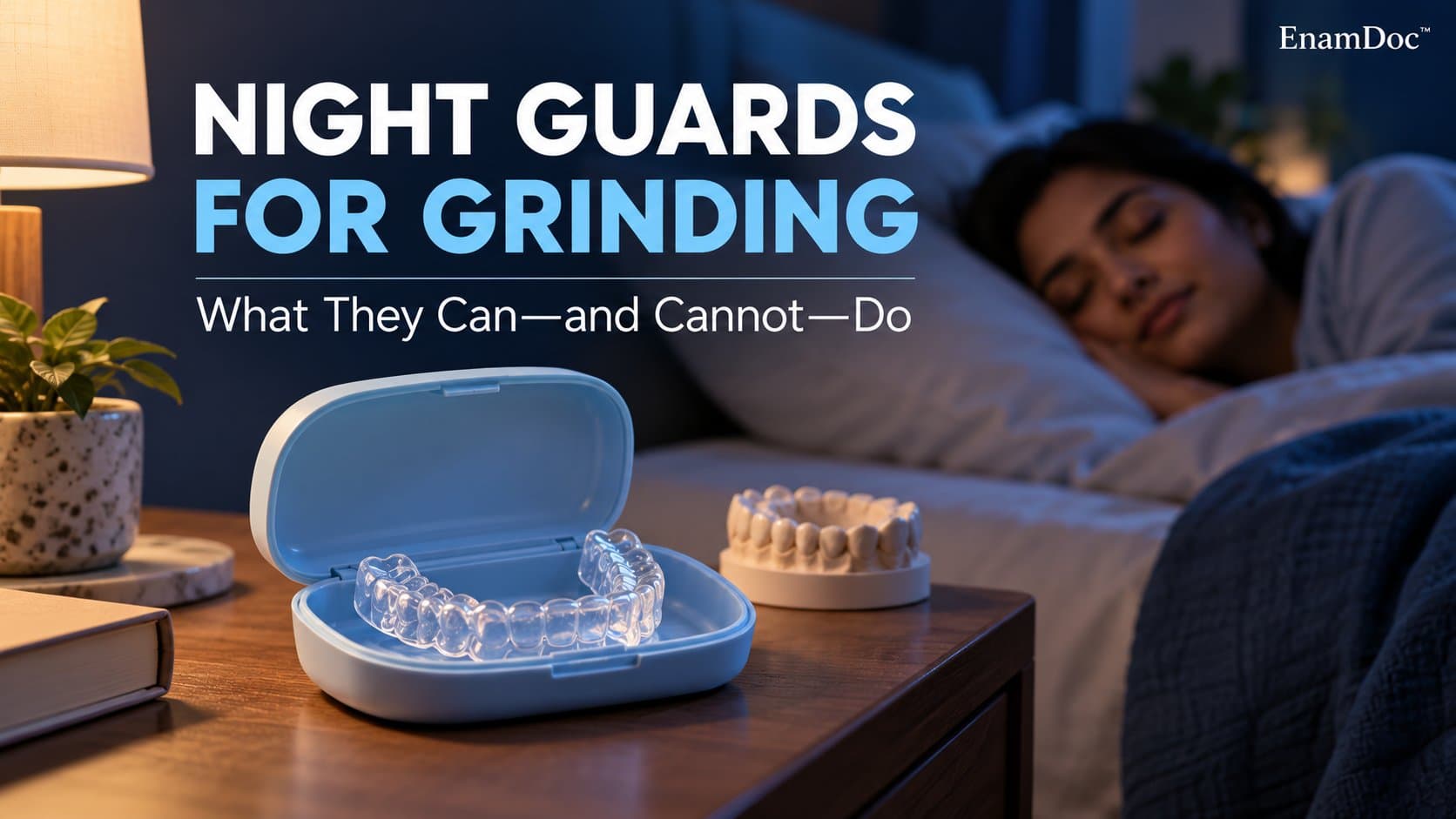
You wake up with a dull ache in your jaw. Your partner tells you they heard grinding noises all night. Your dentist has spotted wear marks on your molars. If this sounds familiar, you have probably been told to get a night guard — and you may be wondering whether this small piece of plastic actually does anything, or whether it is just an expensive inconvenience.
The answer is more nuanced than either "yes, completely" or "no, it is a gimmick." Here is what the evidence actually shows, and what to expect if you decide to try one.
What Is Teeth Grinding, Exactly?
Bruxism is the clinical term for grinding, clenching, or gnashing your teeth. When it happens during sleep, it is called sleep bruxism, and it is classified as a sleep-related movement disorder — similar in some ways to restless leg syndrome. The forces involved can be surprising: while you typically bite down with around 20–40 kg of force when eating, sleep bruxism episodes can generate pressures exceeding 250 kg. Your teeth simply were not designed to sustain that kind of load for hours at a time.
The signs include worn-down enamel, cracked or chipped teeth, jaw soreness on waking, headaches that start at the temples, and in more severe cases, symptoms of temporomandibular joint (TMJ) dysfunction such as clicking, locking, or pain when opening the mouth wide.
What a Night Guard Actually Does
A night guard — also called an occlusal splint or bite guard — does not stop you from grinding. That distinction matters. If you are expecting to put in a mouthpiece and wake up the next morning having slept without any clenching, you will likely be disappointed.
What a night guard does is redistribute and absorb the forces your teeth would otherwise absorb directly. Think of it as a sacrificial layer. The guard takes the wear, the cracking risk, and some of the pressure — your teeth do not have to. In this sense, it is protective rather than curative.
Some studies also suggest that certain night guard designs reduce muscle activity during grinding episodes, which can relieve morning jaw soreness over time. But the effect varies considerably from person to person.
Types of Night Guards
Custom-fitted (from your dentist)
Made from impressions of your teeth, custom night guards fit precisely and are made from either hard acrylic or a dual-laminate material (soft inside, hard outside). They are the most comfortable option for long-term use, the most durable, and the most effective at distributing bite forces. They are also the most expensive upfront — typically ₹3,000–₹12,000 in India depending on the material and clinic.
Boil-and-bite (pharmacy)
These are heated in hot water and then bitten into to create a rough impression. They offer better fit than a generic guard but cannot replicate a professional custom fit. They tend to be bulkier and less comfortable for all-night wear. Some patients find them adequate; others give up after a few nights.
Stock (ready-made)
One size fits all. These are the cheapest option and generally the least well-tolerated. They can actually worsen some TMJ symptoms by holding the jaw in an unnatural position all night. Most dentists advise against relying on stock guards for anything beyond temporary use.
Do Night Guards Work? What the Research Says
The evidence base for night guards is reasonable but not conclusive. A 2016 Cochrane review found that splint therapy showed some benefit for reducing pain and self-reported jaw soreness compared with no treatment, but the quality of evidence across studies was generally low. More recent reviews have supported custom hard splints for managing TMJ-related symptoms, though they note that bruxism itself is rarely "cured."
In practical terms, most patients who use a well-fitted custom night guard consistently report three things:
- Less jaw soreness and morning headaches within the first few weeks
- Slower progression of tooth wear (the guard shows the wear instead)
- Better sleep quality in some cases, as the jaw muscles are less fatigued
What night guards do not reliably do: stop the neurological grinding reflex, treat the underlying cause (which is often stress, a sleep disorder, or an airway issue), or prevent all dental damage if bruxism is severe.
Addressing the Underlying Cause
A night guard is most effective as part of a broader approach. Stress management, sleep hygiene, and — if suspected — an evaluation for sleep apnoea are all worth pursuing alongside the guard. Some patients see a significant reduction in bruxism severity when an underlying obstructive sleep apnoea is treated. Others benefit from physiotherapy for the jaw muscles or, in severe cases, botulinum toxin injections into the masseter muscle, which temporarily reduces clenching force.
If you find that your guard is wearing through quickly, or if your jaw symptoms are getting worse rather than better, these are signs that the root cause needs more attention.
How to Care for Your Night Guard
- Rinse it with cool water immediately after removing it each morning
- Clean it with a soft toothbrush and mild soap (not toothpaste — the abrasives can scratch the surface)
- Let it air-dry before storing it in the case provided — moisture trapped inside encourages bacterial growth
- Bring it to every dental check-up so your dentist can assess wear
- Replace it when it shows visible cracks or significant thinning
A Note on Getting the Right Fit
A poorly fitted night guard can create new problems — shifting teeth slightly, aggravating the joint, or simply being so uncomfortable that you stop using it. If you have been prescribed one, have your dentist check the fit at a follow-up appointment. Small adjustments to the bite surface can make a meaningful difference to both comfort and effectiveness.
EnamDoc's verified dental clinics include practitioners with experience in bruxism management and TMJ care. If you are unsure whether your current symptoms warrant a custom guard, or if a guard you already have does not seem to be helping, a consultation can help you decide whether the guard needs adjustment, whether additional investigation is warranted, or whether another approach would serve you better.
The Bottom Line
Night guards work — just not in the way most people expect. They protect your teeth from the damage bruxism causes, and for many patients they reduce morning jaw pain and headaches. They do not switch off the grinding itself. Used consistently, a well-fitted custom guard is a sensible investment for anyone whose teeth are showing signs of wear. Used alongside stress management and proper sleep, the results tend to be considerably better.
Frequently asked
Frequently asked questions
How long should I wear my night guard?
A night guard is typically worn every night for as long as your bruxism persists. Most people need it indefinitely, as bruxism often returns when the guard is stopped. Your dentist will advise on whether to continue based on how much wear the guard shows and whether your jaw symptoms have improved.
Can a night guard make jaw pain worse?
It can if the bite is not balanced correctly. A guard that sits too high on one side can increase muscle tension and worsen TMJ symptoms. If you experience increased jaw pain after starting a night guard, have your dentist check the bite surface. Small adjustments often resolve this completely.
What is the difference between a night guard and a sports mouthguard?
A sports mouthguard is designed to protect teeth and gums from impact during contact sports — it is soft, thick, and generally worn over the upper teeth only. A dental night guard is made for long-term nightly wear and is designed to distribute grinding forces evenly, not absorb impacts. They serve different purposes and are not interchangeable.
- night guard
- teeth grinding
- bruxism
- TMJ
- sleep bruxism
Keep reading