Why Your Jaw Hurts: Understanding TMJ Disorders and Treatment Options
Jaw pain, clicking, and headaches could be signs of a TMJ disorder. This guide explains the causes, symptoms, and treatment options — from at-home remedies to specialist care.
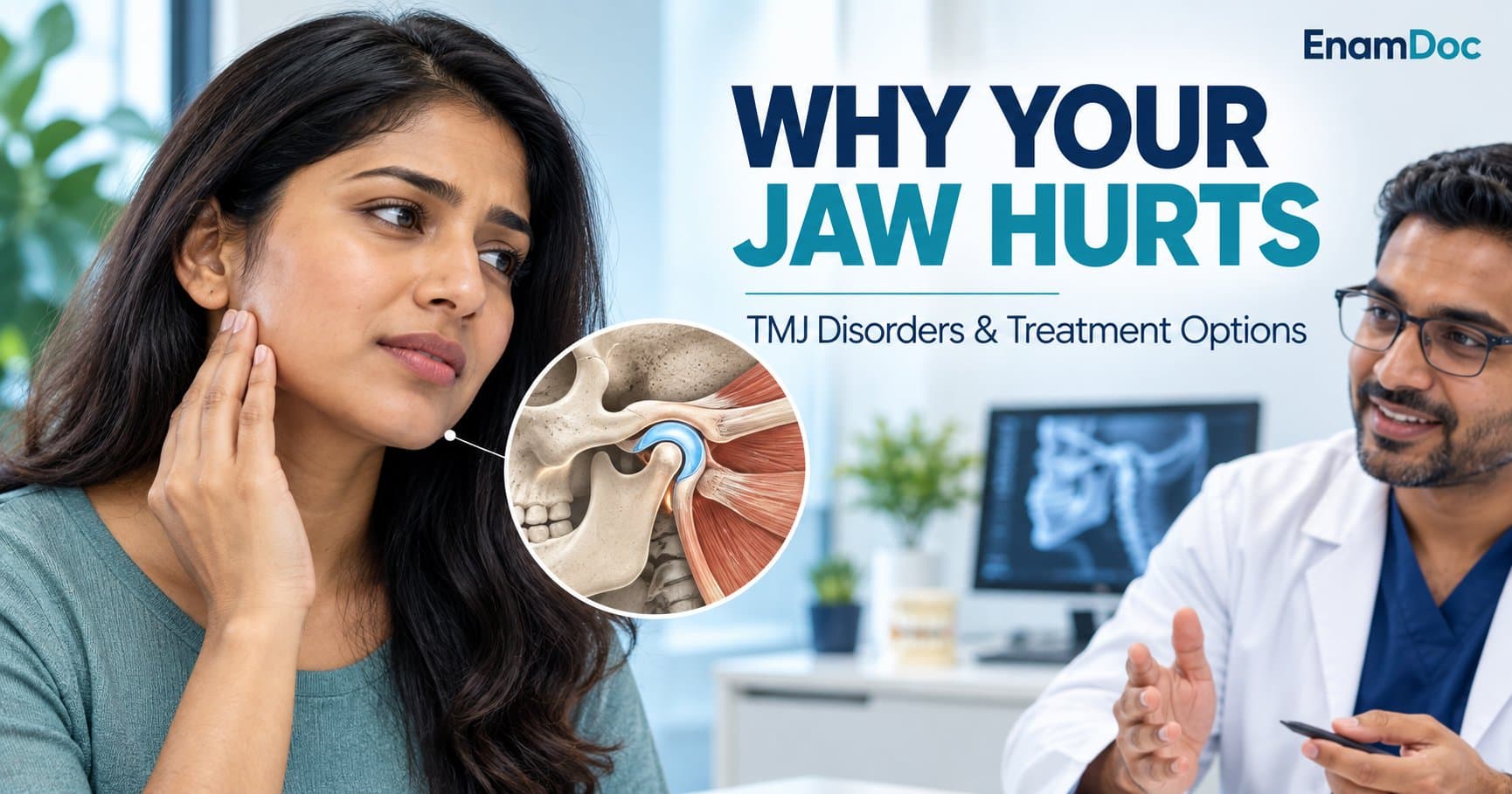
Jaw pain that wakes you up. A clicking sound every time you chew. Headaches that cluster around your temples. Difficulty opening your mouth fully. If any of these sound familiar, you may be dealing with a TMJ disorder — one of the most commonly misunderstood conditions in dentistry. This guide explains exactly what the TMJ is, why it causes so many confusing symptoms, and what you can realistically do about it.
What Is the TMJ?
TMJ stands for temporomandibular joint — the hinge connecting your lower jaw (mandible) to your skull, just in front of your ears. You have one on each side of your head. These joints are unlike any other joint in the body: they allow your jaw to move forward, backward, sideways, and rotate — all the complex movements needed for speaking, chewing, and yawning.
A small disc of cartilage sits inside each joint, cushioning the bones. When this disc shifts out of position, the surrounding muscles compensate, the bones rub against each other, and pain begins.
What Is a TMJ Disorder (TMD)?
A TMJ disorder (also called TMD — temporomandibular disorder) is any condition that affects the joint itself, the muscles around it, or both. TMD is not a single disease but an umbrella term covering several overlapping problems. It is more common in women than men, and most frequently affects people between the ages of 20 and 40.
Common Causes
- Bruxism (teeth grinding or clenching): The most frequent underlying cause. Many people grind their teeth at night without knowing it
- Disc displacement: The cartilage disc slips out of its normal position between the bones
- Arthritis: Osteoarthritis or rheumatoid arthritis can damage the joint
- Jaw injury: A blow to the jaw or whiplash can injure the joint
- Stress: Emotional stress leads to clenching, which strains the joint muscles
- Poor bite alignment: Misaligned teeth or jaw create uneven pressure on the joint
Symptoms of a TMJ Disorder
TMD is notorious for producing symptoms that seem unrelated to the jaw. Patients often visit multiple doctors before a correct diagnosis is made.
Direct Symptoms
- Pain or tenderness in the jaw, especially when chewing or first thing in the morning
- A clicking, popping, or grating sound when opening or closing the mouth
- Difficulty or pain when opening the mouth wide (lockjaw in severe cases)
- The jaw getting stuck or locking in an open or closed position
- Facial pain around the cheeks and jaw muscles
Referred Symptoms (Easy to Confuse With Other Conditions)
- Headaches, particularly tension-type headaches or pain around the temples
- Earache or a sense of fullness in the ear — without any ear infection
- Ringing in the ears (tinnitus)
- Neck and shoulder pain
- Dizziness
- Tooth sensitivity or pain without an obvious dental cause
How Is TMD Diagnosed?
There is no single test for TMD. Diagnosis involves a combination of methods:
- A detailed history of symptoms, timing, and triggers
- Physical examination of the jaw — checking range of motion, clicking sounds, muscle tenderness
- Dental X-rays to rule out tooth-related causes
- In complex cases: MRI or CT scan to assess the disc position and bone structure
Because the symptoms overlap with other conditions, many dentists refer complex cases to an oral and maxillofacial specialist or an orofacial pain specialist.
Treatment Options
The good news: most TMD cases — around 80 to 90 percent — resolve or improve significantly with conservative (non-surgical) treatment. Surgery is rarely needed.
At-Home and Self-Care Approaches
- Soft diet: Eating soft foods (rice, yoghurt, fish, cooked vegetables) reduces strain on the joint. Avoid hard, chewy, or crunchy foods temporarily
- Cold and warm compresses: Ice packs for acute pain and swelling; warm compresses for muscle tension
- Jaw exercises: Gentle stretching and strengthening exercises prescribed by a physiotherapist or dentist can restore normal movement
- Stress management: Yoga, meditation, or counselling to reduce the clenching triggered by anxiety
- Posture awareness: Forward head posture strains the jaw muscles — improving desk and screen posture helps
Dental Treatments
- Night guard (occlusal splint): A custom-fitted plastic device worn over the teeth at night. It prevents grinding, reduces muscle activity, and redistributes bite forces away from the joint. This is the most commonly prescribed dental treatment for TMD
- Bite adjustment (occlusal equilibration): Selectively reshaping teeth to improve bite alignment — only used when a specific bite problem is clearly contributing to TMD
- Orthodontic treatment: In cases where severe malocclusion is driving TMD, braces or aligners may be recommended
Medication
- NSAIDs (ibuprofen, naproxen): For acute pain and inflammation
- Muscle relaxants: Short courses to reduce muscle spasm — not for long-term use
- Tricyclic antidepressants (at low dose): Sometimes prescribed for chronic pain management, not for depression
- Botox injections: Injected into the masseter muscle to reduce clenching force — becoming more popular for bruxism-related TMD
Physical Therapy
A physiotherapist experienced in jaw disorders can provide manual therapy to release tight muscles, ultrasound therapy to reduce inflammation, and a structured programme of exercises to restore normal joint mechanics. This is one of the most effective long-term interventions for TMD.
Surgical Options (Reserved for Severe Cases)
- Arthrocentesis: A minimally invasive procedure where fluid is injected into the joint to flush out inflammatory material — usually performed under local anaesthesia
- Arthroscopy: A tiny camera is inserted into the joint to visualise and treat the problem
- Open-joint surgery: For structural problems that cannot be addressed any other way — rarely required
When Should You See a Dentist?
See a dentist promptly if jaw pain is severe, persistent, or has been going on for more than a few weeks without improvement. Also see a dentist if the pain is accompanied by locking of the jaw, significant swelling on one side of the face, or difficulty eating or speaking.
Do not wait and hope TMD resolves on its own if it is affecting your daily life. Early intervention — usually with something as simple as a night guard — can prevent the condition from worsening.
On EnamDoc, you can find dentists who specialise in TMD and orofacial pain, check their experience with this condition, and book an appointment online. Getting the right specialist early makes a significant difference to outcomes.
Frequently asked
Frequently asked questions
Do I need surgery for a TMJ disorder?
The vast majority of TMJ disorders — around 80 to 90 percent — respond well to conservative, non-surgical treatment. A night guard, soft diet, jaw exercises, and stress management are often enough to resolve or significantly reduce symptoms. Surgery is only considered when conservative treatment has failed after several months and imaging confirms a structural problem in the joint. Most people with TMD never need surgery.
What is the best treatment for teeth grinding (bruxism)?
A custom-fitted night guard is the most effective first-line treatment for bruxism. It cushions the teeth, reduces the force on the jaw joint, and prevents tooth wear. Beyond the night guard, addressing the underlying cause matters: stress reduction through therapy or mindfulness, physiotherapy for jaw muscle relaxation, and sometimes Botox injections into the jaw muscles to reduce clenching force. Avoid caffeine close to bedtime and establish a regular sleep routine, as poor sleep is associated with increased grinding.
Can a clicking jaw fix itself?
A clicking jaw can improve on its own, particularly if it is related to muscle tension that resolves with rest, soft diet, and stress reduction. However, clicking caused by disc displacement — where the cartilage cushion has shifted out of position — rarely fixes itself without some intervention. If the clicking is painless and not worsening, it may be monitored. If it is accompanied by pain, limited movement, or is getting louder or more frequent, it should be evaluated by a dentist to prevent further damage to the joint.
- TMJ disorder
- jaw pain
- teeth grinding
- bruxism
Keep reading